

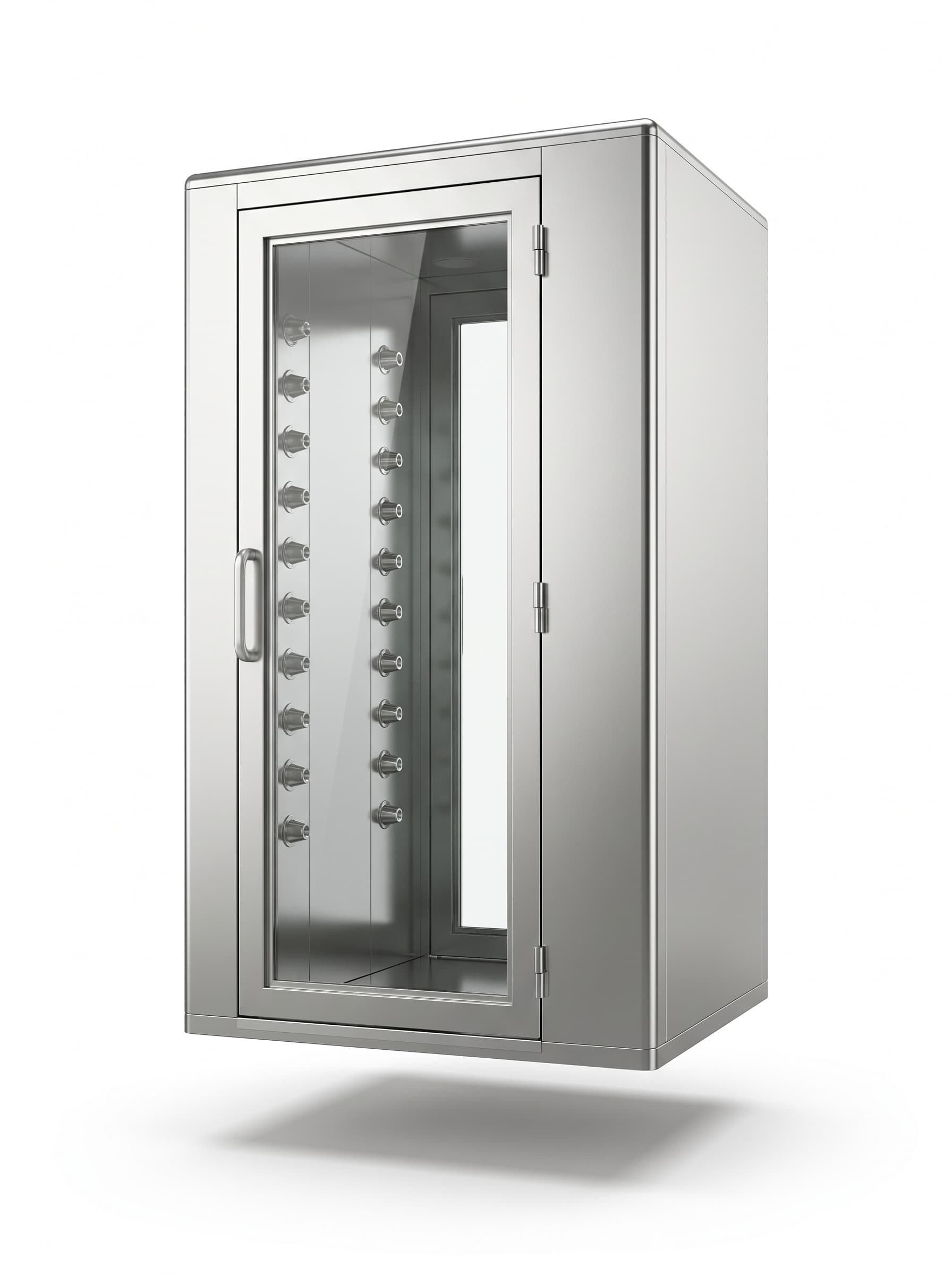
Personnel entry, de-dusted
Personnel Air Shower
A personnel air shower is the small cabin at the cleanroom door that blows loose lint, fibres and particulate off a gowned operator before they go in. Fabtech builds them in-house in India, with HEPA-filtered jets and interlocked doors. Staff walk in cleaner than they walked up, and the room keeps the class you paid to build.
- HEPA H13 / H14 to EN 1822
- Electromagnetic door interlock
- 10 to 30 s timed cycle
- Built in-house in India
What a personnel air shower is, in one paragraph
In one paragraph
A personnel air shower is an enclosed entry vestibule at the edge of a cleanroom. A gowned person stands inside for a few seconds while jets of HEPA-filtered air hit the garment at high velocity. The jets lift loose particulate, lint and fibres off the fabric. The doors are interlocked, so only one opens at a time.
- ISO 14644
- EN 1822
- H13 / H14
- EU-GMP gowning
- Schedule M
The dust does not ride back out with the person. It is pulled through the HEPA filter and trapped there. The cleaned air is then blown again through the nozzles. Staff enter the controlled area carrying a lower particulate load than they otherwise would.
Here is how ours works: HEPA-filtered air at high velocity, in a cabin built for your entry. Below are the cycle, the specifications, and how to spec one.
FIG. 01Nozzle jets lifting loose particulate off a gowned operator. The dislodged load is returned through the HEPA, not released into the room.
- Device class
- Contamination control, entry
- Filter
- HEPA H13 / H14 to EN 1822
- Doors
- Electromagnetically interlocked
- Removes
- Particulate only, never gases
Personnel air shower specifications
Procurement starts with the spec sheet, so the table comes early on this page. We size each unit to your entry and your traffic, so what you are quoted is built for your door, not picked off a shelf.
The machine itself is simple and robust. A blower pushes filtered air through nozzles inside a walk-through cabin. The doors interlock electromagnetically, so only one opens at a time. A control panel runs the cycle on a timer and carries an emergency stop. Materials and dimensions are then configured to your traffic and your room.
How to read the table
Every Fabtech figure below is marked for confirmation. Capacity, materials, dimensions and cycle are all configured to your entry, so the right-hand column reads as a typical build rather than a fixed model.
- Capacity
- 1 to 2persons per cycle
- Filter
- H13 / H14to EN 1822
| Specification | Typical configurationTHIS PAGE |
|---|---|
| Capacity | 1 to 2 persons per cycle, single or tandem, multi-bay for higher traffic |
| Cabin / body | GI powder-coated, or stainless steel 304 / 316 for GMP and washdown areas |
| Nozzles | Adjustable stainless steel jets, arranged for full-body coverage |
| Jet / nozzle velocity | High velocity, typically around 20 to 25 m/s at the nozzle |
| HEPA filterEN 1822 | H13 / H14 to EN 1822, on the recirculating supply |
| Airflow | Recirculating: air drawn back through the HEPA and re-blown by the blower |
| Cycle time | Adjustable, typically around 10 to 30 s per cycle |
| Cabin / footprint | Single-person cabin, internal dimensions built to your entry |
| Electrical supply | For example 230V single phase / 415V three phase, 50Hz, confirmed per configuration |
| Blower / motor | Blower and motor rating sized to hold nozzle velocity across the cabin |
| Sound level | Rated at the cabin, within cleanroom working limits, in dB |
| Doors / interlock | Electromagnetic interlock, one door open at a time, to hold the pressure separation |
| Controls | Control panel with cycle timer, sensor-triggered start, emergency stop |
| Options | Tandem and multi-person bays, floor sizing to traffic, optional UV |
FIG. 02Personnel air shower, typical configuration across capacity, filtration, cycle, doors and controls.
Cabin size, nozzle count and cycle length all follow the same two inputs: the traffic through the door and the gowning protocol behind it.
The personnel de-dusting cycle, step by step
Ten to thirty seconds decide whether this device does anything at all. So it is worth walking through those seconds plainly, before the technical caveats.
- 01
Entry door
The operator enters
They step in from the uncontrolled side. The entry door closes behind them.
- 02
Interlock
The doors interlock
With one door shut, the electromagnetic interlock holds the far door closed. The cabin is never open to both sides at once, so the pressure separation between the rooms is preserved.
- 03
20 to 25 m/s
The nozzles fire
HEPA-filtered air is driven through the adjustable nozzles at high velocity, jetting across the garment from several angles. The blast is turbulent by design. Its whole job is to knock loose lint, fibres and particulate off the fabric. The operator turns to expose every surface.
- 04
H13 / H14
The air recirculates
The dislodged particulate is swept back with the return air and trapped in the HEPA filter. The cleaned air is blown again through the nozzles for the rest of the cycle.
- 05
Clean side
The clean-side door releases
When the timed cycle ends, the interlock frees the clean-side door. The operator steps onto the cleanroom floor carrying a lower particulate load than they arrived with.
FIG. 03One personnel cycle, five states, from the uncontrolled side to the cleanroom floor.
Physics guardrail
Turbulent, not laminar.
A word on the physics, because this is where air showers get oversold. The flush inside the cabin is a turbulent, high-velocity de-dusting blast.
The cabin is a scrubbing step, and what it delivers is a measurable reduction in the particulate that walks through your door.
- And what it is not
- Not unidirectional flowThe blast is deliberately turbulent, so nothing inside the cabin is laminar.
- Not a classified zoneThe cabin holds no ISO class of its own. It protects the room next to it.
- Not a disinfection stepHEPA captures particulate. It does not kill anything, and it removes no gas or vapour.
Do personnel air showers actually work?
Yes, within a clear boundary, and the boundary is worth stating out loud.
FIG. 04Gowning order: hood, coverall, gloves, overboots. The shower is one step inside that sequence, never a substitute for it.
A personnel air shower reduces the particulate load carried in on garments, and that reduction is measurable. It eases the duty on the cleanroom's own filtration. It helps protect the ISO 14644 classification of the room behind it. It reinforces gowning discipline at the exact moment people are most tempted to rush. That is worth having.
What it is not is an absolute. How much comes off depends on the cycle time, the garment and, above all, user compliance.
So the right way to think about an air shower is risk reduction and gowning-discipline support, validated to your protocol. It is not a step that removes all contamination. HEPA captures particulate only, so it does nothing for gases, solvent vapour or chemical hazard. That is a different device entirely.
Cycle time
A cycle cut short to keep a queue moving is the most common way an air shower stops earning its place.
Garment
A shedding fabric behaves nothing like a proper cleanroom suit, and the shower cannot make up the difference.
User compliance
Facing the jets, turning, and letting the timer finish. This is the variable that decides most of the result.
Where the jets reach, and where the garment sheds
The cycle only helps where the air actually arrives. Map a gowned body into zones and two readings fall out of it: how much loose particulate each zone gives up as a person moves, and how well the nozzle rows reach that zone. The two readings do not line up.
- Nozzle jet
- Loose particulate
FIG. 05Eight zones on one gowned operator, drawn front and back. SHED LOAD is how much loose particulate a zone gives up in normal movement. JET REACH is how well the three nozzle rows actually get to it. Both are relative readings on a five step scale, not measured counts, and the nozzle velocity shown is a typical Fabtech figure.
Read the two columns of meters against each other and the argument makes itself. The hood, the chest and the forearms sit square to the nozzle rows and are swept on the first pass. The shoulder blades, the seat, the backs of the knees and the boot tops are the zones a working shift creases, rubs and drags along the floor, and they are the zones the jets reach last or not at all.
That mismatch is the honest engineering reason a cycle carries a minimum dwell rather than a token blast, and the reason the operator is asked to turn instead of standing still. A cycle that is cut short, or an operator who faces the entry door for the whole of it, leaves the heaviest-shedding half of the garment untouched. It is also why the shower is specified as one step inside a gowning protocol rather than as the thing that makes a person clean.
- Three nozzle rows
- Head, torso and thigh height. Everything below the lowest row is reached by spill, not by a jet.
- Minimum dwell
- The timer exists so the low-reach zones get more than one pass of air across them.
- The turn
- Rotating in the cabin is what moves a shadowed zone into a jet line. It is a protocol step, not a courtesy.
A personnel air shower is not a “public air shower”
Search for “public air shower” and you land on beach showers. Search for “personnel air shower” and you land on industrial cabins. The two phrases look alike and the products have nothing in common, so it is worth one line of clarity.
A leisure or beach “public air shower” is a comfort or drying device. A cleanroom personnel air shower is an industrial contamination-control device. It is an interlocked, HEPA-filtered vestibule engineered to strip particulate off gowned staff before they enter a classified area. When a pharma, biotech or electronics buyer asks for a personnel air shower, this industrial device is what they mean, and it is what this page describes.
Three of these you specify. The fourth is the boundary of the device.
An air shower is worth having for what it does take off a garment. It is worth specifying honestly for what it cannot.
- Timed cycle per personAdjustable on the control panel timer.
- 10 to 30 s
- Nozzle jet velocityHigh velocity, turbulent by design.
- 20 to 25 m/s
- Door released at a timeThe interlock holds the other one shut.
- 1
- Gases or vapour removedHEPA captures particulate only.
- 0
Personnel entry, and where the other entry devices fit
Four devices share a cleanroom boundary and get confused with each other constantly. Here is which one does which job.
A personnel air shower is built around a person walking through it. When the thing crossing the boundary is a pallet, a trolley or bulk goods rather than staff, the right device is a material air shower . Same principle, different cabin: it is sized and configured for material transfer instead of a walk-through.
Air showers also sit alongside plain airlocks at a cleanroom boundary, and the two get mixed up constantly. The air shower overview walks through that distinction in one place. Where an air shower for personnel entry belongs in the sequence depends on your gowning protocol and your traffic. That is a design decision we make with you rather than a fixed rule.
If you are also pricing the device, cost follows the cabin size, the body material, the nozzle count and the traffic it has to clear, so send us the entry and we will cost the configuration rather than quote a shelf model.
Pick by what crosses
- A gowned person
- Personnel air showerThis page
- A pallet or trolley
- Material air shower
- Small goods, no jets
- Pass box
- Nothing, it is the leaf
- Cleanroom door
One question decides it: what is crossing the boundary, not how clean the room is.
Air shower overview
The hub for the whole device: the types, how the cabin works, and the distinction between an air shower and a plain airlock.
Read the pageMaterial air shower
The same recirculating HEPA principle in a cabin configured for goods: pallets, trolleys and bulk material rather than a walk-through.
Read the pagePass box
Passive interlocked material transfer through the wall, with no air jets at all. The right device when material moves and people do not.
Read the pageCleanroom doors
The leaves the shower interlocks against, and the pressure separation they are there to hold across the boundary.
Read the pageThe standards that sit behind a personnel air shower
An air shower has no dedicated product standard of its own. That catches buyers out, so anchoring compliance on the right two standards is part of speccing one well.
- EN 1822The first standard is about the filter. The HEPA that does the actual particulate capture is rated to EN 1822. The grades you will see quoted are H13 and H14, and they sit in the spec table above.
- ISO 14644The second is about the room. The area the shower protects is classified to ISO 14644, usually ISO Class 5 to 8. That class is set by air changes per hour (ACPH). The pressure cascade around the room holds it in place.
- EU-GMP, Schedule M, WHO-GMPFor pharma and biotech entries, the shower then sits inside a gowning and personnel-flow discipline. That discipline is set by EU-GMP Grade A/B/C/D. India's Schedule M and WHO-GMP expectations run alongside it, and this is where gowning and de-dusting steps earn their place.
- No named IS/BIS codeThere is no single named Indian Standard we cite as the air shower code. Any specific IS or BIS reference is confirmed per project.
Personnel air showers, common questions
A personnel air shower is an enclosed, interlocked entry vestibule at a cleanroom boundary. HEPA-filtered air fires through nozzles at high velocity and strips loose particulate, lint and fibres off a gowned person's garments. The doors open one at a time, so the pressure separation holds.
Its purpose is to cut the particulate load staff carry into a cleanroom on their garments. Knocking it loose and trapping it in the HEPA filter eases the load on the room's filtration. It helps protect the room's ISO 14644 classification and reinforces gowning discipline at the point of entry.
Yes, within a clear boundary. An air shower measurably reduces the particulate carried in on garments. It is not absolute: how much comes off depends on the cycle time, the garment type and, most of all, user compliance. Treat it as risk reduction validated to your protocol.
No. A leisure or beach “public air shower” is a comfort or drying device. A cleanroom personnel air shower is an industrial contamination-control device: an interlocked, HEPA-filtered vestibule that strips particulate off gowned staff before they enter a classified area. An industrial buyer asking for one means the cleanroom device.
The cycle is adjustable and typically runs around 10 to 30 seconds, set on the control panel timer to suit your gowning protocol. The operator turns to expose every garment surface while the nozzles fire. The clean-side door releases only when the timed cycle finishes.
A personnel air shower is commonly built for 1 to 2 persons per cycle. Tandem and multi-bay configurations are available for higher-traffic entries. The right size follows your peak headcount at the door, one of the first things we confirm when speccing a unit.
They do related jobs at a cleanroom boundary. An airlock is a passive buffer between two zones that holds the pressure cascade. An air shower adds an active high-velocity blast of filtered air that de-dusts people or goods on the way through.
What you get when the air shower is built in-house
Fabtech Cleanrooms engineers and builds air showers in-house in India. We stand behind each one from quote to handover.
In practice that means the unit you are quoted is designed to your entry and your traffic. It is built in the material grade your area needs. It is integrated into the gowning sequence, and validated where the project calls for it. Equipment-level AMC is available afterward.
As a cleanroom manufacturer, we specify the air shower to fit the classified room it serves from the start. It supports that room's ISO 14644 classification rather than being bolted on to it afterward.
Fabtech has delivered cleanrooms and contamination-control systems across pharma, biotech and electronics facilities in India. Project scope and specifications are available on request.
Wherever in India you are speccing a personnel air shower, the working principle is the same. The cabin, the nozzles and the cycle are then sized to your entry, your headcount and your room grade.
- 01
Nozzles
Positioned and set for full-body coverage, then adjusted on the built cabin rather than only on a drawing.
- 02
Blower and HEPA
Sized together so nozzle velocity holds right across the cabin, not just at the first jet in the row.
- 03
Electromagnetic interlock
Reliably keeps one door shut, so the pressure separation across the boundary is preserved through the cycle.
- 04
Control and cycle
Timer, sensor-triggered start and emergency stop, set to your gowning protocol rather than to a default.
The parts that decide whether an air shower is any good are the parts built end to end here.
Send us your entry layout
Headcount at the door, room grade and the gowning sequence you run. Our engineers come back with a costed configuration for a personnel air shower, built, interlocked and integrated into that sequence.