

Careers
Careers at Fabtech Cleanrooms
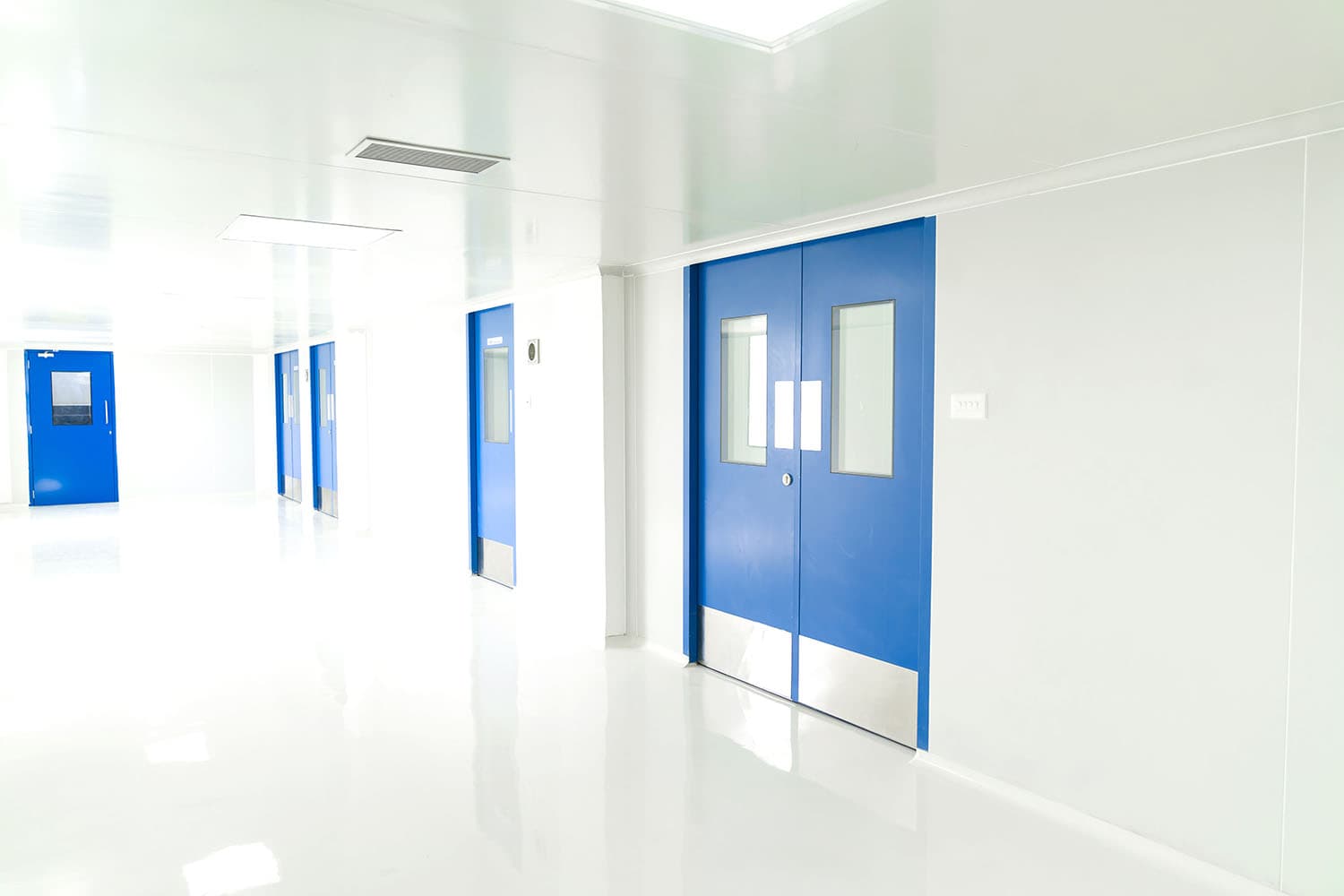
A cleanroom is a quiet room doing a serious job. The tablet in your hand came out of one. So did the vaccine in a clinic fridge, the chip in your phone and the sample in a research lab.
- Cleanroom engineering
- Delivering since 2004
- ISO 14644-1, Class 5 to 8
- Sector agnostic
In rooms like those, one stray particle can spoil a batch, or a life.
You learn the standard first. Then you learn how to prove a room meets it on the day an auditor walks in.
The engineers who design, build and validate those rooms are the reason the product that comes off the line is safe to use. That is the work here. It is why we describe a job at Fabtech as the chance to build a career that saves lives.
We are dedicated to the controlled environments that make accessible, affordable medications possible. We care as much about the place people come to every day. A new idea is welcome here, and people are given room to grow into it.
In engineering terms, that mission becomes controlled environments built to a written standard and then proved against it. We build to ISO 14644-1, at ISO Class 5 to 8. For medicine makers that maps to EU-GMP Grade A to D. The rooms are engineered to withstand inspection under EU-GMP, US-FDA, WHO-GMP and cGMP expectations.
A cleanroom career at Fabtech can touch several parts of that work. You might do process and airflow design, modular construction or cleanroom HVAC. You might work on the equipment that sits inside the room. You might write the qualification file that proves the room holds its class.
Why work here
The mission is the first reason, and for most of the people who stay it is the main one. Cleanroom work is engineering with a clear consequence. Get it right and a medicine reaches a patient, an experiment holds up, a device works.
The line between the design work and the outcome is short here, and you can see it. The rest of the reasons are about how the work is set up.
- 01
Your engineering is visible end to end
Much of what goes inside a Fabtech cleanroom is made in our own facility. So an engineer can follow a design from the first airflow sketch through manufacturing to installation and validated handover. Nothing gets lost across a chain of outside vendors. You see the whole arc of what you build.
- 02
One accountable team
Design, manufacturing, project management, validation and site installation sit under one roof, and they answer for the same result. That means fewer handoffs and clearer ownership. You get to understand how a cleanroom actually goes together, instead of only your slice of it.
- 03
A stable place to build a long career
Fabtech Cleanrooms has been delivering cleanroom projects since 2004, and a project here runs on a long cycle: design, manufacturing, installation, then a validated handover. Work with that rhythm gives an engineer time to take on bigger scopes, instead of moving on to find them.
- 04
Room to grow
We are sector agnostic, from pharmaceuticals and biotechnology to semiconductors and electronics. An engineer here meets a wide range of standards, classes and processes, instead of doing one type of job on repeat. The variety is where the growth is.
FIG. 01A written standard becomes a room, and the room is then proved against the standard. Every discipline on this page is a piece of that loop.
The disciplines we hire
Cleanroom projects are delivered by people from several disciplines working together. So we look for engineers and specialists across the areas below. They are the broad capability areas that cleanroom engineering jobs at Fabtech fall into. Which specific role is open at any given moment moves with the project pipeline, and current openings are shared on request.
- 01
Cleanroom and HVAC design engineering
Process and airflow design. Setting the pressure cascade and the air-change strategy. Turning a governing standard into a room that will hold its ISO class or GMP grade.
On the project Enquiry through to site installation
- 02
Project management
Owning a cleanroom build from kickoff to handover. Schedule, scope, site coordination and the client relationship, all the way through delivery.
On the project Design freeze through to handover
- 03
Manufacturing and production
Making the modular panels, air-handling units, filter housings and cleanroom equipment on our own production floor. They are built to the tolerances the design depends on.
On the project Design freeze through to delivery on site
- 04
Validation and quality assurance
Writing and running the protocols that prove a room performs, stage by stage: design, installation, operation, performance. DQ/IQ/OQ/PQ. Then running particle counts, HEPA integrity tests and airflow verification. The output is the qualification dossier that supports inspection.
On the project Design, then again from commissioning to handover
- 05
Site installation and commissioning
Assembling and finishing the room on the client's site. Getting it from a shell to a room that is ready to be qualified.
On the project Installation through to qualification
- 06
Sales and estimation
Scoping enquiries, then sizing the standard, class and validation plan a client's process needs. Turning that into a proposal a client can act on.
On the project Enquiry through to design freeze
FIG. 02One cleanroom project, enquiry to handover. Each discipline is drawn across the stages where its involvement really starts and ends, and where the bands overlap, several teams are on the same problem at once. Validation appears twice: DQ is written at design, then IQ, OQ and PQ are run at the end.
If your experience sits alongside these areas rather than squarely inside one, we would still like to hear from you. Cleanroom engineering rewards people who can see across disciplines.
The standards you would work to
Whatever discipline you join, the same reference documents sit behind the work. An engineer here is expected to read them, design to them, and be able to show an inspector where a room meets them.
Regulators inspect a facility. They do not certify a cleanroom. What a room can produce is a qualification dossier that shows how it was designed, built and tested.
| Reference | What it governs | Where it shows up in the work |
|---|---|---|
| ISO 14644-1 | Airborne particle classification, ISO Class 1 to 9 | The class a room is designed to hold, and the count that proves it |
| ISO 14644-3 | Test methods for classified rooms | Particle counts, airflow verification and recovery testing at qualification |
| EU-GMP Annex 1, Grade A to D | Contamination control for sterile medicine manufacture | The grade a pharmaceutical room is designed and documented to |
| Schedule M | Indian GMP requirements for drug manufacture | The domestic rulebook a client's plant is inspected against |
| EN 1822, tested at MPPS | Filter classification by efficiency | HEPA H13 at 99.95 percent and H14 at 99.995 percent, ULPA U15 at 99.9995 percent |
| DQ / IQ / OQ / PQ | The four qualification stages | The protocols a validation engineer writes and runs, and the dossier they produce |
| Air changes per hour (ACPH) | The dilution rate that holds a room at its class | Set in HVAC design, then verified at commissioning |
| Contamination Control Strategy (CCS) | The site-wide argument that the controls are adequate | What a qualification dossier has to support |
| ISO 9001 | Quality management system | How the design, manufacturing and handover process itself is controlled |
FIG. 03The documents that come up on almost every project. Not a complete list.
Nobody is expected to arrive knowing all of it. The specific standards can be learned on the job. What matters when you write to us is the discipline you work in and the experience behind it.
How we work
A room either holds its class on test day or it does not.
Cleanroom engineering is precise, documented and audited. So the day to day is measured, methodical problem-solving. The reward is that the work is provable. There is a quiet satisfaction in being on the team that made sure it did.
Alongside that discipline we try to keep a place where a good idea is welcome wherever it comes from. People here are backed to take on more than they arrived able to do.
If you want to understand the company before you apply, the about Fabtech Cleanrooms page explains who we are. The in-house cleanroom manufacturing page shows the facility where much of the work happens.
- Capability areas we hire across
- 6
- Classes we design and prove rooms to
- ISO 5 to 8
- Stages from enquiry to handover
- 7
FIG. 04A room is signed off stage by stage, and each stage answers a different question. A validation engineer writes the protocol, runs the test and records the result.
How to apply
We are always glad to hear from engineers and specialists who want to do cleanroom work that matters. That holds even when no specific role is advertised.
The direct route is the contact page, which reaches our careers team. Send your CV and a short note covering three things: the discipline you work in, your experience, and where you are based.
That is all we need to point you to the right person.
Your CV and the details in it are handled under our privacy policy, which sets out how long we keep an application and how to ask us to erase it.
What to send
- 01
The discipline you work in
Pick the closest of the six capability areas above. Alongside is fine.
- 02
Your experience
Where you have worked and what you were responsible for.
- 03
Where you are based
So we can point you at the right team.
Current openings and role details are shared on request.
Frequently asked questions
Something not answered here? Ask us directly
Ready to write to us? How to apply sets out the three things to send.
Fabtech Cleanrooms designs, builds and validates cleanrooms. We also manufacture much of the equipment that goes inside them. We are sector agnostic, and our clients work wherever a product cannot survive contamination: pharmaceuticals, biotechnology, semiconductors, electronics, solar, data centres, and food and beverage. We have delivered more than 2,000 cleanroom projects since 2004.
The work spans several capability areas: cleanroom and HVAC design engineering, project management, manufacturing and production, validation and quality assurance, site installation and commissioning, and sales and estimation. People who can work across more than one of these are especially valued.
Not always. Cleanroom engineering draws on mechanical, HVAC, process, quality and project backgrounds. The specific standards can be learned on the job. Tell us the discipline you work in and your experience, and we will tell you where it might fit.
Rooms are designed to ISO 14644-1, at ISO Class 5 to 8, and for medicine makers that maps to EU-GMP Grade A to D. Filters are classified under EN 1822 and tested at MPPS, so HEPA H13 is at least 99.95 percent efficient and H14 at least 99.995 percent. Validation engineers work through the four qualification stages, DQ, IQ, OQ and PQ, then run particle counts, HEPA integrity tests and airflow verification.
Both. Much of what goes inside a Fabtech cleanroom is made in our own facility: modular panels in PUF and Rockwool, air-handling units, HEPA housings and terminal boxes, fan filter units, laminar airflow units, pass boxes, air showers, cleanroom doors and biosafety cabinets. So a production engineer works on real product, a design engineer can follow a drawing on to the shop floor, and a site engineer installs equipment the same company built.
Send your CV and a short note about your discipline to the careers team. You can also reach us through the contact page. We keep applications on file and get in touch when a suitable role opens. Current openings are available on request.
Join the team that proves the room
If the idea of engineering the rooms that protect medicines, research and technology appeals to you, we would like to hear from you. Send us a note about yourself and we will point you to the right person.
Where to look next
About Fabtech Cleanrooms
Who we are, how the company is organised, and what it has delivered since 2004.
In-house cleanroom manufacturing
The production floor where modular panels, air-handling units, filter housings and cleanroom equipment are made.
Leadership and how the company is run
Who is accountable for what, and how a cleanroom project is governed from the top down.
Cleanroom validation and qualification
DQ, IQ, OQ and PQ, the tests behind each stage, and the dossier a validation engineer produces.
Cleanroom equipment we manufacture
The devices a production engineer builds and a design engineer specifies, from pass boxes to air showers.
Turnkey cleanroom services
Design, HVAC, installation and validation: the four service lines a project passes through.
The industries we serve
Pharmaceutical, biotechnology, semiconductor, electronics, solar, data centre, and food and beverage.
Cleanroom projects delivered
A sample of the rooms the disciplines on this page designed, built and proved.
Tell us about your cleanroom
Share your industry, ISO class and floor area. Our engineers respond with a scoped proposal, not a brochure.