

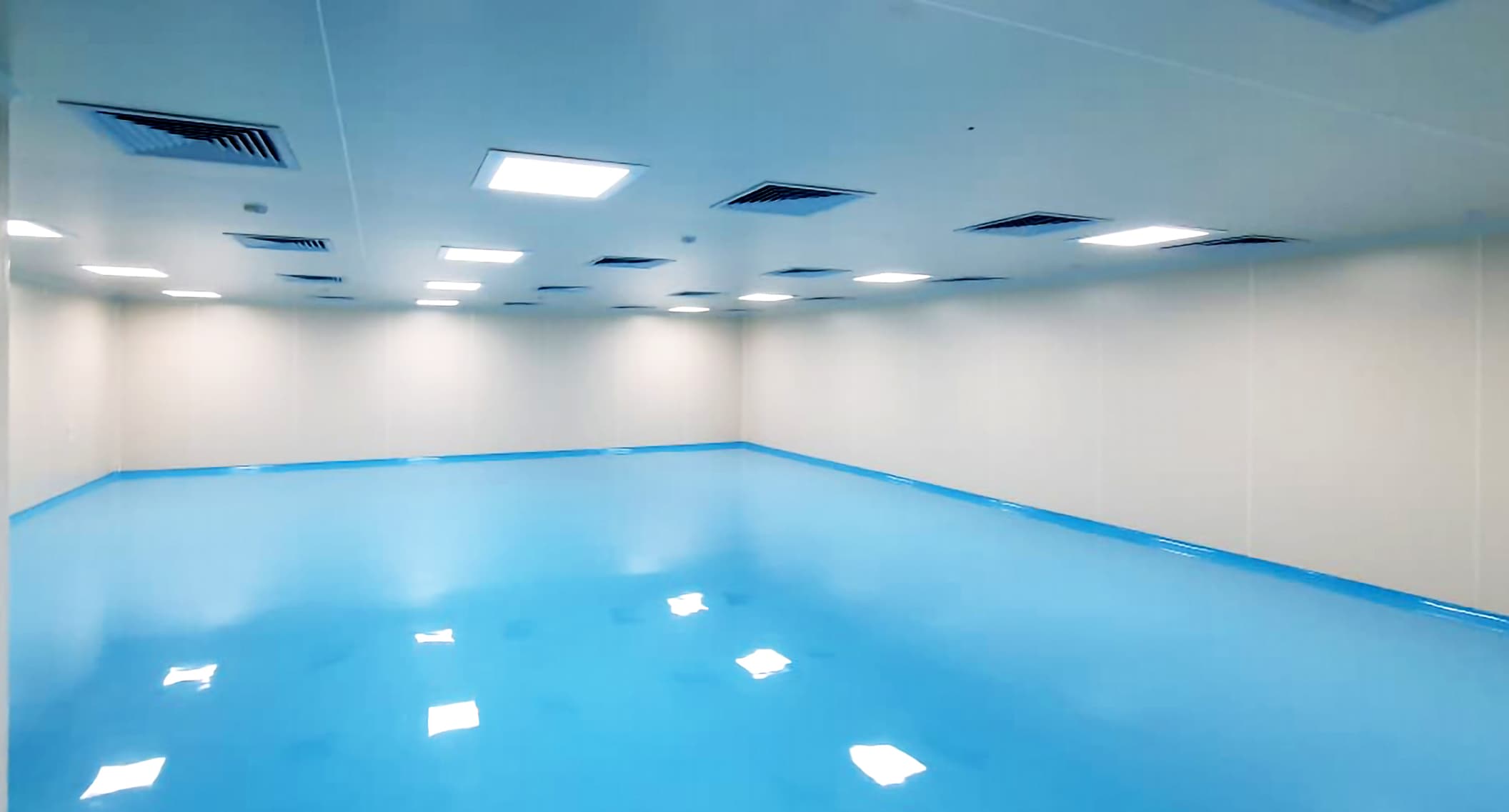
The surface your whole cleanroom stands on
Cleanroom Epoxy Flooring
Fabtech specifies and installs seamless epoxy and PU cleanroom flooring across India, coved into the wall and laid jointless to your ISO 14644 or EU-GMP grade. A cleanroom floor cannot behave like an office floor. It needs no seams for particles or microbes to hide in, a surface that shrugs off whatever your process spills, and a cove where it meets the wall instead of a corner that traps dirt.
- Seamless epoxy and PU
- Coved wall-floor junction
- ISO 14644 classified rooms
- EU-GMP Grade A to D
What makes cleanroom flooring different
Cleanroom flooring is a seamless, jointless resin surface, usually epoxy or polyurethane. It is coved up into the wall, so there are no corners or joints to trap particles. It is non-shedding, chemically resistant and easy to clean and disinfect. The floor is never a particle source itself, so it supports the room's ISO 14644 cleanliness and passes GMP hygiene inspection.
- Seamless
- Coved
- Non-shedding
- ISO 14644
- EU-GMP Grade A to D
That is what a properly specified seamless epoxy or PU floor gives you.
An ordinary tiled or vinyl-sheet floor has grout lines, seams and a sharp skirting corner. Every one of those is a place where particles collect and microbes grow. A cleanroom floor removes all of them.
It is poured or applied as one continuous membrane. It curves up into the wall in a smooth cove instead of meeting it at a right angle. Its surface is dense enough that spills sit on top to be wiped away, rather than soaking in.
The floor also takes chemical, foot-traffic and cleaning-agent abuse every day. So the resin system is chosen for the room's grade, its process chemistry and its wear. The daily disinfectant routine then does not degrade the finish, and the floor keeps its cleanable surface over years of use.
Fabtech specifies and installs seamless epoxy and PU cleanroom flooring as part of the whole envelope. The system is matched to your room's grade and chemistry. It is coved into the wall-floor junction and laid jointless, so the room cleans the way it is meant to.
FIG. 01The same spill on two floors. A grout channel gives particles somewhere to settle and liquid somewhere to run. A seamless resin membrane gives it neither, so the spill stays on the surface to be wiped away.
Epoxy vs PU vs vinyl: which cleanroom floor
Three systems cover almost every cleanroom floor. Seamless epoxy, seamless polyurethane (PU / urethane) and welded vinyl sheet. They are not interchangeable. Pick by chemistry, temperature and wear.
| Parameter | Seamless epoxyTHE DEFAULT | PU / urethane | Welded vinyl sheet |
|---|---|---|---|
| Build | poured / applied jointless resin, coved | poured / applied jointless resin, coved | sheets heat-welded at seams, coved skirting |
| Durability | high, hard, abrasion-resistant | high, tougher against impact and thermal cycling | moderate, resilient underfoot, seams are the weak point |
| Chemical resistance | strong against most process chemicals and cleaning agents | strong, and better against organic acids and aggressive agents | good, but joints and adhesives are the vulnerable path |
| Thermal / thermal-shock | good for stable temperatures | best where wash-downs, steam or temperature swings hit the floor | limited, not for thermal-shock duty |
| ESD / anti-static option | yes, conductive / dissipative epoxy | yes, conductive / dissipative PU | yes, static-dissipative vinyl |
| Cost band (relative) | mid | higher | entry to mid |
| Best-fit use | general pharma, lab and electronics cleanrooms | food, wet-process, thermal-cycling and heavy-chemical areas | fast-track fit-outs and where a resilient underfoot surface is wanted |
FIG. 02Relative comparison. The system is confirmed against your room's grade, chemistry and wear at quote.
In short, seamless epoxy is the default for most pharma, lab and electronics cleanrooms. PU earns its higher cost where wash-downs, steam, thermal shock or aggressive chemistry hit the floor. Welded vinyl suits a fast fit-out, or a room that wants a softer, resilient surface. Its welded seams simply have to be detailed properly.
Fabtech specifies whichever system fits your grade and chemistry. We then integrate it with the wall panels, so the whole envelope behaves as one system. Where the flooring completes a full room, see modular cleanroom panels for the walls and ceiling it coves into.
The coved wall-floor junction: why it matters
Watch the figure
One cleaning pass runs across both junctions on a loop, three passes to a cycle. Watch what each side is still holding by the third one.
The detail that decides a cleanroom floor is not the flat field. It is the corner. Where the floor meets the wall, it is never left as a sharp right angle. It is curved up into the wall in a smooth, continuous cove.
- Correct
Radiused cove
The mop follows the curve into the corner, so the junction cleans out completely on every pass.
- Wrong
Square internal corner
No mop reaches the angle. Each pass leaves residue behind, and it builds up pass after pass.
FIG. 03One wall, one slab, two junctions. The coved radius cleans out on every pass. The square corner keeps what the mop leaves behind. Cove radius confirmed per project.
The build-up, substrate first
- 01
Substrate
The prepared slab. Ground back and made good, because a seamless floor is only ever as sound as what it is bonded to.
- 02
Primer
The slab is sealed and primed so the resin bonds into it rather than sitting on top of it.
- 03
Body coat
The self-levelling build that carries the traffic, the spills and the daily cleaning routine.
- 04
Cove former
A radiused fillet set into the corner, so the 90 degree internal angle simply stops existing.
- 05
Seal at the wall panel
The upstand is closed against the wall-panel system, so floor and wall read as one surface rather than two trades.
- 06
Top coat
One continuous membrane over floor, cove and upstand. There is no joint anywhere along that path for a mop to miss.
- 01
One resin, floor to wall
The cove is formed from the same resin system as the floor, and tied into the wall panel, so there is no seam at the join for particles or microbes to enter.
- 02
Cleanable and inspectable
There is no gap and no corner, so the junction can be cleaned and disinfected to the same standard as the flat floor. That is exactly what a GMP hygiene inspection looks for.
Not a separate trade
This is why flooring cannot be a separate trade bolted on at the end. The cove has to marry into the wall-panel system. So Fabtech details the wall-floor junction as part of the envelope, coving the flooring into the panels instead of butting two finished trades together and leaving a joint. Floor and wall become one washable shell.
Which floor fits which grade
The floor is specified to the room it serves. The cleaner and more regulated the room, the more the seamless, coved, non-shedding, chemical-resistant properties matter.
| Room context | Typical grade | What the floor has to doTHIS PAGE |
|---|---|---|
| Aseptic / sterile pharma | ISO 14644 Class 5-7, EU-GMP Grade A/B, Schedule M | seamless, coved, non-shedding, disinfectant-resistant, validated for hygiene |
| General pharma / OSD / lab | ISO 14644 Class 7-8, EU-GMP Grade C/D | seamless epoxy, coved, chemical-resistant to process and cleaning agents |
| Electronics / semiconductor | ISO 14644 Class 5-8 | seamless with ESD-dissipative properties and an earthing network |
| Food and beverage | HACCP / FSSAI context | PU / urethane for wash-downs and thermal shock, slip-resistant, hygienic cove |
FIG. 04Room classification per ISO 14644-1. Grade context per EU-GMP Annex 1 and Schedule M.
Across all of them the non-negotiables are the same. One jointless surface. A coved wall-floor junction. Non-shedding and cleanable, with the resin system tuned to the chemistry and the wear.
What changes is how hard the room pushes back. An aseptic Grade A/B room drives a disinfectant-resistant finish, validated for hygiene. A Class 5-8 electronics room drives ESD-dissipative properties and an earthing network. A food area drives a thermal-shock PU that can take hot wash-downs.
The grade sets which of those are mandatory, and how hard the proving is. Fabtech specifies the floor against the same ISO 14644 class and GMP grade the room itself is built to. For the full grade picture, see our ISO classification of cleanrooms reference.
One surface. No joints at the junction. Specified to the room, not to a catalogue.
Figures describe the flooring system this page specifies, not a project. Values for your room are confirmed at quote.
- Continuous membraneFloor, cove and upstand, laid as one
- 1
- Joints at the junctionNothing for particles or microbes to enter
- 0
- Systems to choose fromSeamless epoxy, PU / urethane, welded vinyl
- 3
- Properties you can specifyChemical, ESD, thermal shock, antimicrobial, slip
- 5
Cleanroom flooring specification at a glance
A cleanroom floor comes down to four things: its system, its thickness, its finish and its detailing. It is not one generic finish either, so the properties your process actually needs are specified here line by line. This is the shape of a Fabtech flooring specification, confirmed to your room at quote.
- System
- Seamless epoxy or PU / urethane, or welded vinyl sheet, chosen to the room's grade, chemistry and wear.
- Finish type
- Self-levelling, self-smoothing or coating, per duty. Thickness and build are set by the traffic and the chemical load.
- Thickness
- Typically 2 to 4 mm for self-levelling systems, with thicker builds for heavy-duty and high-impact areas.
- Coving
- Seamless coved skirting at the wall-floor junction, integrated into the wall-panel system, with no joint at the join.
- Non-shedding
- A continuous membrane with no particle shedding, so the floor is never a particle source and supports the room's ISO 14644 cleanliness.
- Chemical resistance
- Matched to process and cleaning-agent chemistry, including the acids and solvents your process spills. The resin system is selected per room.
- ESD option
- Conductive or dissipative with an earthing network, for electronics, semiconductor and other areas where a static discharge would damage product.
- Antimicrobial option
- An additive finish that inhibits microbial growth on the surface, for aseptic and hygiene-critical rooms.
- Thermal-shock duty
- PU / urethane for hot wash-downs, steam cleaning and temperature swings without cracking, in wet-process and food areas.
- Slip resistance
- A controlled texture where wet processing or safety underfoot calls for it, balanced against cleanability.
- Colour
- To specification, with light shades favoured for contamination visibility.
The levers you actually control are few. The system, epoxy or PU or vinyl. The thickness and build, to suit traffic and chemical load. Whether the floor needs ESD or antimicrobial properties. And how the cove is detailed into the wall. Which of the optional properties apply is set by the room's grade, process chemistry and duty, and each one is specified to your requirement rather than assumed.
Every Fabtech figure is confirmed for your room before it is quoted. Any value not yet fixed is provided on request.
How Fabtech delivers cleanroom flooring
Specified against the room it serves, laid as one membrane, coved into the wall panels and carried through to handover.
Fabtech specifies, installs and integrates seamless epoxy and PU cleanroom flooring as part of the whole cleanroom envelope. We stand behind it from spec to handover.
That means the floor is chosen to your room's grade and process chemistry. It is laid jointless as one continuous membrane. It is coved into the wall-floor junction. And it is validated for hygiene where the project calls for it.
The same team sets the room's ISO 14644 class. It also sets the EU-GMP or Schedule M grade the room is built to. So the flooring system, its ESD or antimicrobial properties and its coved detailing are all specified against those requirements from the start. Nothing is left to be fixed after the walls are up.
Behind that sits Fabtech Cleanrooms, a cleanroom turnkey company that has designed, built and validated controlled environments across India since 2004, holding ISO 9001 quality management.
Proof of capability: Fabtech has delivered ISO 14644 classified, GMP-compliant cleanrooms for pharma and research clients across India. A coved epoxy floor is one element of that seamless, hygienic envelope.
The work includes Ajanta Pharma, Desano and German Remedies, plus BSL-3 containment facilities at PGICH Noida and ASMC Shahjahanpur. Flooring project scope and specifications are available on request.
- Ajanta PharmaOSD SUITE, AURANGABAD
- DesanoPHARMA FACILITY, BANGALORE
- PGICH NoidaBSL-3 CONTAINMENT
- ASMC ShahjahanpurBSL-3 CONTAINMENT
Specify
Match the system to the room
Grade, process chemistry, wear and the cleaning routine decide the system and the properties it carries.
Detail
Draw the junction, not just the floor
The cove is detailed into the wall-panel system while the envelope is still on paper, not on site.
Prepare
Make the substrate sound
The slab is prepared and primed first. A jointless floor inherits every fault in what sits under it.
Lay
One continuous membrane
Floor, cove and upstand go down as one surface, coved into the panels rather than butted against them.
Hand over
Validate, then hand over
Checked with the rest of the envelope and, where the project calls for it, validated for hygiene.
FIG. 05The delivery sequence for a coved seamless floor, from specification to validated handover.
Cleanroom flooring, common questions
Cleanroom epoxy flooring is a seamless resin floor, applied as one continuous membrane and coved into the wall. That leaves no seams, grout lines or corners where particles and microbes collect. It is non-shedding, chemically resistant and easy to clean. It is never a particle source, so it supports the room's ISO 14644 cleanliness and passes GMP hygiene inspection.
Epoxy is a resin poured or applied on site. It cures into one jointless surface with no seams. Vinyl comes as sheets heat-welded together, so it has weld seams and relies on adhesive. Both can be coved, and both offer static-dissipative options. Epoxy suits most pharma, lab and electronics rooms. Vinyl suits fast fit-outs and a softer surface.
Epoxy is harder and more abrasion-resistant. It is the default for general pharma, lab and electronics cleanrooms. PU, or polyurethane, is tougher against impact, thermal cycling and organic acids. It is chosen for food, wet-process and hot wash-down areas. PU costs more, so it is specified where that toughness is needed.
A sharp 90-degree corner where floor meets wall traps dust and cleaning residue, and cannot be wiped clean. A cove curves the floor smoothly up into the wall. It is formed from the same resin, so there is no seam at the join. The result is one cleanable surface, floor to wall.
A cleanroom floor is specified by its system: seamless epoxy, PU or welded vinyl. Then thickness and build, set by traffic and chemical load. Then the coved wall-floor junction. Then the properties: non-shedding, chemically resistant, ESD-dissipative or antimicrobial. Each is set to the room's ISO 14644 class and GMP grade.
Cost depends on the system, the thickness and build, the floor area, and whether ESD or antimicrobial properties are needed. Coved detailing and the state of the substrate underneath also count. Those levers change from room to room, so the floor is priced to your specification rather than a single rate.
Standard epoxy is not conductive. A conductive or static-dissipative epoxy can be specified instead, with an earthing network, for electronics and other static-sensitive areas. PU and vinyl offer the same option. The system is chosen to the site's ESD requirement, so static drains away safely.
For most pharmaceutical cleanrooms a seamless epoxy floor is the standard choice. It is coved into the wall and chemically resistant to process and cleaning agents. For wet-process, food or hot wash-down areas, a PU system is used instead. Your EU-GMP grade, Schedule M requirements and process chemistry decide.
Yes. The flooring is coved into the wall-panel system, so the floor curves up into the wall as one continuous surface with no joint. Detailing floor and wall together, rather than butting two finished trades against each other, is what makes the junction cleanable and inspectable.
Yes, and how it is built is what keeps it that way. The slab is ground back and primed first, then a self-levelling body coat and a top coat go down over it as one bonded membrane across floor, cove and upstand. There is no grout line and no weld seam anywhere along that path to open up later. The daily disinfectant routine does not degrade the finish either, so the surface stays dense and cleanable over years of use, and the HEPA filtration and air changes are not fighting a floor that sheds.
Ready to price the floor?
Share your room grade, process chemistry and area, and get a quote for seamless epoxy or PU flooring specified, coved and integrated with your cleanroom envelope.