

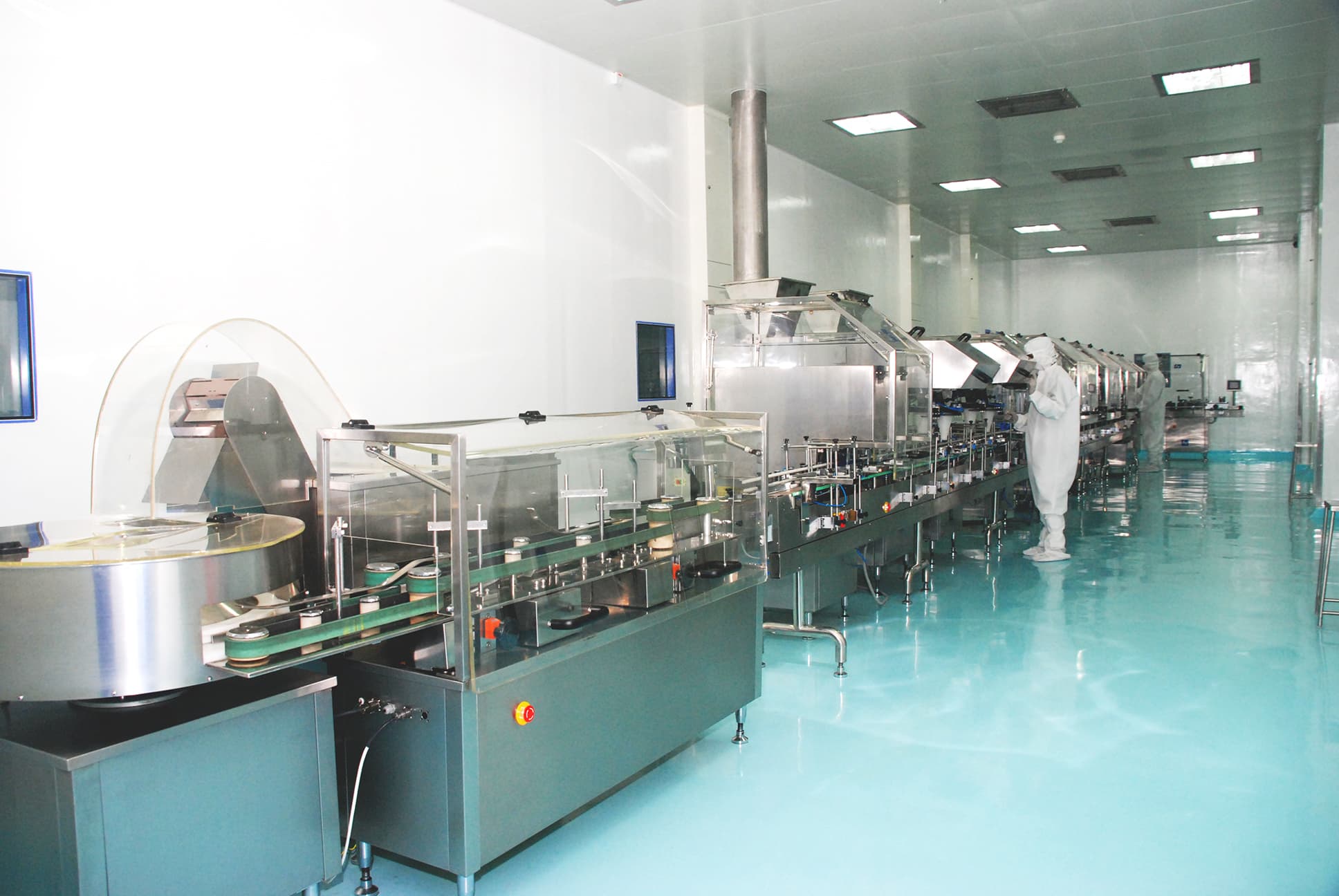
Qualification and validation
Cleanroom validation services in India
Fabtech's cleanroom validation services in India test the room and hand your QA team the signed file that says it passed. Before you run one batch, the room must prove itself, DQ through PQ.
- DQ/IQ/OQ/PQ
- ISO 14644-1 particle counts
- HEPA integrity PAO/DOP
- GMP-ready documentation
- Validated in scope with design and build
What cleanroom validation is
Validation is planned in from the design stage and runs alongside the build, so qualification and handover finish together.
In one line
Until a cleanroom is validated, it is a room you cannot legally run product through. Your QA lead cannot release a batch from it. An inspector will not take “we built it well” on trust. Validation is how the room stops being a claim and becomes a facility you can use.
- ISO 14644-1
- EU-GMP Annex 1
- DQ / IQ / OQ / PQ
- Schedule M
- HEPA H13 / H14
In practice, cleanroom validation is the documented proof that the room and its HVAC perform to the standard they were designed for. It runs through the four qualification stages, from the design on paper to performance in daily use. We measure particle counts to ISO 14644-1, scan the filters, check the pressures, and record every result. The room ends up qualified, documented and fit for regulated production.
Why validation decides whether the room is usable
A cleanroom you cannot prove is a cleanroom you cannot use. The air, the pressures, the filters and the recovery all have to meet the specification, and every test has to be signed and traceable.
The cheapest place to fail is on paper, during design. The most expensive is at the end, when a missed requirement means rework. Because we design and build the room, we also set its pass marks at the design stage. Test day then confirms the room. It does not go looking for surprises.
Acceptance criteria are agreed before any test is executed. Every stage closes signed.
- Written protocol
- Each of the four qualification stages runs to a written protocol, with acceptance criteria agreed before anyone tests anything.
- Criteria source
- Those criteria come from the published standard your product is regulated under, never from a house rule.
- Stage close-out
- Each stage closes with a signed, traceable report. The file also carries the as-built records, aligned to your Contamination Control Strategy (CCS).
The four stages of cleanroom qualification: DQ, IQ, OQ, PQ
Four stages, four sign-offs. Each gate answers one question, produces its own documentary evidence, and depends entirely on the gate before it. The table below maps what each one answers, what it confirms and what it is executed against, so you know exactly what the final file will contain.
FIG. 01The product of validation is a file, not a feeling. Each gate answers one question and produces its own documents, and each one depends on the gate before it, so a failure anywhere voids everything after it. At rest the chain is drawn complete: all four gates satisfied, every artefact lit.
| Stage | Question it answers | What it confirms | Executed against |
|---|---|---|---|
| DQ: Design Qualification | Will the design meet the requirement? | The design satisfies the User Requirement Specification and the target ISO class / EU-GMP grade, before anything is built. | The URS, plus your EU-GMP Annex 1 or Schedule M target |
| IQ: Installation Qualification | Was it installed correctly? | Equipment, filters, ductwork and instruments are installed, calibrated and documented as specified. | The approved design, equipment schedules and calibration records |
| OQ: Operational Qualification | Does it work across its range? | Airflow, ACPH, pressure cascade, temperature and humidity perform within limits across the operating range. | Design limits for airflow, ACPH and pressure cascade |
| PQ: Performance Qualification | Does it hold in real use? | The room sustains its class in operation over time, with particle counts and (where aseptic) viable monitoring in spec. | ISO 14644-1 at rest and in operation, plus EU-GMP Annex 1 viable limits where aseptic |
FIG. 02
Together these four stages are the clean room validation process. The same sequence covers cleanroom commissioning and qualification: commissioning sets the system to work, qualification proves it and writes it down.
What we validate: the test scope
Every project is different, but the proof set is not. Below is the checklist we test against, written so a buyer can lift it straight into a User Requirement Specification or an RFQ. Every test has a pass mark agreed in advance. Every result is closed out in the file.
Airborne particle classification
Non-viable particle counts to ISO 14644-1, at-rest and in-operation, confirming the room holds its ISO class / GMP grade.
HEPA/ULPA filter integrity
PAO/DOP integrity scanning of installed terminal filters, the test that proves no leak past the filter face or seal. HEPA H13/H14, ULPA U15-U17 where fitted.
Airflow and air changes
Air velocity, supply volume and air-change rate (ACPH) verified against design.
Air-pattern and smoke studies
Airflow-visualisation (smoke) studies for unidirectional LAF zones, proving sweep and the absence of dead spots.
Pressure cascade
Differential pressures between classified rooms verified, so air always moves clean to less-clean under real conditions.
Recovery
Recovery testing: how fast the room returns to class after a disturbance.
Temperature and relative humidity
Conditions verified and mapped to specification.
Viable (microbial) monitoring
Settle/active air and surface counts per EU-GMP Annex 1 (Grade A-D limits) where the area is aseptic.
Most of these tests are, in practice, validation of the HVAC system. See Cleanroom HVAC systems .
For how the target class is set in the first place, see ISO classification of cleanrooms .
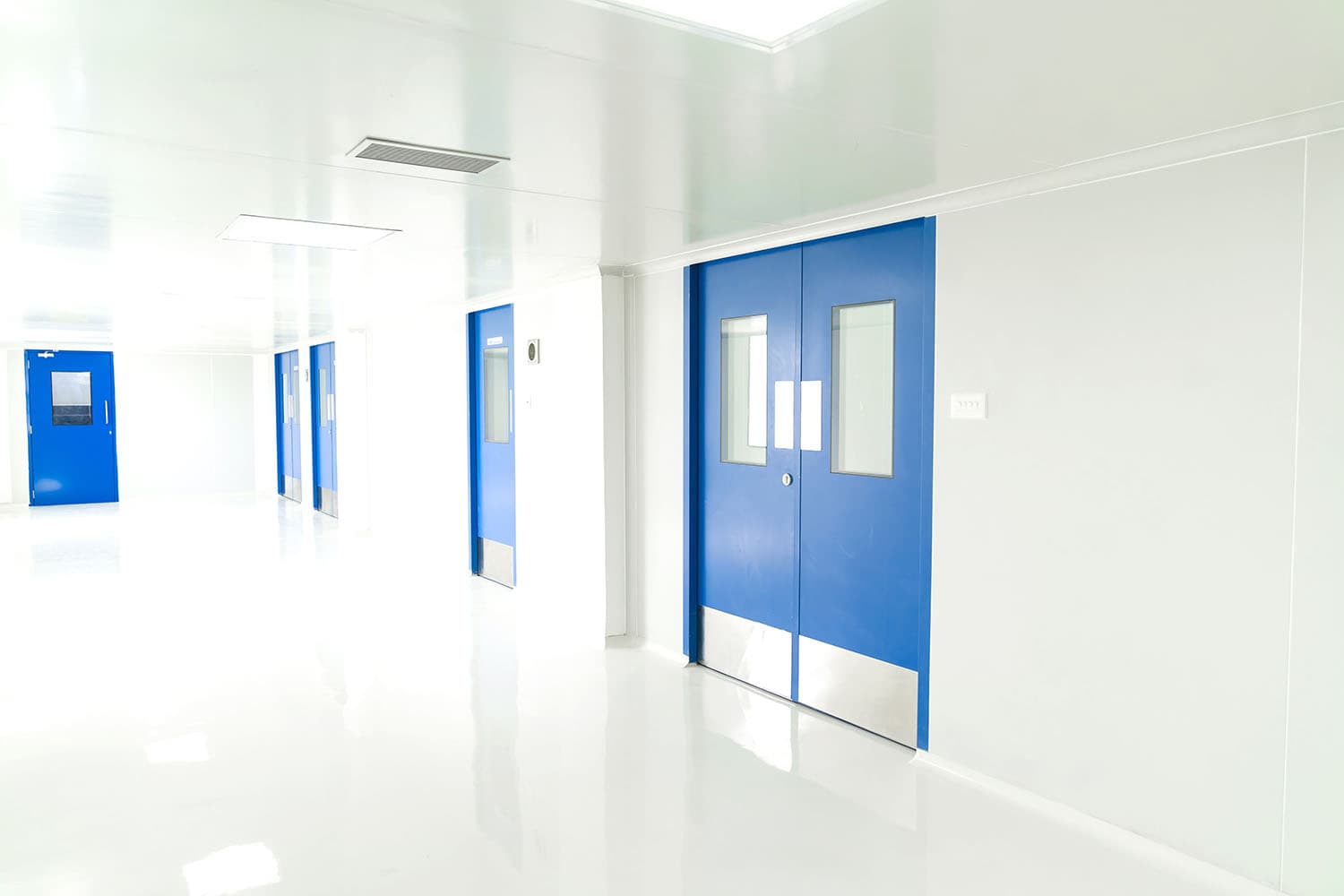
At rest, with the HVAC running and no people present. This is the first of the two states ISO 14644-1 classification is measured in. The second is in operation, with the process running and the room staffed.
How it works
Validation is the fifth stage of our six-stage delivery. The work to pass it starts on day one, at design.
Stage 05 of 06 is this page. Stages 01 to 04 build the evidence it signs off.
- 01
Requirements and site survey
The User Requirement Specification and regulatory target are captured up front, because they become the validation acceptance criteria.
- 02
Design (DQ)
Design Qualification confirms the design will meet those criteria.
- 03
Build and install (IQ)
Installation Qualification documents that equipment is installed and calibrated correctly.
- 04
Commission and operate (OQ)
Operational Qualification proves performance across the operating range.
- 05
Performance (PQ) and particle classification This page
Performance Qualification and ISO 14644-1 classification prove the room holds in real production.
- 06
Handover
The validated facility with its full documentation dossier. Re-validation and equipment AMC can be arranged; ongoing facility maintenance is client-managed.
Proof
We validate the cleanrooms we build. We have designed, built and validated GMP facilities for India's regulated manufacturers, including Ajanta Pharma (Aurangabad), Desano and German Remedies. The list also includes BSL-3 biosafety facilities at PGICH Noida and ASMC Shahjahanpur, where validation is not optional. Scope and specifications per project are available on request.
- Ajanta Pharma, AurangabadOSD facility
- DesanoPharmaceutical
- PGICH NoidaBSL-3 biosafety
- ASMC ShahjahanpurBSL-3 biosafety
- Four signed gates
- DQ IQ OQ PQ
- Counts at rest and in operation
- ISO 14644-1
- Filters scanned with PAO or DOP
- H13 / H14
- EU-GMP Annex 1 viable limits
- Grade A to D
- Controlled environments since 2004
- 2,000+
Why Fabtech
The builder validates the build, designed to pass, not hoped to.
The team that designed and made the room also validates it. The pass marks are set at design, in DQ. So on test day, validation confirms the room rather than discovering surprises in it. And when a test does fail, one team owns the fix and the re-test. No trade points at another while your schedule slips.
- One accountable partyDesign, manufacture (in our own facility) and validation sit with one team, so a failed test has a single owner who can fix and re-test.
- GMP-ready documentationProtocols, executed results and as-builts in the format your QA and a regulator expect.
- Audited governanceAudited governance and single-point accountability, under an ISO 9001 quality management system.
Cleanroom validation, common questions
It is the documented proof that a cleanroom and its HVAC perform to the standard they were designed for. The proof runs through the four qualification stages. You get particle counts to ISO 14644-1, airflow, pressure and recovery data, every result signed. Filter integrity is proved by PAO/DOP scanning. Until that file exists, the room is only a claim.
These are the four qualification stages. DQ, Design Qualification, proves the design can pass. IQ, Installation Qualification, proves correct, calibrated installation. OQ, Operational Qualification, proves performance across the range. PQ, Performance Qualification, proves it holds in real use. Together they are the clean room validation process.
Commissioning sets the cleanroom and its HVAC to work and tunes them to design. Qualification then proves, against pass marks agreed in advance, that the commissioned system meets the standard. One makes it work, the other proves it. Doing both, in that order, is what makes the handover stand up to an inspection.
The full test scope, in one traceable file. Particle counts to ISO 14644-1, at rest and in operation. HEPA and ULPA filter integrity. Every filter is scanned with PAO or DOP. Airflow and air changes per hour (ACPH). Smoke studies for laminar (LAF) zones, pressure cascade, recovery, temperature and humidity. Aseptic areas add viable monitoring to EU-GMP Annex 1.
It proves an installed HEPA or ULPA filter has no leak past the medium or its seal. We challenge the filter with PAO or DOP aerosol and scan the clean side for leaks. It is part of IQ and OQ, and of routine re-validation. We cover H13 and H14 filters. ULPA grades U15 to U17 are included where fitted.
We prove the HVAC in the operational and performance stages, OQ and PQ. That means airflow volumes and velocities, plus air changes per hour (ACPH). It also covers the pressure cascade between rooms, temperature, humidity, and recovery after a disturbance. Every reading is checked against design.
By airborne particle counting to ISO 14644-1, at rest and in operation. The counts are measured against the limits for your target ISO class or EU-GMP grade. The result is the document that says the room holds its class.
Our strongest model is validating the cleanrooms we design and build, because responsibility stays with one team from start to finish. Validation of an existing or third-party cleanroom or HVAC system can be scoped on request.
Periodically, and after any significant change. The interval is set by your risk assessment and your regulator, and commonly runs six-monthly to annually depending on room grade. We can arrange re-validation and equipment AMC.
Standards we validate to
The grade your room must hold is set by your product and your regulator, not by us. For pharmaceutical builds that usually means EU-GMP Annex 1, with its grades from Grade A to Grade D. Tell us which one applies to you, and we write the tests to it.
We work to the published standard from the design stage, so nothing about the pass marks gets decided on test day. Here is the full list, and what each one does on your project.
- Acceptance criteria travelling into the file
FIG. 03Two different jobs, often confused. ISO 14644, EU-GMP Annex 1, Schedule M, WHO-GMP and cGMP set the pass marks before anyone tests anything. The US FDA, the UK MHRA and the TGA inspect the file that results. They inspect. They do not certify a cleanroom.
| Standard | Role | What it covers |
|---|---|---|
| ISO 14644-1/-2/-3 | Primary, design-driving | Particle classification, monitoring, test methods |
| EU-GMP Annex 1 | Primary, design-driving | Grade A to Grade D, and the viable limits |
| India's Schedule M | Primary, design-driving | India's good manufacturing practice baseline for pharmaceuticals |
| WHO-GMP and cGMP | Primary, design-driving | Good manufacturing practice expectations for regulated products |
| US FDA, UK MHRA, TGA | Inspection | The regimes the documentation is built to withstand inspection under |
| Federal Standard 209E | Legacy | Class 100 / 1,000 / 10,000, superseded by ISO 14644 in 2001 |
FIG. 04
Older specifications still quote those legacy classes. That is not a problem. Tell us the class you were given, and we test to the current class and map the old figure onto it. See ISO classification of cleanrooms .
Tell us the room and the target standard
Share the ISO class or EU-GMP grade you have to hold, the floor area and your inspection date. Our engineers come back with a scoped validation plan, not a brochure.