

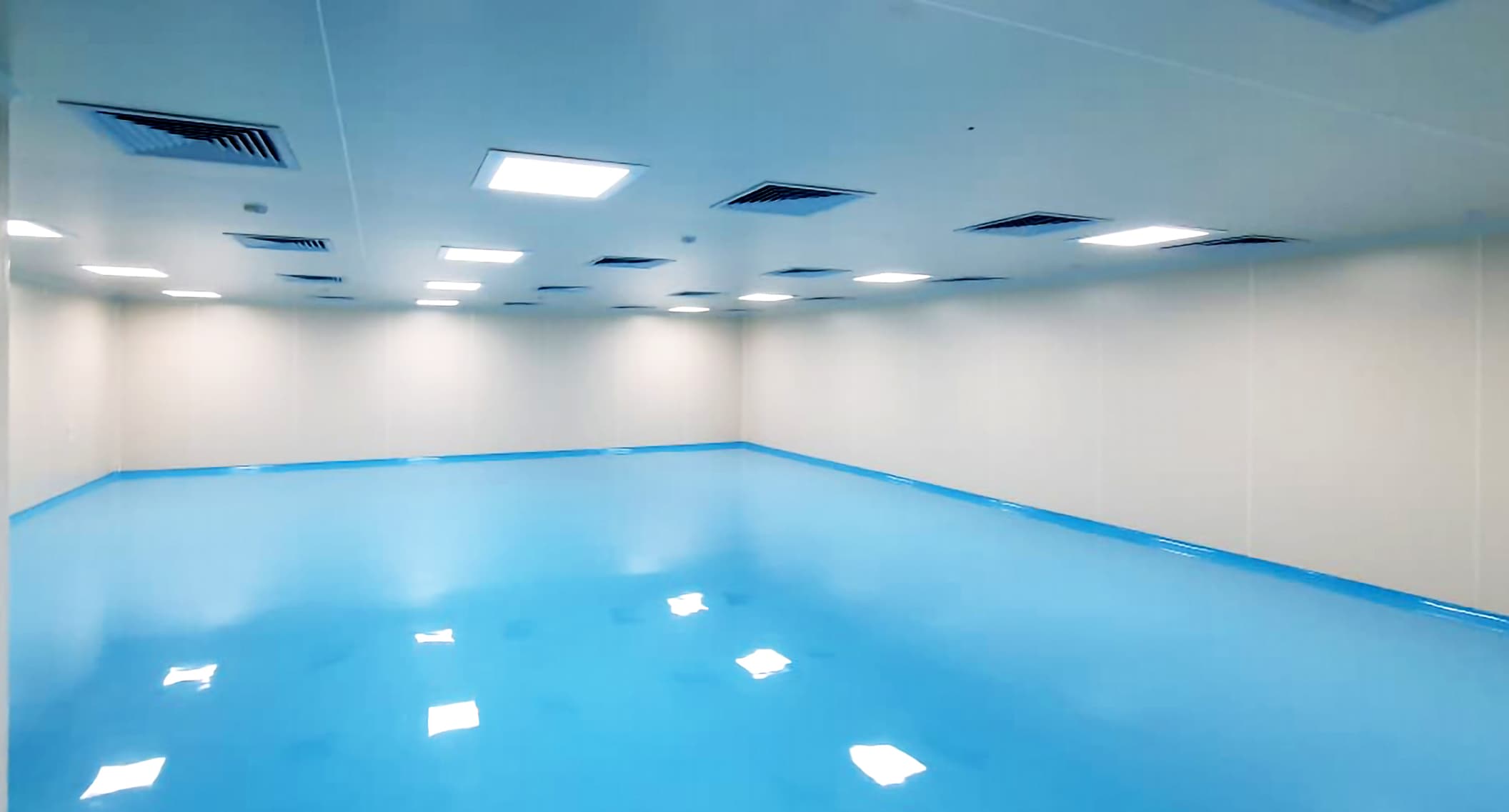
ISO Classification of Cleanrooms
ISO classification grades a cleanroom's air cleanliness from ISO Class 1 to ISO Class 9 under ISO 14644-1. If you landed here you are most likely speccing a room, or decoding the class a tender or an auditor has put in front of you.
- ISO 14644-1:2015
- EU-GMP Annex 1
- FED-STD-209E legacy
What is the ISO classification of cleanrooms?
The ISO classification of cleanrooms is the grading system, set by ISO 14644-1, that ranks a cleanroom by how clean its air really is. There are nine classes, from ISO Class 1 (the cleanest) to ISO Class 9 (the least clean). The lower the number, the cleaner the room. A room earns its class by keeping the particles in every cubic metre of its air under a fixed ceiling.
- ISO 14644-1
- ISO Class 1 to 9
- EU-GMP Grade A to D
- FED-STD-209E
Turning a required class into a room that actually holds it is what we have done on 2,000+ projects since 2004, across every industry that needs controlled air, with one accountable team from design through build.
So here is the whole picture, laid out plainly.
The ISO 14644-1 cleanroom class table
Every ISO class is a particle ceiling. It caps how many particles the air may carry per cubic metre, at a stated particle size. Most specifications quote the 0.5 µm size, so that is the column shown below.
| ISO class | Max particles ≥0.5 micron / m³ | Typical use |
|---|---|---|
| ISO Class 1 | n/a (defined at 0.1 µm only) | Research, extreme nanotechnology |
| ISO Class 2 | n/a (defined at 0.1-0.3 µm) | Advanced semiconductor lithography |
| ISO Class 3 | 35 | Semiconductor front-end, photolithography |
| ISO Class 4 | 352 | Semiconductor, precision optics |
| ISO Class 5 | 3,520 | Aseptic pharma fill-finish (EU-GMP Grade A) |
| ISO Class 6 | 35,200 | Electronics assembly, sterile support |
| ISO Class 7 | 352,000 | Pharma background, medical device (EU-GMP Grade B/C) |
| ISO Class 8 | 3,520,000 | General GMP, packaging, food (EU-GMP Grade C/D) |
| ISO Class 9 | 35,200,000 | Controlled space, minimal classification |
FIG. 01Source: ISO 14644-1:2015.
The two cleanest classes are special cases. ISO Class 1 and ISO Class 2 are measured at smaller particle sizes, which is why their cells in this column sit blank. From ISO Class 3 down the rule is simple: each step allows ten times more particles than the one above. That ×10 step is the spine of the whole table.
You do not get to pick a class by preference. Your process picks it for you. A packing hall or a general assembly line is comfortable at ISO Class 8. An injectable line needs ISO Class 5 air over the open fill point.
FIG. 02A cleanroom class is a particle ceiling: the maximum count of particles at 0.5 µm and larger that each cubic metre of air may carry. Step one class cleaner and the ceiling drops to a tenth, so the air system must hold the room under a limit ten times tighter.
And the class is never just a label. Once it is set, it becomes the first domino in the whole design, deciding how hard the air system, the filters and the monitoring have to work. More on that below.
ISO classes mapped to EU-GMP grades (at rest vs in operation)
If you make medicines, one class number is never the whole story. A pharmaceutical facility is also classified by EU-GMP Grade A to D, and the two grading systems line up with each other.
The grades also split the requirement into two states. "At rest" means the room is complete and the equipment is running, with nobody inside. "In operation" means people and process are active. A grade must hold its class in both states. That is why each grade carries two ISO numbers in the table below.
| EU-GMP grade | At rest | In operation | Where it applies |
|---|---|---|---|
| Grade A | ISO Class 5 | ISO Class 5 | Aseptic core, sterile fill-finish, open product, LAF zones |
| Grade B | ISO Class 5 | ISO Class 7 | Background to the aseptic core; gowning into Grade A |
| Grade C | ISO Class 7 | ISO Class 8 | Preparation, compounding, less critical processing |
| Grade D | ISO Class 8 | (not defined) | Oral solids, secondary packing, general GMP support |
FIG. 03Source: EU-GMP Annex 1. Grade D in-operation limits are not predefined; the manufacturer sets them in its Contamination Control Strategy (CCS).
This is the part of a regulated build that trips people up most. The same area is held to a tighter limit when it is empty than when it is working. We design to whichever target your process and regulator require. See how it plays out on a real project in our pharmaceutical cleanroom work .
FIG. 04The same Grade B room carries two ISO numbers: ISO Class 5 with nobody inside, ISO Class 7 once people and process are active. A classification report must state which condition was tested.
Legacy classes: Federal Standard 209E (Class 100, 1,000, 10,000…)
Plenty of older specifications and tenders still speak in Class 100, Class 1,000, Class 10,000 and Class 100,000, in India often written "class 1 lakh". Those names come from the US Federal Standard 209E, a legacy standard that was retired in 2001 when the current ISO classes replaced it. If you are holding one, here is what it means today.
| Legacy (FS-209E) | Equivalent ISO class |
|---|---|
| Class 1 | ISO Class 3 |
| Class 10 | ISO Class 4 |
| Class 100 | ISO Class 5 |
| Class 1,000 | ISO Class 6 |
| Class 10,000 | ISO Class 7 |
| Class 100,000 ("1 lakh") | ISO Class 8 |
FIG. 05FED-STD-209E was cancelled in 2001; shown for translation only.
Class 1 and Class 10 were the ultra-clean semiconductor tiers. Class 100 up to Class 100,000 covered everything from sterile pharma to general manufacturing. The commas change nothing: a "class 10000 clean room" is a Class 10,000 room, and a "class 100000 clean room" is a Class 100,000 room.
So a tender that still reads "Class 10,000 clean room" is asking for an ISO Class 7 cleanroom. "Class 1 lakh" means ISO Class 8. We read both languages, and we translate any older specification onto its current ISO class, so nothing is lost when an old design meets a new one.
Clean area classification in microbiology (viable monitoring)
A particle counter cannot tell dust from bacteria. It measures non-viable particles: total airborne matter, living or not. In a pharmaceutical or microbiology setting, the clean area is therefore classified a second way, by viable monitoring: the number of live micro-organisms it is allowed to carry.
PARTICLE COUNTER · NON-VIABLE
Counts every particle, dust or living. This sample: 15 particles counted.
sets the ISO 14644-1 class
VIABLE MONITORING
Settle plates, contact plates and active air sampling grow only the living. This sample: 3 colonies grow.
Annex 1 grade limit · Grade A: effectively no growth
FIG. 06Clean area classification in microbiology grades the same air twice: the particle counter's non-viable total sets the ISO 14644-1 class, and viable monitoring proves the microbial load sits inside its EU-GMP Annex 1 grade limit.
Viable load is measured with settle plates, contact plates and active air sampling. Annex 1 of the European GMP rules then sets a viable limit for each grade, and for Grade A that limit is effectively no growth at all.
So "clean area classification in microbiology" means grading a space in both ways at once: by its particle count and by its microbial load. Together they decide whether an aseptic area is genuinely in control. Both are proven during qualification and routine environmental monitoring, never assumed from the particle count alone.
How the class drives the cleanroom design
An ISO class is not a label you add at the end. It sets the engineering envelope from the first line of the design. A cleaner class means more work in four places at once, and all four have to agree with each other. The table below shows where that work goes.
- Air changes
- On the order of 20 air changes per hour (ACPH) for a typical ISO Class 8 room; far more for an ISO Class 5 core, with unidirectional (laminar) airflow over the critical zone
- Filtration
- Terminal HEPA H13/H14 filters across most classified space; ULPA U15-U17 where the air must be cleanest
- Pressure cascade
- Cleaner rooms held positive to dirtier ones, so the class holds even as doors open and people move
- Proving it
- Particle counts to ISO 14644-1, plus airflow, HEPA filter integrity (PAO/DOP) and recovery testing
Then the room has to prove all of this on record, in what is called the qualification file.
Design qualification (DQ) confirms the design matches your requirement. Installation qualification (IQ) confirms the room was built to that design. Operational qualification (OQ) shows every system behaves as intended. Performance qualification (PQ) shows the room holds its class in use. That file is what your auditor reads first.
That is why the class you choose, how we hold it with cleanroom HVAC and how we prove it through validation are one conversation, not three.
What is made in a cleanroom, and who builds the room
If a speck of dust can ruin it, it is made in a room like this.
A cleanroom exists to make things that cannot tolerate contamination. Sterile medicines and injectables. Semiconductor wafers and microchips. Medical devices, electronics, solar cells and biologics.
"Cleanroom manufacturing" is used two ways. It can mean the products fabricated inside the controlled space. It can also mean the building of the space itself: the ISO cleanroom assembly, the modular wall and ceiling panels, and the technical parts that make up the room.
Fabtech works on the second of those. We build the controlled space itself, serving facilities across Mumbai, Maharashtra and the rest of India.
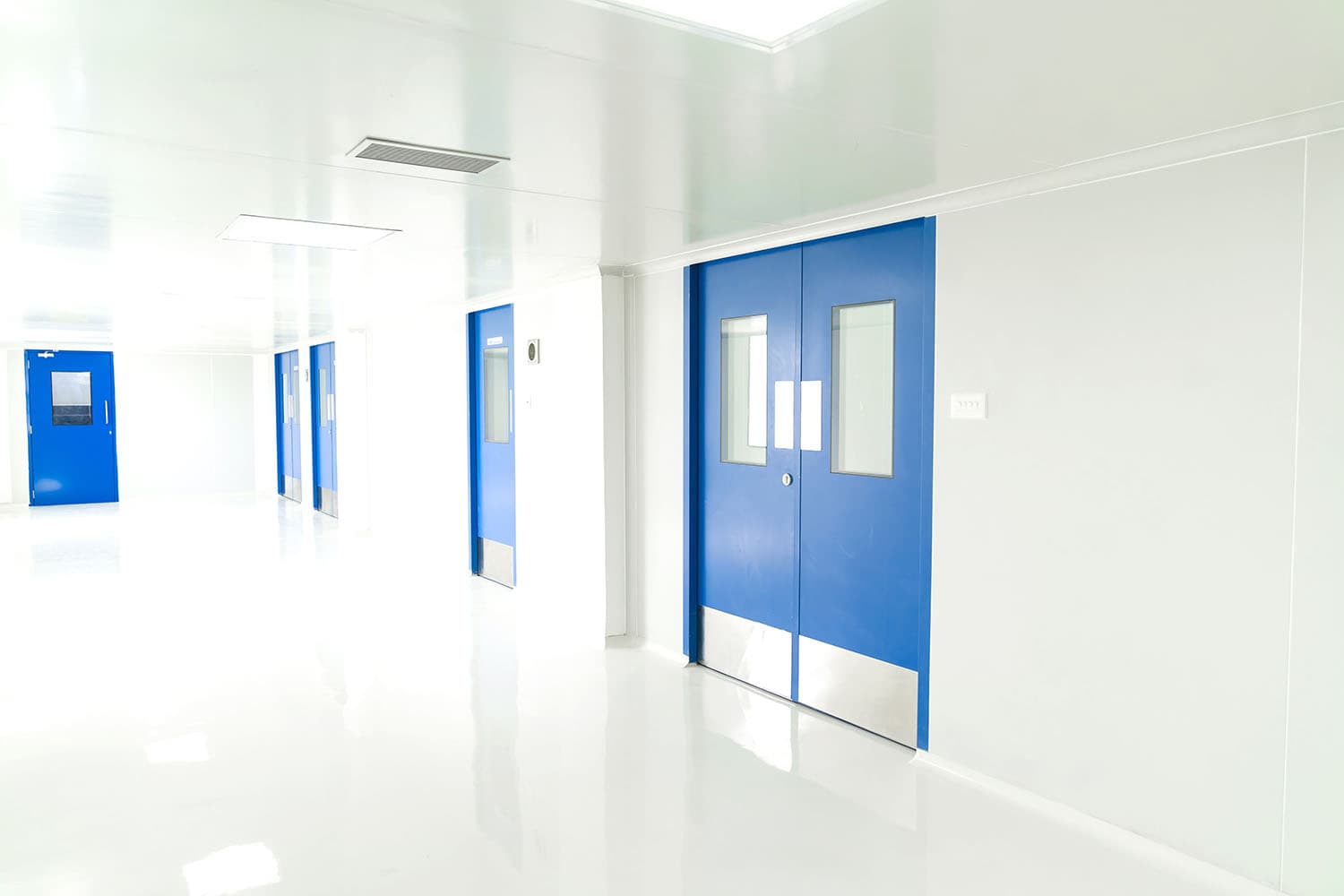
FIG. 07Fabtech designs, builds and validates cleanrooms to every ISO 14644 class, from ISO 5 aseptic cores to ISO 8 support areas.
Once this guide helps you settle on the right class, the natural next question is how a room is built and validated to hold it. If you would rather talk that through than read on, that is what we are here for. Otherwise it all lives in our turnkey cleanroom services .
ISO cleanroom classification: common questions
Nine. The standard runs from ISO Class 1, the cleanest, to ISO Class 9, the least clean. Each class is graded by the maximum number of airborne particles allowed per cubic metre of air at a given particle size.
Each step between classes allows roughly ten times more particles. ISO Class 5 permits up to 3,520 particles of 0.5 µm and larger per cubic metre. ISO Class 7 sits two steps up at 352,000, and ISO Class 8 at 3,520,000. The cleaner the class, the harder its air system works.
They are legacy Federal Standard 209E terms, retired in 2001. A "Class 10,000" or "class 10000" clean room maps to ISO Class 7 today. "Class 100,000", written "class 100000" or "class 1 lakh" in India, maps to ISO Class 8. We translate older specifications onto the current classes.
"At rest" measures the room complete and running, but with nobody working inside. "In operation" measures it during actual production. GMP rules require both, because the room must also hold its class once people and process are active. That is why a grade carries two ISO numbers.
It means grading a clean area by its viable load, the live micro-organisms present, as well as its particle count. Particle limits come from the ISO classes. Viable limits come from Annex 1, checked with settle plates, contact plates and active air sampling. An aseptic area needs both within limit.
Your process and your regulator do. The product you make, and the standard you are inspected against, set the class; think GMP rules for pharma, or India's Schedule M. The design then translates that target into a buildable, validated room.
ISO Class 9 is the least clean classified level, allowing up to 35,200,000 particles of 0.5 µm and larger per cubic metre. It marks a controlled space with minimal classification: cleaner than an ordinary room, but far below the aseptic or semiconductor classes.
Products that cannot tolerate contamination: sterile medicines and injectables, semiconductor wafers and microchips, medical devices, electronics, solar cells and biologics. The term also covers building the room itself, from the modular panels and technical cleanroom parts to the ISO cleanroom assembly that forms the controlled space.
Still working out which class you need?
Tell us the ISO class your process needs, or the tender language you are trying to decode, and we will scope the room to hold it.