

Material crosses the wall, the people don't
Pass Box
A pass box is a small interlocked chamber in a cleanroom wall that lets material cross between areas of different cleanliness without a person walking through. Fabtech builds all three types in-house, static, dynamic and VHP, specified with your room. The right one is set by the cleanliness gap the material has to cross, not by the brand.
- Static
- Dynamic
- VHP
- SS 304 / SS 316
- HEPA H13 / H14
- ISO Class 5 chamber
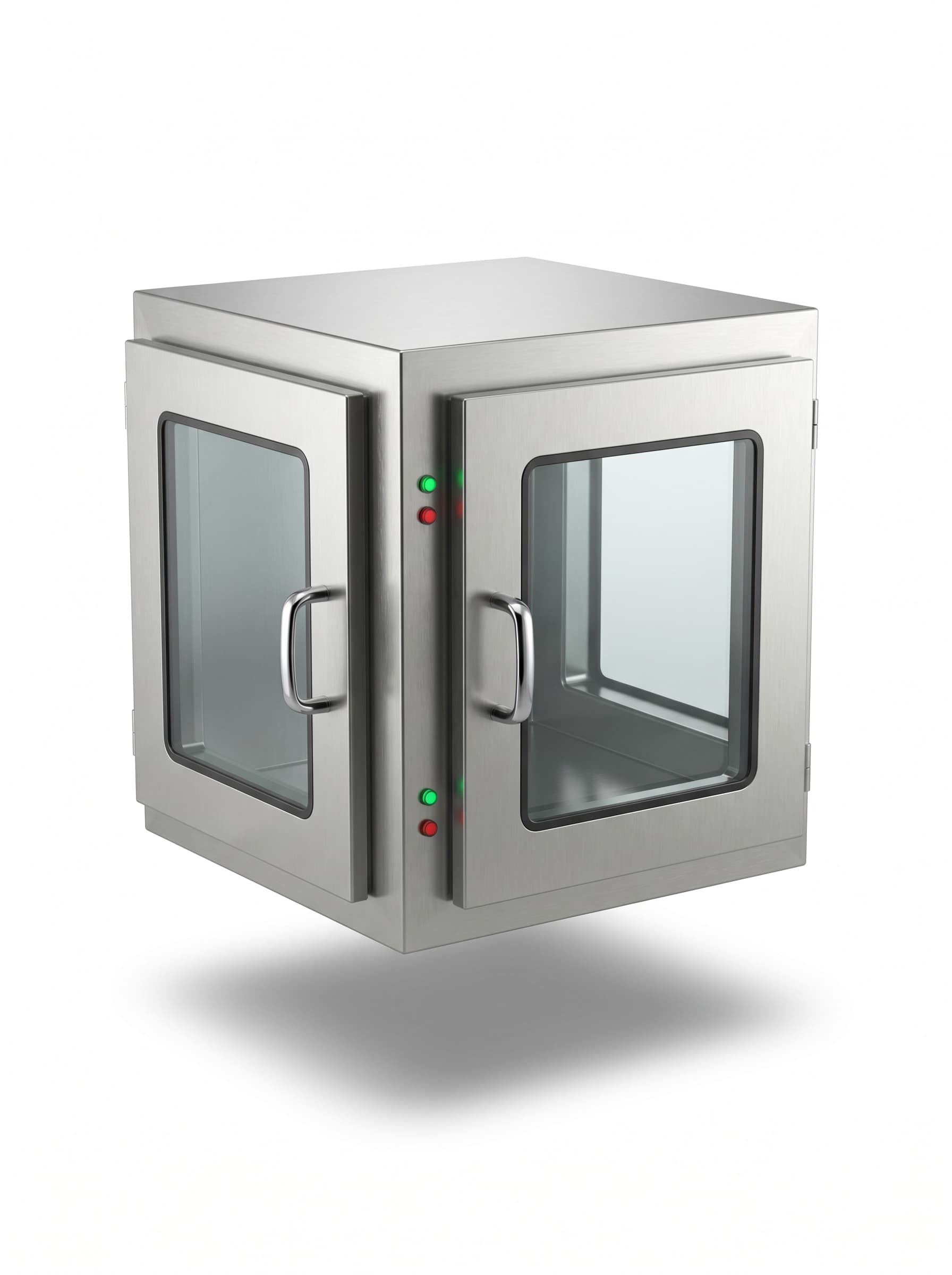
FIG. 01Pass box, stainless steel chamber with an interlocked door on each face.
What a pass box is
A pass box is a small chamber built into a cleanroom wall. It has a door on each face, and the two doors are interlocked so both can never open at once. One person sets the material inside. A colleague on the other side takes it out.
That is how components, tools and samples cross between areas of different cleanliness. Nobody carries them through. No clean door has to be opened onto a dirtier corridor.
The interlock is the whole idea: the clean room is never directly exposed to the less-clean one. What separates a real contamination-control device from a plain hatch is what happens to the air and the material surface while it waits inside. That is exactly what splits the pass box into three types.
- Doors
- One on each face, electromagnetically interlocked
- Body
- SS 304 as standard, SS 316 for aseptic or corrosive duty
- Chamber
- ISO Class 5 inside a dynamic or VHP box
Which pass box you need: start with the boundary
Pick a pass box by the cleanliness step the material is crossing, not by the label on it. There are three types. Each one answers a different version of the same question: how much cleaning does the material need on the way in?
Same grade on both sides
The material needs no treatment. It only has to cross without a person or an open door doing it. That is a static box.
Stepping up a grade
The material carries particles into the cleaner room. A dynamic box floods the chamber with HEPA-filtered air to sweep them off.
Into a sterile or aseptic area
Now the worry is living micro-organisms on the surface. A hydrogen-peroxide cycle kills them. That is a VHP box.
So this is not three competing products. It is three answers to one boundary question, and the call belongs to the design of the room's grade boundaries rather than to a catalogue. Here is the difference, exactly.
Static vs dynamic vs VHP pass box: the difference, exactly
All three share the same interlocked-door skeleton. What changes is what happens to the material while it waits inside.
Static
No air treatment
Isolates only, removes nothing
Dynamic
HEPA H13 / H14 downflow
Sweeps particles off the surface
VHP
HEPA downflow plus a VHP cycle
Particles and surface bioburden
- HEPA-filtered downflow
- Untreated chamber
FIG. 02The three pass box types in section. All three carry the same interlocked doors, the same coved stainless chamber and the same shelf. What separates them is what the chamber does to the material while it waits: nothing at all, a HEPA-filtered flush, or that flush plus a vapourised hydrogen-peroxide cycle admitted through a dock.
| What changes inside | Static pass box | Dynamic pass box | VHP pass box |
|---|---|---|---|
| Air treatment inside | None, a passive chamber | Its own HEPA-filtered airflow | HEPA airflow plus a vapourised hydrogen-peroxide (VHP) cycle |
| What it removes | Nothing, it isolates only | Airborne particles off the surface | Particles and surface micro-organisms (bioburden) |
| Boundary it bridges | Same grade on both sides | Different grades, stepping up | Into sterile or aseptic areas and isolators |
| Typical setting | Low-risk transfer inside a classified zone | Unclassified into classified, or Grade C to Grade B material flow | Grade A/B filling, cell and gene therapy, sterile transfers |
| Validation depth | Interlock and cleanability | Adds HEPA integrity (PAO/DOP) and airflow | Adds a validated VHP cycle, proven with biological indicators |
| Relative cost | Lowest | Mid | Highest |
FIG. 03The canonical comparison for the pass box family. Each type is covered in full on its own page.
None of them is better. Each answers a different contamination question. Each has a full page of its own.
How a pass box works
At its core a pass box is two interlocked doors and a sealed chamber. The interlock is the engineering that makes it a contamination-control device rather than a cupboard. One transfer runs through six states, and the two rooms are never joined in any of them.
- 01
Both doors closed and interlocked
At rest the chamber is sealed on both faces and the electromagnetic interlock holds both leaves. Neither room can reach the other, and the pressure boundary across the wall is unbroken.
- 02
Dirty-side door releases
The interlock frees the leaf on the less-clean face, and only that leaf. The clean-side door stays locked for the whole of the next three states, whatever anyone does to its handle.
- 03
Item placed in the chamber
An operator on the less-clean side puts the material in, on the shelf, and nothing has yet moved into the cleaner room. This is the load step, and it is the same on all three types.
- 04
Dirty-side door closes and relatches
The outer door shuts and the interlock takes it. Only now can the middle step run, and the middle step depends on the type: nothing in a static box, a HEPA-air flush in a dynamic box, a full hydrogen-peroxide cycle in a VHP box.
- 05
Clean-side door releases
With the outer face proven shut, the interlock frees the inner door. This is the only moment in the cycle when the cleaner room is open to the chamber, and by then the chamber has been treated.
- 06
Item removed on the clean side
A colleague lifts the material out into the cleaner area and closes the leaf behind it. The interlock relatches, the chamber is sealed again, and the cycle is back at state one.
FIG. 04One transfer, six states, looping. The two leaves are electromagnetically interlocked, so the sequence cannot skip a state and the cleaner room is never open to the corridor. At rest the drawing holds state 01: both leaves latched, both releases dark, material waiting in the sealed chamber.
- 01
Both doors closed and interlocked
At rest the chamber is sealed on both faces and the electromagnetic interlock holds both leaves. Neither room can reach the other, and the pressure boundary across the wall is unbroken.
- 02
Dirty-side door releases
The interlock frees the leaf on the less-clean face, and only that leaf. The clean-side door stays locked for the whole of the next three states, whatever anyone does to its handle.
- 03
Item placed in the chamber
An operator on the less-clean side puts the material in, on the shelf, and nothing has yet moved into the cleaner room. This is the load step, and it is the same on all three types.
- 04
Dirty-side door closes and relatches
The outer door shuts and the interlock takes it. Only now can the middle step run, and the middle step depends on the type: nothing in a static box, a HEPA-air flush in a dynamic box, a full hydrogen-peroxide cycle in a VHP box.
- 05
Clean-side door releases
With the outer face proven shut, the interlock frees the inner door. This is the only moment in the cycle when the cleaner room is open to the chamber, and by then the chamber has been treated.
- 06
Item removed on the clean side
A colleague lifts the material out into the cleaner area and closes the leaf behind it. The interlock relatches, the chamber is sealed again, and the cycle is back at state one.
What the interlock does not do
The HEPA-air flush of a dynamic box and the hydrogen-peroxide cycle of a VHP box are covered in full on their own pages. One thing the interlock itself does not do is hold the pressure balance between rooms. That pressure cascade is the job of the building HVAC. A pass box is specified to sit inside the cascade without breaking it, which is why it is sized to the rooms it joins.
The parts of a pass box
A pass box is the sum of a few parts. Some sit on every box. Others belong only to the dynamic and VHP types, and they are the parts that do the cleaning work.
Shared by every box
- Interlocked doorsElectromagnetically interlocked, so they can never open together. The most important contamination and safety feature on the box.
- Stainless-steel bodyCoved internal corners, so residue has nowhere to sit and the chamber cleans down properly.
- UV germicidal lampStandard, for line-of-sight disinfection of the empty chamber between transfers.
- Status lights and overrideThe interlock state is visible from both faces, and emergency release is controlled.
Only on a dynamic or VHP box
- HEPA filterSets how clean the air entering the chamber is.
- Pre-filter and blowerThe fan-filter unit that generates and conditions the airflow.
- Magnehelic gaugeReads filter loading, so it signals when a change is due.
- VHP dockOn a VHP box only. It connects to the suite's room or external VHP unit.
| Parameter | What it is | Fabtech standard |
|---|---|---|
| Construction | Body and work surface | SS 304 standard, SS 316 for aseptic or corrosive duty |
| Filter grade | Final HEPA on a dynamic or VHP box | H13 / H14 to EN 1822 |
| Chamber class | Particle class inside a dynamic or VHP box | ISO Class 5, matched to the destination grade |
| Interlock | Door-control logic | Electromagnetic |
| UV lamp | Disinfection of the empty chamber | Fitted as standard, limited line-of-sight only |
| Gauge | Filter-loading indicator, not a room-pressure gauge | Magnehelic, reads the HEPA filter's pressure drop |
| VHP dock | Connection for the bio-decontamination cycle | Built to connect to the suite's external or room VHP unit |
| Sizing | Opening and depth | 600 x 600 x 600 mm up to 900 x 900 x 900 mm, set by the largest item and the wall |
FIG. 05Standard specification across the pass box family. Size and finish are set per project.
The rule the device exists to enforce
Two doors. Never both at once. That is the whole device.
Everything else on a pass box, the HEPA flush, the hydrogen-peroxide cycle, the coved stainless body, is refinement layered on one rule the interlock enforces mechanically rather than procedurally.
- Types in the family
- 3
- Chamber class, dynamic and VHP
- ISO 5
- Final filter grade, EN 1822
- H13 / H14
Where pass boxes are used
Wherever a wall separates two cleanliness levels and material has to cross it, a pass box appears. These are the common settings.
Pharmaceutical and aseptic manufacturing
The most common use by a distance. Components, tools and samples move between gowning, prep and filling areas without anyone walking them through.
Biotech and containment labs
Material flow in and out of BSL-2 and BSL-3 suites, where the direction of the risk is reversed.
Electronics and precision manufacturing
Particle-controlled handling between assembly grades, where a single particle is a yield loss.
Hospitals
Sterile supply, transfer between operating-theatre zones, and sample pass-through to the labs that sit outside the theatre suite.
Radiology darkrooms are a different animal
The pass box in a dark room that people search for is a light-tight transfer hatch. It passes exposed film cassettes between the X-ray room and the processing darkroom without letting light in. Same interlocked-transfer idea, applied to light instead of air. It is unrelated to cleanroom HEPA pass boxes.
Each setting drives the choice of type, size and finish. That is why the box is specified with the room, not after it.
Standards and validation
A dynamic or VHP pass box is a piece of qualified equipment, not just a metal box. It lives inside a classified room and it governs how material crosses a grade boundary. So the rules that apply are the cleanroom and GMP rules.
Two standards set the frame. ISO 14644-1 defines the cleanliness grades the box sits between. EU-GMP Annex 1 governs how material moves between Grade A to D. India's Schedule M and WHO-GMP set the same expectations for Indian pharmaceutical manufacture. Regulators inspect against those rules, so what a manufacturer owes you is the evidence a room and its equipment hold their grade.
FIG. 06The pass box is fitted into one of these walls. The differential across each boundary, typically 10 to 15 Pa between adjacent grades, is held by the building HVAC, not by the box. The interlock's job is to make sure that differential is never short-circuited by two open doors.
Which box you need then follows the grade boundary being crossed. The chamber of a dynamic box is verified by particle count, to ISO Class 5.
Every box also carries a paper trail proving it does what it claims. A static box's file is the simplest: interlock function and cleanability. A dynamic box adds HEPA integrity testing and airflow checks. A VHP box adds a validated decontamination cycle, proven with biological indicators.
| The qualification file | What it proves | Applies to |
|---|---|---|
| DQ/IQ/OQ/PQ | Design, installation, operational and performance qualification of the unit | Every unit, simplest on a static box |
| Interlock and cleanability check | The doors never open together and the surfaces clean down | Every unit |
| HEPA integrity test (PAO/DOP) | The filter and its seal are leak-free | Dynamic and VHP |
| Chamber particle count | The chamber holds ISO Class 5 | Dynamic and VHP |
| Validated VHP cycle | A measured sporicidal log reduction, confirmed with biological indicators | VHP only |
FIG. 07Equipment validation and AMC are available for the unit.
A pass box is a transfer hatch inside a classified room. It does not discharge to atmosphere, so the exhaust and CPCB rules that govern a fume hood do not apply here. Any specific IS/BIS reference is confirmed per project. We anchor India compliance on the room context set out above.
How Fabtech approaches material transfer
Fabtech manufactures pass boxes in-house: static, dynamic and VHP. They go out as standalone products and inside turnkey cleanroom projects. So the box you get is one we build and engineer for the room it joins.
That answers the real worry at a transfer point. A pass box is never an afterthought here. The type, the interlock logic and the airflow are specified as part of the room's grade boundaries and pressure cascade. They line up with the cleanroom around them, rather than being bought to fit later.
Behind that sits Fabtech Cleanrooms. It is a cleanroom equipment manufacturer that has designed, built and validated controlled environments across India since 2004.
Proof of capability: Fabtech has delivered HEPA-filtered, classified cleanrooms for pharma and research clients across India. That is the contamination-control engineering a pass box is one element of.
Named pass-box project references are available on request.
Turnkey cleanroom solutions Cleanroom equipment we make Talk to an engineer about your transfer points
- Ajanta PharmaOSD facility, Aurangabad
- DesanoPharma cleanrooms, Bangalore
- PGICH NoidaBSL-3 containment
- ASMC ShahjahanpurBSL-3 containment
Pass boxes, common questions
A pass box is an interlocked transfer chamber built into a cleanroom wall. Material is placed in from one room and taken out in the other. The two doors can never open at once, so material crosses between cleanliness levels without a person carrying it through.
Transferring components, tools, samples and documents between cleanroom areas. It is used most in pharmaceutical and aseptic manufacturing, hospitals and labs. It keeps the cleaner area isolated from the less-clean one, and limits how often a clean door has to be opened.
Three common types. A static box is a passive interlocked chamber with no air treatment. A dynamic box adds its own HEPA-filtered airflow to strip particles off the material. A VHP box is a dynamic box that also runs a hydrogen-peroxide cycle to bio-decontaminate the surface.
A static box only isolates two areas of the same cleanliness. It does nothing to the material. A dynamic box adds HEPA-filtered airflow to strip particles off the surface, which is what you need when stepping up a grade.
In radiology, a dark room pass box is a light-tight transfer hatch. It passes exposed film cassettes between the X-ray room and the processing darkroom without letting light in. Same interlocked-transfer idea, applied to light instead of air. It is unrelated to cleanroom HEPA pass boxes.
Read the cleanliness boundary the material crosses. Same grade on both sides means a static box. Any step up in grade means a dynamic box. Into a sterile or aseptic area, or an isolator, means a VHP box. If a person must cross, that is an air shower.
Yes. Dynamic and VHP boxes are qualified in four documented stages. Their HEPA filters are integrity-tested as well. A VHP box also needs its decontamination cycle proven with biological indicators. A static box is qualified mainly on interlock function and cleanability, because it has no filter to test.
Flush into the wall between two areas of different cleanliness. Typically that is between a corridor or prep area and a classified suite, or at the boundary of a gowning room. Material then crosses without a person moving between the two zones.
Pricing depends on the type, static, dynamic or VHP, plus size, construction grade and validation scope. So it is quoted per requirement rather than as a list price. Tell us what you are transferring, and between which cleanliness grades, and we will quote it.
Tell us about your transfer points
Send us the grade on each side of the wall, what has to cross it and how often. Our engineers come back with a specified box, not a catalogue page.