

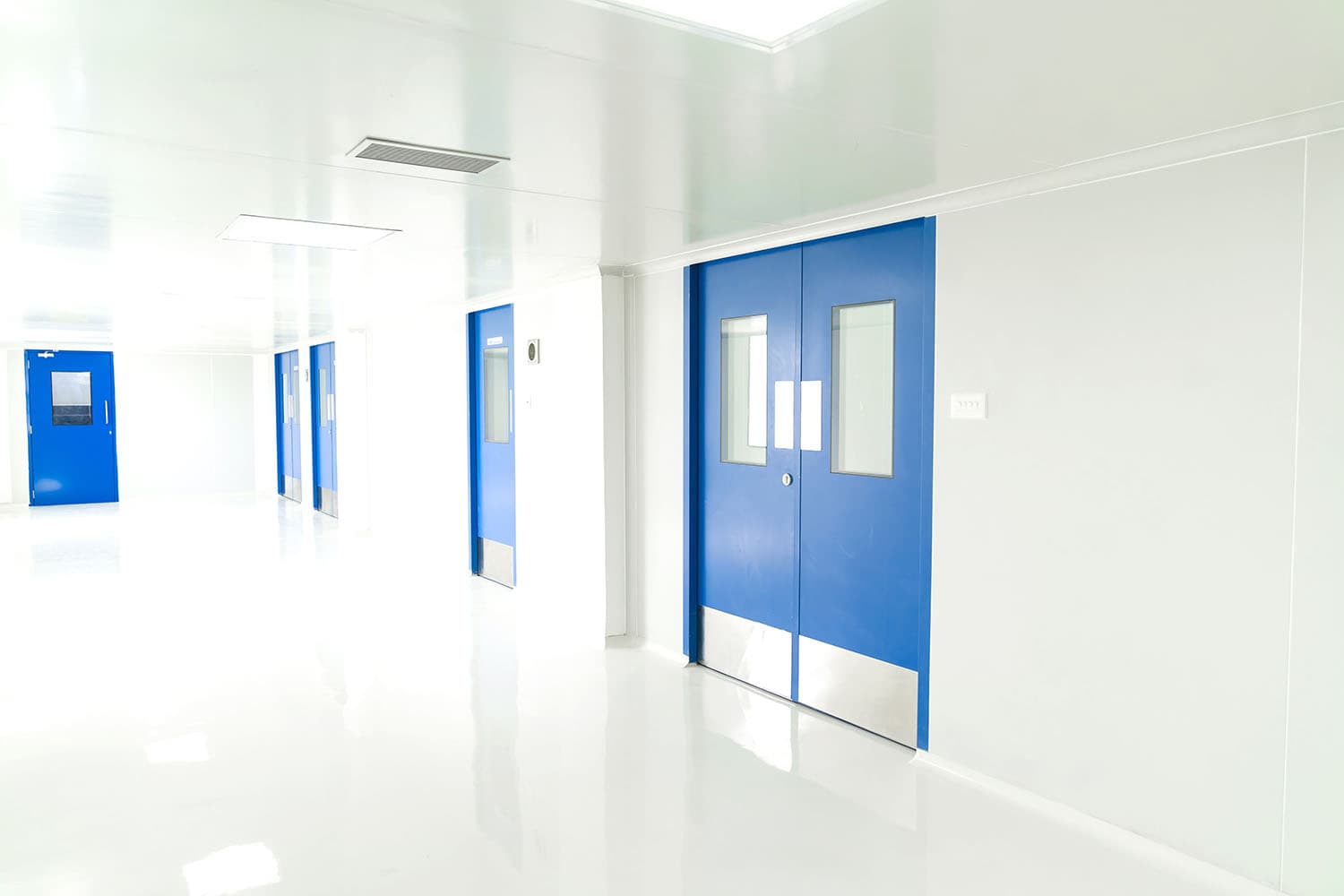
The box for when the grade goes up
Dynamic Pass Box
A dynamic pass box is an interlocked transfer chamber with its own HEPA-filtered air, so particles come off the material before the inner door opens. The moment material moves into a cleaner area, isolation is not enough. Fabtech builds this box in-house for exactly that boundary.
- HEPA H13 / H14
- Unidirectional, ISO Class 5 design
- Electromagnetic interlock
- SS 304 / SS 316
What a dynamic pass box is
A dynamic pass box is an interlocked transfer chamber with its own HEPA-filtered air supply. While the material waits inside, clean air sweeps across it and carries surface particles away before the inner door will open.
That airflow is why you specify it when the two sides of the wall sit at different cleanliness grades. It removes the particles the material would otherwise carry across the boundary. A passive hatch would simply move them along with the load.
We've built and validated more than 2,000 controlled environments since 2004, across every industry that needs controlled air. The equipment is made in our own facility, and one accountable team stands behind it. So a pass box like this is engineered for the room it joins.
The name, decoded
The “dynamic” is the airflow.
Where a passive box only isolates, this one turns the chamber into a small, active clean zone.
How a dynamic pass box works
The dynamic pass box working principle is one job done well: clear the particles off the material before it crosses. The sequence:
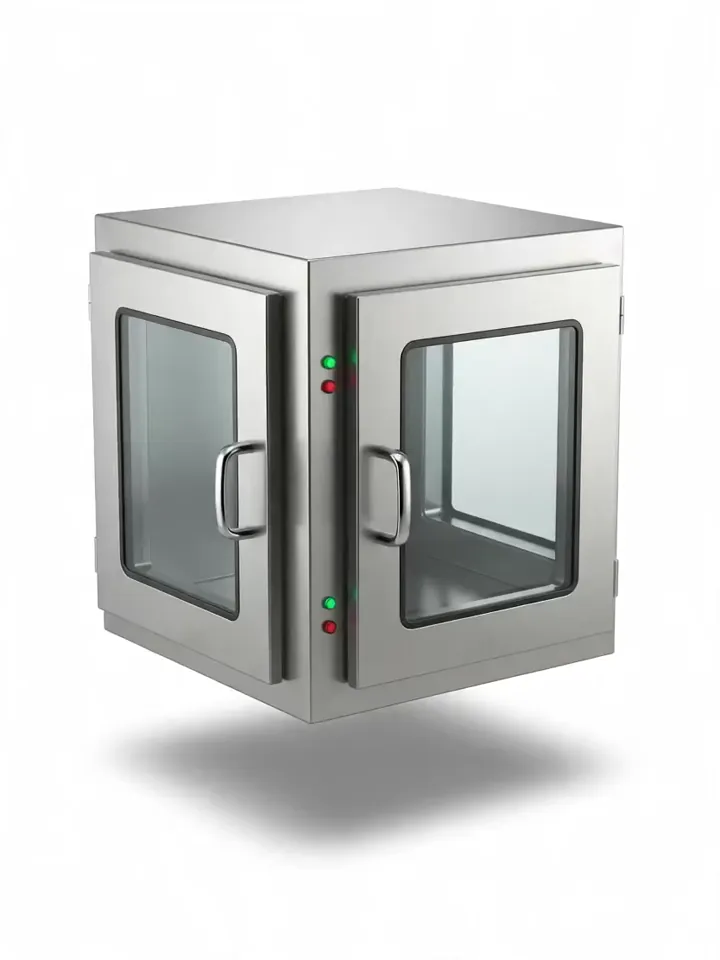
FIG. 01Dynamic pass box, illustrative render. The step in view drives the model.
- 1
Load and close
An operator on the less-clean side places the material inside and closes the outer door. The electromagnetic interlock locks the inner door at once. The two doors can never be open together.
- 2
HEPA flush
A blower or fan-filter unit pulls air through a pre-filter, then through the main HEPA filter. That clean air floods the chamber. It lifts particles off the material's surface and carries them out of the box.
- 3
Flush time
The flush runs for a set, timed and indicated period before the inner door will release. The unit fixes that period, long enough to clear the particle load. It is never left to the operator's eye.
- 4
Release and remove
When the flush completes, the interlock releases the inner door. A colleague removes the material into the clean area.
The interlock logic itself, six states shared by every box in the family, is drawn state by state on the pass box overview. Pass box overview
Why it exists
Step two is the whole difference from a static box.
It is why a dynamic box, not a static one, is specified wherever the material steps up a cleanliness grade.
- Captures at least 99.95% at MPPS, EN 1822
- H13
- Captures at least 99.995% at MPPS, EN 1822
- H14
- Chamber airflow design target, ISO 14644-1
- ISO 5
Two things that decide whether a dynamic box performs
A dynamic box looks simple on paper. Two details decide whether it actually does the job.
Truly laminar, or a HEPA flush?
A “laminar” label and a HEPA flush are not the same thing. Many boxes sold as “dynamic” only deliver a flush. Filtered air floods the chamber and turns over many times. That clears particles, but it is not a single, even sheet of air.
True full-face unidirectional airflow, often loosely called “laminar”, is a higher specification. It is the one Fabtech builds to. Our standard dynamic box delivers unidirectional airflow designed to ISO Class 5 inside the chamber. So the honest question to ask any supplier is simple: which one am I buying? The two are not interchangeable.
- 01Outer doorClosed. The electromagnetic interlock holds the inner door.
- 02HEPA flushTimed and indicated. It runs to completion, never to an operator's eye.
- 03Inner doorReleases only when the flush completes. The load crosses clean.
Unidirectional flow moves in one direction at a steady velocity, so particles lifted off the load are carried to the return in a single pass instead of circulating back over it. Inside a pass box chamber the sheet passes the shelf and the load on it, and any surface the air has to part around is a cleaning point rather than protected space.
- HEPA-filtered supply
- Surface particle load, out
FIG. 02The airflow principle the chamber is built to, drawn at room scale so the sheet reads. HEPA-filtered air enters full-face from above, passes the load in one direction at a nominal 0.45 m/s, and leaves through the low level return carrying the surface particle load with it. Inside a 600 to 900 mm pass box the same sheet passes the shelf rather than a bench, and any surface the air has to part around is a cleaning point rather than protected space. In a Fabtech unit this is unidirectional airflow designed to ISO Class 5, not a loose turbulent flush.
FIG. 03The magnehelic gauge is plumbed across the HEPA filter, so its needle is a change-the-filter signal. The room-to-room cascade is held by the building HVAC and never appears on this dial.
The gauge on the front
The magnehelic gauge reads the filter, not the room. The gauge on the front shows the HEPA filter's loading: the pressure drop across it. It tells you when the filter is clogging and due for change. It does not show the room-to-room pressure difference.
That difference, the pressure cascade, is held by the building HVAC. And the real design risk is the opposite of what people expect. A dynamic box specified or installed wrong can disturb that cascade. A cleaner room can briefly go negative as the inner door opens. A box sized to the rooms it joins avoids this.
Components of a dynamic pass box
Eight parts, one job: deliver clean air onto the load and guarantee the two doors never open together.
| Component | Role |
|---|---|
| Electromagnetically interlocked doors | Prevent both doors opening together, the core contamination and safety feature |
| HEPA filter (H13/H14) | Delivers the clean, HEPA-filtered air into the chamber |
| Pre-filter | Catches coarse dust, protecting the HEPA and extending its life |
| Blower / fan-filter unit (FFU) | Generates and balances the unidirectional airflow as the filter loads |
| Magnehelic gauge | Shows the HEPA filter's loading (its pressure drop), the change-out signal, not room pressure |
| Stainless-steel body (SS 304 / SS 316) | Cleanable, corrosion-resistant; coved corners (SS 304 standard, SS 316 for aseptic/corrosive duty) |
| UV germicidal lamp (fitted as standard) | Limited line-of-sight surface disinfection of the empty chamber |
| Interlock indicators | Status lights showing which door may open |
FIG. 04The eight components and the role each one plays. Filter grade, body grade and size are specified with the room the box joins.
Standard sizes run from 600 × 600 × 600 mm up to 900 × 900 × 900 mm. The biggest item you transfer, and the wall the box sits in, set the size.
Both HEPA grades are classified under EN 1822 and rated at the most-penetrating particle size, MPPS, the hardest particle for any filter to catch.
Dynamic or static: the short answer
Stepping up a cleanliness grade? You need a dynamic box.
If both sides already sit at the same grade, a static box does the job for less.
- The full side-by-side comparison, including VHP, is set out in the static vs dynamic vs VHP comparison.
- The passive case is covered on the static pass box page.
- Step further still, into a sterile or aseptic area, and the answer becomes a VHP pass box.
Where dynamic pass boxes are used
A dynamic box sits at a boundary where material moves from a less-clean to a cleaner area.
Pharmaceutical & aseptic manufacturing
Component, tooling and sample transfer between gowning, prep and filling zones.
Biotech & containment labs
Moving material into higher-grade suites without carrying the corridor in with it.
Hospital sterile supply
Transfer into clean storage and theatre zones, where every crossing is a risk to manage.
Electronics & precision assembly
Where particle control across grades matters as much as it does in pharma.
Wherever a static box would simply carry the contamination across with the material, a dynamic box is the correct specification.
Standards and validation
A dynamic pass box is written against, and qualified to, the standards of the cleanroom it serves.
- 01ISO 14644-1The chamber's clean zone is verified by particle count. Fabtech's standard unit is designed to ISO Class 5, and the target is confirmed against the destination grade.ISO classification of cleanrooms
- 02EU-GMP Annex 1, Grade A/B/C/DThis governs the material transfer the box performs between grades.
- 03Schedule M and WHO-GMPIndia's Schedule M and WHO-GMP apply the same expectations to Indian pharmaceutical manufacture.
- 04DQ/IQ/OQ/PQEach unit is proven with the four-stage qualification file: design, installation, operation, performance. The HEPA filter itself passes an integrity test. That test is the PAO/DOP challenge, repeated after each filter change. Airflow velocity and recovery are measured and re-checked on the same schedule. Equipment validation and AMC are available for the unit.Cleanroom validation and qualification
- 05What does not applyA pass box is a transfer hatch inside a classified room, with no discharge to atmosphere. So fume-hood exhaust and CPCB rules do not apply.
How Fabtech approaches dynamic transfer
Want to see one in place before you commit? A named dynamic-pass-box project reference is available on request. Just ask, and we'll walk you through it.
We build our dynamic pass boxes ourselves, and we size each one to the room it will join. Airflow, flush time and interlock logic are set to match the cleanroom around it, not bought to fit afterwards. A dynamic box sits on the room's grade boundaries and its pressure cascade. That fit is the whole point, not a detail.
Fabtech Cleanrooms is a cleanroom equipment manufacturer. It designs, builds and validates controlled environments across India, and airflow design is the core of that work. It manufactures dynamic pass boxes in-house, supplied both as standalone products and integrated within turnkey cleanroom projects.
Fabtech has delivered HEPA-filtered, classified cleanrooms for pharma and research clients across India. That is the airflow and contamination-control engineering a dynamic box depends on.
- Ajanta PharmaOSD facility, Aurangabad
- DesanoPharma cleanrooms, Bangalore
- PGICH NoidaBSL-3 facility
- ASMC ShahjahanpurBSL-3 facility
Frequently asked questions
A dynamic pass box is an interlocked transfer chamber with its own HEPA-filtered airflow. It moves material between areas of different cleanliness. Clean air sweeps particles off the surface before the inner door opens. That is why it is the box specified when stepping up a grade.
Doors with an electromagnetic interlock, a HEPA filter fed by a pre-filter, and a blower or fan-filter unit. Plus a magnehelic gauge that reads the filter's loading, a stainless-steel body (SS 304/316), a UV lamp fitted as standard, and interlock status indicators.
To transfer material into a cleaner area without carrying particles in. Its HEPA-filtered airflow cleans the material's surface. And the box is specified so it does not break the cleanroom's room-to-room pressure cascade.
Load the material and the interlock locks the inner door. A blower pushes air through a HEPA filter, flushing the chamber and lifting particles off the material. The flush runs for a set, indicated time. Then the inner door releases and the material passes into the clean area.
A static box passively isolates two areas of the same cleanliness. A dynamic box adds HEPA-filtered airflow to strip particles off the material when moving between different grades.
Grade H13 or H14. An H13 filter captures at least 99.95% of particles at the most-penetrating particle size. An H14 captures at least 99.995%. Fabtech supplies both grades.
Through the standard four-stage qualification file, from design review to performance testing. The HEPA filter passes a physical integrity test. That test is the PAO/DOP challenge. Airflow velocity and recovery are measured as well. The checks repeat periodically and after every filter change.
Tell us the two grades your box has to bridge
We'll size it so it holds the room's pressure cascade. Send the grade on each side of the wall, what has to cross and how often, and an engineer comes back with a specified unit, not a catalogue page.