

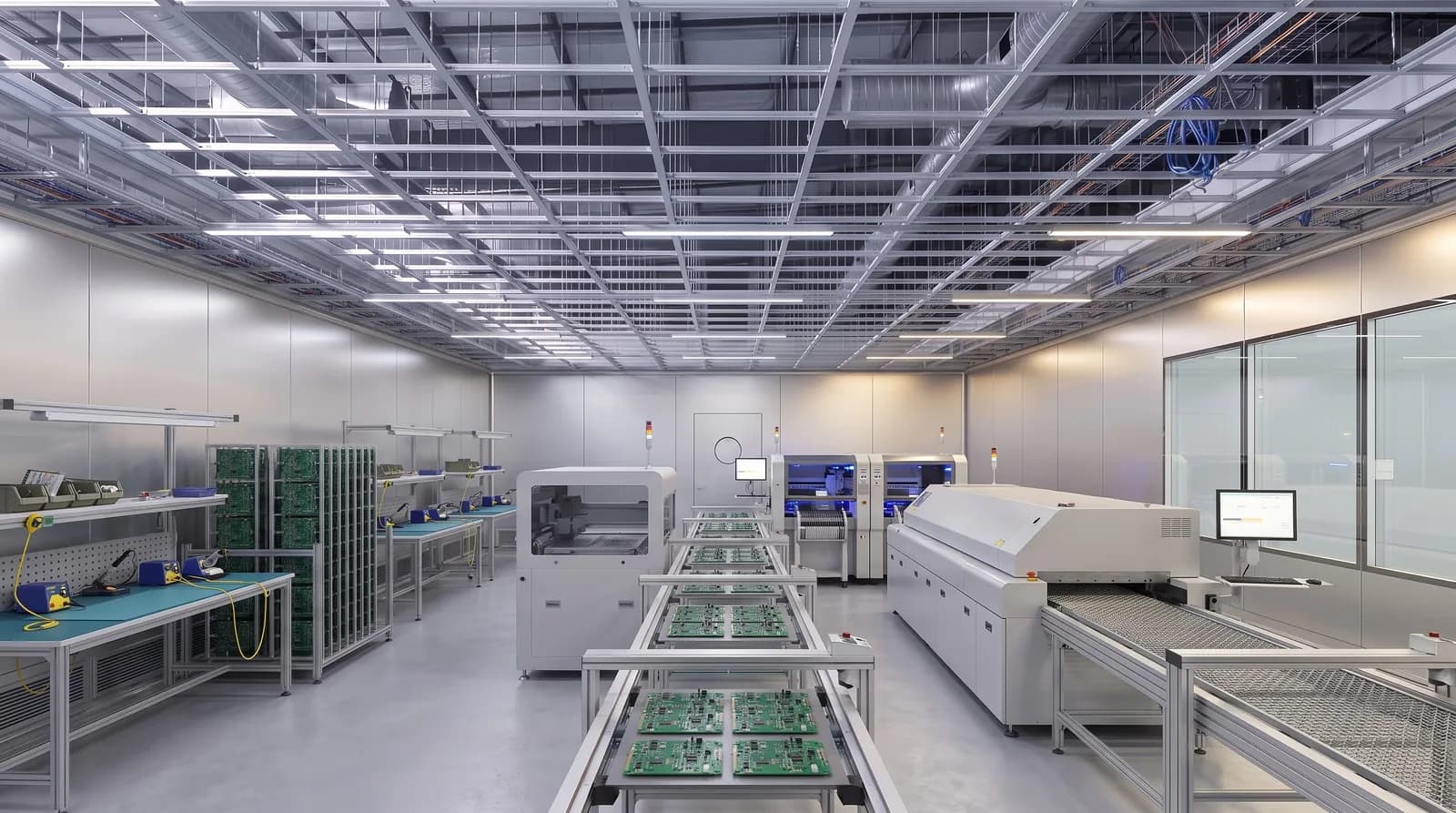
Electronics cleanroom manufacturer
Electronics cleanrooms for India's PCB, assembly and battery lines
Fabtech Cleanrooms is the Indian manufacturer behind electronics cleanrooms for PCB and SMT lines, assembly floors, and EV and lithium-ion battery dry rooms. A static spark or a stray particle rarely shows up at test. It comes back months later as a field failure, and we build the rooms that stop that happening. Since 2004 we have delivered more than 2,000 controlled environments across every industry that needs controlled air.
- ISO Class 6 to 8
- ESD-protected areas (EPA)
- Dry-room capability for battery lines
- HEPA on fan-filter-unit ceilings
- Manufactured in our own facility
The room an electronics line needs
An electronics cleanroom is a particle- and static-controlled space. Circuit boards, components, connectors and battery cells are assembled inside it. Most sit at ISO 14644-1 Class 6 to 8, with electrostatic-discharge (ESD) protection. That pairing stops the contamination and the static charge that cause latent failures. For lithium-battery work the room goes further and becomes a dry room, held at a very low dew point.
- ISO 14644-1
- ISO Class 6 to 8
- ESD / EPA
- HEPA H13 and H14
- Dew point
- ACPH
Either name, one job
Call it an electronics cleanroom or a clean room for electronic industry work. Either way it has one job. It keeps the particles and the static away from the line, and both of those quietly wreck a board or a cell.
At a glance
What the room is asked to hold
- Particle class
- ISO 14644-1 Class 6 to 8, set by the process
- Static control
- ESD-protected area (EPA): dissipative flooring, grounding, ionisation
- Humidity
- Controlled relative-humidity band, dry room for lithium cell work
- Air change rate
- ACPH sized to the class and to the operation
In electronics, contamination is latent failure
The damage a particle or a static discharge does is usually invisible at the moment it happens. The board passes test. It ships. Then it fails in a customer's hands weeks or months later.
That failure arrives as a warranty return, a recall, or a battery that loses capacity early. Cleanrooms for electronic manufacturing exist to stop you building those failures in. For battery cells the margin is thinner still. Moisture is the enemy. A room that is not dry quietly wrecks cell chemistry and safety.
Latent
The defect that passes test and comes back as a field failure
We engineer to three targets at once, and each one pulls on the other two.
- 01 Particle classISO 14644-1 Class 6 to 8, chosen for how sensitive the components and the assembly steps are. HEPA-filtered air from fan-filter-unit ceilings is what holds it.
- 02 The ESD regimeAn ESD-protected area, or EPA, with dissipative flooring and grounding, covering operators, benches and line equipment end to end.
- 03 The humidity bandRelative humidity held so static stays in a safe range. Lithium-ion cell manufacturing adds a dry room at a very low dew point on top of that.
Get one of the three wrong and the latent-defect rate climbs. Get all three right and the line builds the same way, shift after shift.
Classification and standards for an electronics cleanroom
The process and the product set the target. We engineer the room to it, not the other way round.
The reason a class is specified at all is a size coincidence. A glove fibre, a skin flake and a grain of solder paste powder are the same size as a wire-bond pad pitch or an 01005 component, and none of them is visible at the bench.
FIG. 01What is in the air of an electronics room, against what is on the board, on one logarithmic diameter scale. The two groups overlap between roughly 15 and 200 micrometres: a glove fibre, a skin flake and a grain of solder paste powder are the same size as a wire-bond pad pitch, an 01005 chip component or a fine-pitch lead. That coincidence is why the room is classified. ISO 14644-1 counts from 0.5 micrometres, well below the roughly 50 micrometre limit of unaided vision, and the tinted band at the left is MPPS, the most penetrating particle size between 0.1 and 0.3 micrometres, where EN 1822 sets a filter's rating: HEPA H13 at 99.95 percent and H14 at 99.995 percent.
| ISO 14644-1 class | Typical electronics useTHIS PAGE | Core controls |
|---|---|---|
| ISO 6 | Sensitive component and sub-assembly work, microelectronics packaging | HEPA H14, ESD floor, tight relative humidity |
| ISO 7 | Mainstream electronics and battery assembly, test | HEPA H13 or H14, ESD floor, ACPH sized to the class |
| ISO 8 | General assembly, inspection, packaging | HEPA, ESD control, controlled relative humidity |
| Dry roomultra-low dew point, about 1 percent RH or lower | Lithium-ion and battery cell assembly | Ultra-low dew point, plus the ISO class, plus the ESD regime |
FIG. 02Classes per ISO 14644-1. Legacy Class 100, 1,000 and 10,000 map onto these classes; Federal Standard 209E was superseded in 2001.
Most electronics and battery assembly needs a clean room with strict static control. Lithium battery cell work adds a room kept bone-dry on top of that.
One footnote on older paperwork. Legacy Class 100, 1,000 and 10,000 ratings map onto these ISO classes. Federal Standard 209E was superseded by ISO 14644 in 2001, so we simply translate an older spec into the current one.
Every class, side by side
The full ISO 14644-1 table, the EU-GMP grades beside it and the legacy Class 100 mapping live on one reference page.
ESD control and the battery dry room
This is the part a generic cleanroom build gets wrong. On an electronics line, clean air is not enough. The room also has to stop static. On a battery line it has to stay bone-dry as well.
Static you cannot see or feel can still punch a hole through a chip. A few percent of humidity that feels fine to a person can ruin a lithium cell.
So the room is engineered around two things a pharma or food cleanroom never has to think about. It has to discharge static safely. And it has to pull almost all the moisture out of the air.
Two levers
Charge and moisture, the pair no other sector page has to set together
The two levers, side by side.
| Lever | What it does | Engineering detail |
|---|---|---|
| ESD / EPAelectrostatic-discharge control | Bleeds charge away before it reaches a component | The whole room is built as an ESD-protected area. Dissipative epoxy or PU flooring bonded to a grounding grid. Grounded and antistatic work surfaces and seating. Wrist-strap and footwear-grounding points. Air ionisation where charge can build on insulators. Relative humidity held in a band that keeps static generation low. |
| The battery dry roomEV and lithium-ion | Takes out the moisture a normal cleanroom still carries | Deep dehumidification layered on top of the particle class. Dew point pulled down to the value cell chemistry needs, commonly well below minus 40 degrees Celsius, which is about 1 percent relative humidity. The room still holds its ISO class and its ESD regime. |
FIG. 03
Dry-room design for lithium cell and pack work is scoped per project, and the dew point we design to is confirmed against the cell chemistry before anything is built.
Why humidity and ESD are set together
Humidity and static are linked, which is why those two levers are set together. ESD performance depends directly on humidity.
Drying the room is how a lithium line protects its cells. It is also how an electronics line gives up its cheapest static control. Both of those are true at the same time, on the same axis, and that is the whole reason the air system and the ESD strategy are designed as one job rather than as two specifications.
How to read FIG. 04
The horizontal axis is relative humidity, with the matching dew point beneath it, running from ordinary conditioned air on the left down to battery dry-room conditions on the right. The vertical axis is the time a charge takes to bleed away from a surface. As the air dries, that time climbs. It climbs gently at first, then bends sharply once there is too little moisture left on surfaces to carry charge away, and it never comes back down.
FIG. 04Electrostatic charge decay time against relative humidity and dew point, from ordinary conditioned air down to battery dry-room conditions. The four operating windows are the processes an electronics room is asked to hold. The conflict zone is the band where the dry-room requirement and reliable charge decay cannot both be met by air, and the room has to solve it with ionisation, grounding and materials discipline instead. Axis values are physical air conditions, not a Fabtech specification, and decay also depends on materials and grounding; project targets are set per process.
Four operating windows sit on that curve, and each one is a real process asking the room for something different. The moment a window crosses the decay limit a specification normally sets, air has stopped being the tool that solves static, and everything else in the room has to take over.
General electronics assembly
- Humidity band
- About 60 down to 35 percent relative humidity
- Dew point
- Dew point about plus 14 down to plus 6 degrees Celsius
- Charge decay
- Charge decay under 0.3 seconds
Comfortable conditioned air. Adsorbed moisture on surfaces is doing most of the static work for free, and the room only has to keep it there.
ESD charge decay still reliable
- Humidity band
- About 35 down to 20 percent relative humidity
- Dew point
- Dew point about plus 6 down to minus 2 degrees Celsius
- Charge decay
- Charge decay still inside a typical 2 second limit
The normal working band for an ESD-protected area. Dissipative flooring, grounding and antistatic surfaces carry it, and the humidity band is the safety margin underneath them.
Moisture-sensitive device storage
- Humidity band
- About 20 down to 5 percent relative humidity
- Dew point
- Dew point about minus 2 down to minus 19 degrees Celsius
- Charge decay
- Charge decay of tens of seconds
Dry enough for moisture-sensitive parts and dry storage cabinets before reflow. Decay time has already passed the point where air is any help, so ionisation starts carrying the load.
Lithium cell assembly, dry room
- Humidity band
- About 5 percent relative humidity down to 1 percent and below
- Dew point
- Dew point commonly well below minus 40 degrees Celsius
- Charge decay
- Charge decay measured in minutes
Cell chemistry sets this, not comfort, and there is no negotiating it. Static now has to be controlled by everything in the room except the air.
The conflict zone
From the point the curve crosses that limit, all the way down to dry-room conditions, the dry-room requirement and the reliable-decay requirement cannot both be satisfied by air. Drying the room further protects the cells and makes the static problem worse in the same breath. There is no humidity setting that solves both, so the room stops trying to solve it with air.
What resolves it is ionisation sized to the charge the process actually generates, a grounding grid that reaches every surface an operator or a cell touches, and materials discipline on flooring, seating, trolleys, packaging and gloves. Those are chosen for the dry end of the axis, not for the comfortable end, which is a different specification from the one a general assembly room is built to.
So the air system and the ESD strategy are designed as one. They are then proven by ESD verification of the floor and the surfaces, wherever that control is specified.
What a clean room for electronics assembly must deliver
Five promises, and the engineering that holds each one.
- 01
ESD control everywhere
A static event during handling leaves an injury nobody can see at the bench. So the whole assembly area is built to bleed charge away safely.
- 02
Particle class matched to the product
The cleaner the room, the fewer latent defects ship.
- 03
Humidity and dry-room control
Moisture governs static. It also ruins lithium cells.
- 04
Stable conditions for repeatable assembly
The line has to behave the same way all shift, every shift.
- 05
A cleanable, durable, ESD-rated build
Surfaces that survive a real production floor and still stay clean.
And the engineering behind each promise.
FIG. 05, below
| Promise | Engineering detailTHIS PAGE |
|---|---|
| ESD control | An ESD-protected area (EPA): dissipative flooring, grounding grid, antistatic surfaces, ionisation and a controlled humidity band, covering operators, benches and line equipment end to end |
| Particle class | ISO Class 6 to 8 per ISO 14644-1, HEPA H13 or H14 air, fan-filter-unit coverage and ACPH sized to the operation |
| Humidity and dry room | Tight relative-humidity control across the room, plus a low dew point dry room for lithium-ion cell assembly |
| Stable conditions | Controlled temperature and relative humidity, stable ACPH, and a maintained pressure cascade against the dirtier spaces around it |
| Cleanable build | Modular wall and ceiling panels manufactured in-house, seamless ESD flooring, flush detailing and wide clear spans for line equipment |
FIG. 05
HVAC, humidity and ESD for the electronic industry
On an electronics or battery line the air system is doing three jobs at once. It keeps particles out. It holds humidity in a tight band, so static stays controlled and battery cells stay dry. And it keeps conditions steady through every shift.
Clean, dry and stable together. That is what a purpose-built electronics air system delivers, and what a comfort air-conditioning system never can.
The HVAC for an electronics clean room pairs HEPA-filtered air-change rates with precise temperature and humidity control. Those rates are sized to the ISO class. A battery dry room adds deep dehumidification, down to a low dew point.
Two jobs, two sets of equipment. HEPA filtration takes out the particulates and dehumidification takes out the moisture. Carbon filtration is a fume-hood control for solvent vapour, and these rooms control particles and moisture instead.
Because ESD performance is tied to humidity, the air system and the ESD strategy are engineered as one. They are then proven together in validation.
A dry room is an air-handling problem
Air-handling units and fan filter units are both built in our own facility, alongside the HEPA terminal housings that carry the filters into the ceiling. So when a battery line asks for deep dehumidification on top of an ISO class, the plant and the ceiling that have to agree with each other are designed and made by the same engineering team.
For the equipment-level detail, our cleanroom HVAC overview walks through the air-handling unit (AHU) and the make-up air unit (MAU). It also covers FFU grids, filter stages and pressure control.
- The ISO 14644-1 class band for electronics
- ISO 6 to 8
- HEPA grades: 99.95 and 99.995 percent at MPPS, per EN 1822
- H13 / H14
- The whole assembly floor as one ESD-protected area
- EPA
- Dryness order for a lithium cell dry room
- 1% RH
Electronics applications we engineer for
Electronics is not one process. It is dozens. Each one draws its own line on how clean, how dry and how static-free the air around it has to be. Here is the range we scope rooms for.
Grouped by
The nine applications below are tagged by the part of an electronics operation they belong to.
- Assembly
- Board level
- Battery
- Packaging
- Devices
- Test
- Entry
ESD-protected assembly floors
The general clean room electronics assembly floor, built ESD-safe end to end as one protected area rather than as a set of static-safe benches.
PCB and SMT assembly
Printed-circuit-board (PCB) cleanrooms wrapped around the placement and reflow line.
Connector, cable and sub-assembly
Component and interconnect manufacturing where handling, not process chemistry, sets the class.
EV and lithium-ion cell manufacturing
Cell manufacturing and assembly inside a dry room, with the ISO class and the ESD regime held alongside it.
Battery pack and module assembly
Pack and module lines that need stable conditions and a static-safe floor without full cell-room dryness.
Microelectronics packaging
Cleanroom packaging for die-attach, wire-bond and encapsulation steps at a tighter class.
Sensor, camera-module and medical electronics
Optical and medical-electronics assembly where a single particle is a cosmetic and a functional defect at once.
Electronics test, burn-in and metrology
Stable, clean, ESD-safe conditions for measurement and reliability work, where drift in the room reads as drift in the data and a static event at handling reads as a failed part.
Gowning and air-shower entry
The gowning rooms and air-shower entries that protect the class on the way in to an assembly, packaging or battery floor.
Each operation carries its own particle class, ESD regime and humidity target. We scope the room to the process, not to a catalogue. Wafer-level and semiconductor-fab back-end rooms run at ISO Class 3 to 7 with their own controls, so they sit on their own page rather than in this list.
How we deliver
One team, one line of accountability. Five stages on the axis, tuned for an electronics cleanroom design, and a handover at the end.
Requirements and class target
We capture the process, the user requirement specification (URS) and the floor area, then set the ISO class, the ESD requirement and the humidity or dry-room target.
Design and DQ
Airflow, the ESD strategy and the humidity or dry-room design are all qualified on paper, before anything is built.
Manufacture and factory testing
Panels, FFU grids, doors and equipment are built and tested in our own facility. FAT covers equipment only.
Installation and IQ
The room is assembled and installation-qualified on site, against the design that was already signed off.
Commissioning, OQ and PQ
We test HEPA integrity, airflow uniformity and recovery. We map pressures, verify humidity, verify ESD performance and certify the particle count to ISO 14644-1.
FIG. 06The five build stages an electronics cleanroom runs through, from the class target to performance qualification. Handover closes it.
Stage 06
Handover
As-builts, the validation dossier and the equipment AMC. Ongoing facility maintenance stays with your team.
One team owns the class target, the ESD strategy, the humidity design, the manufacture and the paperwork, so nothing falls between two suppliers at the point it matters. See the full delivery process
Validation, documentation and compliance
We don't ask you to take the class on trust. Every room we hand over is tested and written up first. Your quality and process teams get proof that the room performs, not just a space that looks finished.
Four stages carry that proof. Design qualification (DQ) locks the engineering. Installation qualification (IQ) verifies what was built. Operational qualification (OQ) proves the systems run as designed. Performance qualification (PQ) proves the room performs in use.
And here is what actually gets tested on the day.
What you take away
The documentation is packaged for your quality and process-engineering teams to inspect and own.
| Test on the day | What it provesTHIS PAGE |
|---|---|
| HEPA filter integrity (PAO/DOP) | No leak through or around a terminal filter |
| Airflow velocity and uniformity | The ceiling delivers even, stable flow |
| Recovery time | The room returns to class quickly after a disturbance |
| Pressure mapping | Room-to-room pressure relationships hold as designed |
| Humidity and dew-point verification | The humidity band, and the dry room, hold their targets |
| Particle-count certification to ISO 14644-1/-2/-3 | The room meets its class on the meter, not just on paper |
| ESD verification of flooring and surfaces | Static control performs where that control is specified |
FIG. 07
Why Fabtech for an electronics cleanroom
You are dealing with one accountable engineering team at an electronics cleanroom manufacturer.
That gives you electronics manufacturing cleanroom solutions in India from one accountable source, from the panels on the wall to the particle count on the day.
What holds it up
ESD and humidity control are engineered in, not bolted on. That includes the low dew point dry-room design behind lithium-battery work. The room and the equipment are built in our own facility. Delivery is validated and documented to ISO 14644.
Electronics cleanrooms, common questions
Most electronics work runs in an ISO 14644-1 Class 6 to 8 cleanroom with strong ESD control. The exact class follows how sensitive the components and the assembly steps are. Microelectronics packaging may need ISO 6. General assembly and packaging sit at ISO 7 or 8.
Four things, all proven before handover. Particle control to an ISO 14644-1 class. An ESD-protected area, with dissipative flooring, grounding and antistatic surfaces. Controlled temperature and relative humidity. And HEPA-filtered air at an air-change rate sized to the class.
A particle- and static-controlled room built around a printed-circuit-board line. It holds its ISO class to keep contamination off the boards. It runs as an ESD-protected area, so static does not damage components during placement, reflow and handling.
Yes. Li-ion cell and pack work needs ESD control plus a humidity-controlled dry room at a very low dew point. We design and build that room to the process. It keeps its ISO class and ESD regime while staying dry. The dry-room dew-point scope is confirmed per project on request.
Humidity governs static. Too dry and charge builds. Too damp and other problems appear. So it is held in a controlled band, as part of ESD control. For lithium cells, moisture damages the chemistry directly, so a dry room drives the dew point far down and verifies it.
An EPA is a zone engineered so static charge cannot damage electronics. It uses dissipative flooring bonded to ground, grounded and antistatic surfaces, wrist-strap and footwear grounding, and air ionisation where needed. A controlled humidity band completes it. ESD testing verifies the lot.
Yes. Microelectronics packaging covers die-attach, wire-bond and encapsulation. It usually runs at a tighter ISO class with full ESD control. We design, build and validate that room, then prove the class on test day.
Because particles and static cause latent defects. Those defects pass test and then fail later, in the field. A clean, ESD-controlled, stable and humidity-managed room stops you building those failures into the product.
Yes. Semiconductor wafer fabrication pushes to far lower particle classes (ISO Class 3 to 6) with its own controls. Electronics assembly sits higher, with ESD control as the lead concern.
Both. We manufacture the panels, FFU grids, doors and equipment in our own facility. We design, build and validate the room as one accountable team. One team owns the design, the build and the paperwork, so our documentation is built to be inspected.
Electronics cleanrooms we have delivered
We built and validated an electronics-manufacturing cleanroom with an ESD floor for Bosch, Nashik. Our own team designed it, manufactured it and qualified it.
Bosch Nashik is the one we can name here. Its ISO class and full scope are confirmed on request, and other electronics, component and battery projects join it as we clear each one for display. Ask us and we will walk you through comparable scope on a call.
All delivered projects Bosch Nashik project: page in preparation
- Bosch, NashikElectronics-manufacturing cleanroom with an ESD floor. Designed, manufactured and qualified by our own team.
- Electronics and componentsAssembly, test and packaging rooms across the ISO Class 6 to 8 band.
- EV and energy storageDry-room design scope for lithium cell and pack work, confirmed per project.
What we manufacture in-house
The envelope comes from our own facility. That means modular wall and ceiling systems on PUF and Rockwool panels, with honeycomb-infill panels available where a project calls for them.
So does the equipment. We build the air-handling units, the FFU ceiling grids and the terminal HEPA housings. We also build the pass boxes, the air showers, the laminar-flow benches and the flush, ESD-rated doors. One engineering team designs and builds both the room and the equipment that goes in it, which is why a dry room and the ceiling above it never arrive as two suppliers' problems.
Building an electronics or battery line?
Tell us your ISO class, ESD requirement, humidity or dry-room target and floor area. The engineers who will actually design the room come back to you with a scoped proposal, not a brochure.