

The last thing a garment does before the cleanroom
Air Shower
An air shower is the small vestibule at a cleanroom door that blasts loose particles off people and goods with HEPA-filtered air before the inner door opens. Fabtech engineers and builds them in-house in India, sized to your entry point. Far less rides into the room with each entry, so the room keeps the class you designed it for.
- Engineered and built in-house
- Personnel and material
- HEPA H13 / H14
- Interlocked doors
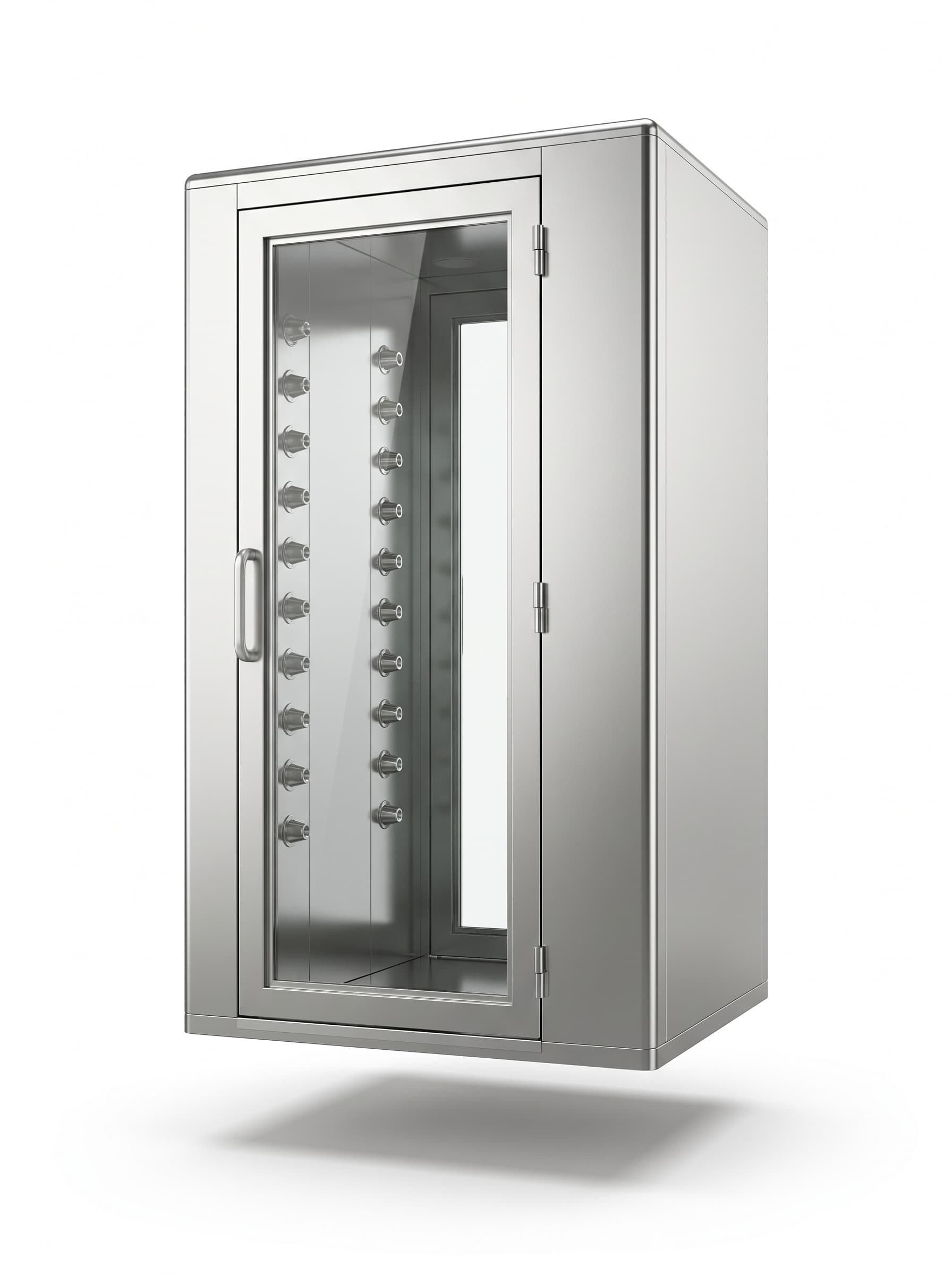
FIG. 01Personnel air shower, illustrative unit. Nozzle count and cabin size are set per entry point.
What an air shower does
An air shower is an enclosed entry vestibule at a cleanroom boundary. A person or a cart of goods stands inside while HEPA-filtered air is driven through nozzles at high velocity. The jets dislodge and carry away loose particulate, fibres and lint before the inner door opens. The air recirculates: it is drawn back through the filter and re-blown.
- HEPA H13 / H14
- EN 1822
- ISO 14644
- Interlocked doors
The point is simple. Most contamination that reaches a cleanroom rides in on people and materials. An air shower cuts that carry-in at the door. That protects the room's classification, eases the load on the room's own filtration, and reinforces gowning discipline.
It is a de-dusting blast, not a classified clean zone. It works on particulate only, not on gases, vapours or fumes.
Air shower specification at a glance
A cleanroom air shower comes down to two things worth reading closely: the air it moves and the doors that hold the separation. This is the shape of a Fabtech air shower system, confirmed to your entry point at quote.
| Parameter | Specification | Notes |
|---|---|---|
| HEPA filter grade | H13 / H14 (EN 1822) | ULPA U15 available where the destination grade calls for it |
| Nozzle / jet velocity | around 20-25 m/s | high-velocity jetting to shear particulate off the garment, adjustable stainless nozzles |
| Airflow pattern | recirculating, HEPA-filtered | air returns through the HEPA and is re-blown by the blower |
| Doors | electromagnetic interlock, one-at-a-time | interlocked so the two doors are prevented from opening together, holding the pressure separation |
| Cycle time | typically 10-30 s, adjustable | set on the control timer to suit garment type and gowning practice |
| Capacity | single or multi-person, and cart / goods sizes | sized to headcount and throughput at the entry point |
| Body / construction | GI powder-coated or stainless steel 304 / 316 | 316 for aseptic or corrosive duty |
| Controls | cycle timer, door status, emergency stop | optional UV where specified |
| Qualification | DQ/IQ/OQ/PQ with HEPA integrity testing (PAO/DOP) | where the project calls for it, the cycle validated to the room it protects |
FIG. 02Every Fabtech figure is confirmed for your entry point before it is quoted.
The numbers above are the levers you actually specify. How clean the air is, set by the filter grade. How hard it hits, the nozzle velocity. How long it runs, the cycle time. And how many people or how much material it clears per cycle.
Two configurations: personnel and goods
An air shower comes in two configurations, and what is crossing the boundary decides which one you need: people or material. The unit is the same idea in both, a HEPA de-dusting vestibule. The size, nozzle layout and cycle differ.
Most sites need the personnel configuration at the people entry. Where goods enter in bulk, a material unit goes on the material route. Each has its own page with the sizing, nozzle and throughput detail.
FIG. 03The same HEPA de-dusting vestibule, aimed at two different things. A personnel cabin converges its jets on a standing body; a material cabin rakes them across the faces of a load. Nozzle count, cabin size and cycle follow from that one decision.
| Personnel air shower | Material air shower | |
|---|---|---|
| What it cleans | operators entering the cleanroom, in gowning | carts, trolleys, packaged goods and containers entering |
| Sizing | single or multi-person vestibule | cart or goods pass-through, sized to the load |
| Nozzle layout | nozzles aimed at the standing body from multiple sides | nozzles aimed to sweep the surfaces of the load |
| Where it sits | at the gowning-to-cleanroom people entry | on the material-entry route into the classified area |
| Full detail | Personnel air shower | Material air shower |
Every configuration below, personnel and material, is engineered and built in-house. So the unit is designed around your room and your entry sequence from the outset.
Personnel air shower
The people entry. A vestibule sized to headcount, with the nozzles aimed at a standing body from both side walls and the ceiling, and a cycle set to the garment. Most sites need this configuration at the gowning door.
Full detailBLoad sizing, sweep, throughputMaterial air shower
The goods entry. A cart or pass-through cabin sized to the load, with the nozzles aimed to sweep the surfaces of a trolley, a pallet or a stack of cartons rather than a body. It goes on the material route.
Full detailAir shower vs airlock vs pass box: what is the difference
These three sit at cleanroom boundaries and are often confused, but they do different jobs. Pick by what is crossing and whether it needs active cleaning:
Active
Air shower
An entry vestibule that blasts particulate off what walks or rolls through it.
Passive
Airlock
A pressure buffer between two grades, with no air jets of its own.
- What crosses
- People or goods, entering
- People or goods, in transit
- What it does
- Advantage. Actively blasts HEPA air at high velocity to strip particulate off surfaces
- A passive pressure buffer between two grades, no air jets
- Air treatment
- Recirculating HEPA de-dusting jets
- Pressure separation only
- Doors
- Advantage. Electromagnetic interlock
- Advantage. Interlocked doors
- Use it for
- Reducing particulate carried in on personnel or carts
- Maintaining the pressure cascade at a doorway
FIG. 04The two devices most often swapped for each other at a doorway.
Pass box
An interlocked transfer window through a wall, for material only.
- What crosses
- Material only, through a wall
- What it does
- Hands material across without a person walking through
- Air treatment
- None (static) or a HEPA flush (dynamic)
- Doors
- Interlocked doors
- Use it for
- Moving components, tools and samples between grades
So an air shower is the active de-dusting step for entry. An airlock is the passive pressure buffer. A pass box is for material that should cross without a person carrying it.
If your need is passive material transfer without air jets, a pass box is the right device. Many suites use both: a pass box for the material and an air shower for the people.
How an air shower works
An air shower is a sealed vestibule, a blower, a HEPA filter and a bank of nozzles, tied together by an interlocked-door cycle.
It reduces particulate carry-in. It does not remove all of it. How well it works depends on cycle time, garment type and user compliance. That is why the cycle is validated to the room rather than left on a default.
- Filtered supply
- Dust-laden return
FIG. 05One closed circuit. The blower pushes air through the HEPA pack into the plenums down both side walls, the nozzles fire it at the garment, the floor grille takes it back, and the same air is filtered again and re-blown for the length of the cycle.
- 011
Enter, outer door closes
A gowned operator (or a cart) steps in from the less-clean side and the outer door shuts. The electromagnetic interlock now holds the inner door locked.
- 022
The jets fire
The blower drives air through the HEPA filter and out of the adjustable nozzles, around 20-25 m/s. The jets shear loose particulate, fibres and lint off the garment or the load. The dislodged dust is carried back through the return, filtered again and re-blown, so the air recirculates.
- 033
Cycle completes, inner door releases
After the set cycle, typically 10-30 s, the interlock releases the inner door. The person or cart passes into the cleanroom.
Because the interlock stops the two doors opening together, the unit holds the pressure separation while it runs. A rush of less-clean air cannot simply follow the person in.
What the jets reach, and what they miss
A cycle timer tells you how long the jets run. It does not tell you where they land. Coverage inside an air shower is a geometry problem: the nozzles are fixed, a body is not a flat panel, and an operator who stands still presents the same shadows to the same jets for the whole cycle.
- Jet, firing
- Swept surface
- Shadowed pocket
FIG. 06Coverage inside a personnel air shower, drawn twice and then plotted. The jets fire continuously; the swept surfaces carry a travelling highlight and the shadowed pockets never do. Nozzle exit velocity is a Fabtech design figure; the velocity at the garment is not a published number at all, because the cabin, the nozzle aim and the operator's own position decide it.
Swept hard
The hood, the shoulders, the upper back, and the outer face of the arms and thighs. Those surfaces sit square to a jet and take the full sweep, over and over, for as long as the cycle runs.
Shadowed
The underside of the arms, the small of the back, the area between the legs and the insteps. Each one sits in the lee of the body itself, so the jet passes over it instead of across it, and a longer cycle does not change that.
The velocity gap
Air leaves a nozzle at around 20-25 m/s. A free jet spreads and drags room air along with it, so the speed at the garment is always lower than the speed at the exit, and it keeps falling as the standoff grows. The exit figure is on the spec sheet. The figure at the garment is set by the cabin, the nozzle aim and where the person stands.
This is why every gowning instruction tells the operator to turn. Rotating through the cycle moves the shadows, so a surface that sat in the lee at second two is square to a jet at second eight. It is also why the nozzle layout is set per entry point rather than shipped as a default: the aim decides which surfaces are ever presented to a jet at all.
Nozzle aim is set per entry point, so the shadow map is set per entry point too.
The carry-in problem
Most of what reaches a cleanroom walked in through the door.
Every gowned entry carries fibres, skin and lint past the boundary. The air shower is the one step in the entry sequence that takes some of it off before the inner door releases, instead of asking the room's own filtration to catch it afterwards.
- HEPA grade, EN 1822
- H13 / H14
- Nozzle exit velocity
- 20-25 m/s
- Cycle, adjustable
- 10-30 s
The parts of an air shower
An air shower is the sum of a few parts, each doing one job:
- 01Jetting
Adjustable stainless nozzles
Aim the high-velocity jets at the body or the load from multiple sides. They are set so the air actually reaches the garment.
- 02Filtration
HEPA filter
Cleans the recirculated air back to cleanroom grade before it is re-blown through the nozzles. The grades on offer are in the spec table above.
- 03Air movement
Blower and motor
Drives the high-velocity airflow the nozzles need to shear particulate off the garment.
- 04Boundary
Electromagnetically interlocked doors
Stop the two doors opening together. That holds the pressure separation and enforces one-at-a-time passage.
- 05Control
Control panel
The cycle timer that sets the 10-30 s cycle, door status indicators and an emergency stop.
- 06Air movement
Recirculation return
Draws the dust-laden air back through the HEPA rather than dumping it, so the unit is self-contained.
- 07Construction
Body
GI powder-coated or stainless steel 304 / 316, with a smooth, cleanable interior.
- 08Option
Optional UV
Fitted where specified, for surface disinfection of the empty chamber.
Where an air shower sits in the entry sequence
An air shower is one step in a designed entry sequence into a controlled area, not a stand-alone box. For personnel, the order is:
- 01
Gowning room
The operator changes into cleanroom garments.
- 02
Air shower
The gowned operator passes through the de-dusting cycle. Loose particulate comes off the fresh garment before it can enter.
- 03
Cleanroom
The operator steps into the classified area, carrying far less particulate than they otherwise would.
- Route of travel
- Air shower
- Interlocked door
FIG. 07The air shower is not a stand-alone box. On the personnel route it is the last step between the gowning room and the classified area, so the particulate that comes off a fresh garment comes off before the inner door releases rather than inside the room. Goods reach the same room on their own route, through a material air shower where the load needs an active blast or a pass box where a passive interlocked transfer will do. The pressure figures are a conventional cascade; the cabin itself holds separation through the interlock rather than to a setpoint.
For material, a material air shower or a pass box sits on the goods-entry route. The choice comes down to whether the load needs an active air blast or a passive interlocked transfer.
Positioned this way, the air shower cuts the particulate load reaching the room. That protects the room's ACPH and classification. It also eases the duty on the room's own HEPA filtration.
The entry sequence is part of the room design, so the air shower is engineered with the cleanroom, its HVAC and its airflow as one system. Most often that is in pharmaceutical and biotech facilities, where gowned people or goods cross into a classified area.
The standards an air shower is built to
There is no single dedicated air shower standard, and no dedicated Indian Standard we cite as the air-shower code. An air shower is judged by the two things it actually delivers: clean air and a held boundary. Its compliance anchors on:
- EN 1822The European standard behind the HEPA grades in the spec table above. A ULPA grade is available where the destination grade calls for it.
- ISO 14644 (ISO Class 5-8)The classification of the cleanroom the air shower protects. It sets how clean the entry has to keep the incoming load. Note it classifies the room, not the turbulent air inside the shower. The shower is a de-dusting blast, not a classified clean zone.
- GMP gowning practiceFor pharma and biotech work, the air shower supports the gowning and entry discipline expected under EU-GMP Grade A/B/C/D. India's Schedule M and WHO-GMP expect the same, as part of contamination control at the boundary.
Air showers, common questions
An air shower blows HEPA-filtered air through nozzles at high velocity. The jets strip loose particulate, fibres and lint off garments or goods before they enter a cleanroom. The air recirculates through the filter. Less contamination rides into the room, so the room holds its classification more easily.
An airlock is a passive pressure buffer. It sits between two grades and holds the pressure cascade at a doorway, with no air jets. An air shower is active: it fires high-velocity HEPA-filtered air to strip particulate off people or goods. An airlock separates, an air shower cleans.
Yes. An air shower reduces the particulate carried into a cleanroom on garments and goods. That is why it is standard at gowning entries. It cuts carry-in rather than removing everything. Results depend on cycle time, garment type and proper use, so the cycle is validated to the room.
Between the gowning room and the cleanroom, so a gowned operator passes through the de-dusting cycle before entering the classified area. For goods, a material air shower sits on the goods-entry route. It is one step in the entry sequence, so it is specified with the room, not added afterward.
A personnel air shower is a vestibule for gowned people, with nozzles aimed at the standing body. A material air shower is sized for carts, trolleys or packaged goods, with nozzles aimed to sweep the load's surfaces. Same principle, different sizing and nozzle layout.
People or goods pass through an air shower while high-velocity HEPA air strips particulate off them. A pass box is an interlocked window in a wall, for moving material across a boundary without anyone walking through. Use an air shower for entries and a pass box for material transfer.
It is quoted per requirement. The cost depends on the configuration (personnel or material), the size and headcount, the HEPA grade, the number of nozzles, the construction grade and the controls. Send us the entry point and the grade of the room it protects and we will come back with a figure to your spec.
Yes. Fabtech engineers and builds air showers in-house in India, in personnel and material configurations. We supply, install and integrate them with the cleanroom, and equipment-level AMC is available afterward. Buying from the manufacturer means the unit is specified to your entry point and destination grade from the start.
An air shower uses a HEPA filter. The usual grades are H13 and H14. Where the destination grade demands more, ULPA grades from U15 up are used. These ratings come from EN 1822, the filter standard. HEPA removes particulates only, never gases, vapours or fumes.
Typically 10 to 30 seconds, set on the control timer. The right setting depends on the garment, the gowning practice at that entry and the grade of the room being protected, which is why the cycle is validated to the room rather than left on the factory default.
What an air shower costs
An air shower is quoted per requirement rather than sold at one list price. The number is set by the configuration (personnel or material), the size and headcount, the HEPA grade, the number of nozzles, the construction (GI or stainless 304 / 316) and the controls.
A single-person GI personnel unit and a multi-person stainless material unit are quoted worlds apart. Send us your entry point, the headcount that passes through it and the grade of the room it protects, and the quote comes back against those numbers rather than against a catalogue.
- Configuration
- Personnel or material, sized to what crosses
- Size and headcount
- Single person, multi-person, or cart and goods
- Filter grade
- H13, H14, or ULPA U15 where the destination grade calls for it
- Nozzle count
- Set by cabin size and the surfaces that have to be swept
- Construction
- GI powder-coated, stainless steel 304, or 316 for aseptic duty
- Controls
- Cycle timer, door status, emergency stop, optional UV
What actually moves the number. No two entry points quote the same.
- HEPA grade, EN 1822
- H13 / H14
- Rooms it protects
- ISO 5-8
- Qualification, where specified
- DQ/IQ/OQ/PQ
- Filter integrity test
- PAO/DOP
How Fabtech builds air showers
Fabtech engineers, builds, supplies, installs and integrates air showers in-house in India, and stands behind each one from quote to handover. Equipment-level AMC is available afterward.
The unit you get is specified to your entry point and your room. The filter grade is set to the destination classification. The nozzle layout is aimed for the way your people actually gown. The interlock is tied into your door logic, and the cycle is validated where the project calls for it.
Behind that sits Fabtech Cleanrooms, a cleanroom equipment manufacturer that has designed, built and validated controlled environments across India since 2004, holding ISO 9001 quality management.
Turnkey cleanroom solutions Cleanroom equipment Talk to an engineer
Capability record
An air shower is one element of contamination-control engineering, and Fabtech has delivered the whole discipline.
- Pharma and researchAjanta Pharma, Desano and German RemediesHEPA-filtered, classified cleanrooms delivered for pharmaceutical and research clients across India.
- ContainmentPGICH Noida and ASMC ShahjahanpurBSL-3 containment facilities, where the entry sequence and the boundary are the whole design problem.
- Quality systemISO 9001 quality managementThe manufacturing and validation discipline the equipment is built and documented under.
- ScopeAir-shower project scopeProject scope and specifications for delivered air showers are available on request.
Tell us about your entry point
Send the entry point, the headcount that passes through it and the grade of the room it protects. Our engineers come back with a quote to your spec, not a catalogue page.