

Pillar guide
Cleanroom compliance and standards, explained
If your product cannot survive contamination, the room it is made in has to prove, on paper, that it keeps particles and, in some cases, live organisms under tight control. That proof is what "cleanroom compliance" means in practice: a set of published standards that say how clean the air has to be, how the room has to behave, and how you demonstrate both to an auditor. This guide is the plain-language map to those standards, written for the project head or quality lead who has to understand them before signing off a build, and it links out to the deeper articles and the service pages where each topic is handled in full.
Overview
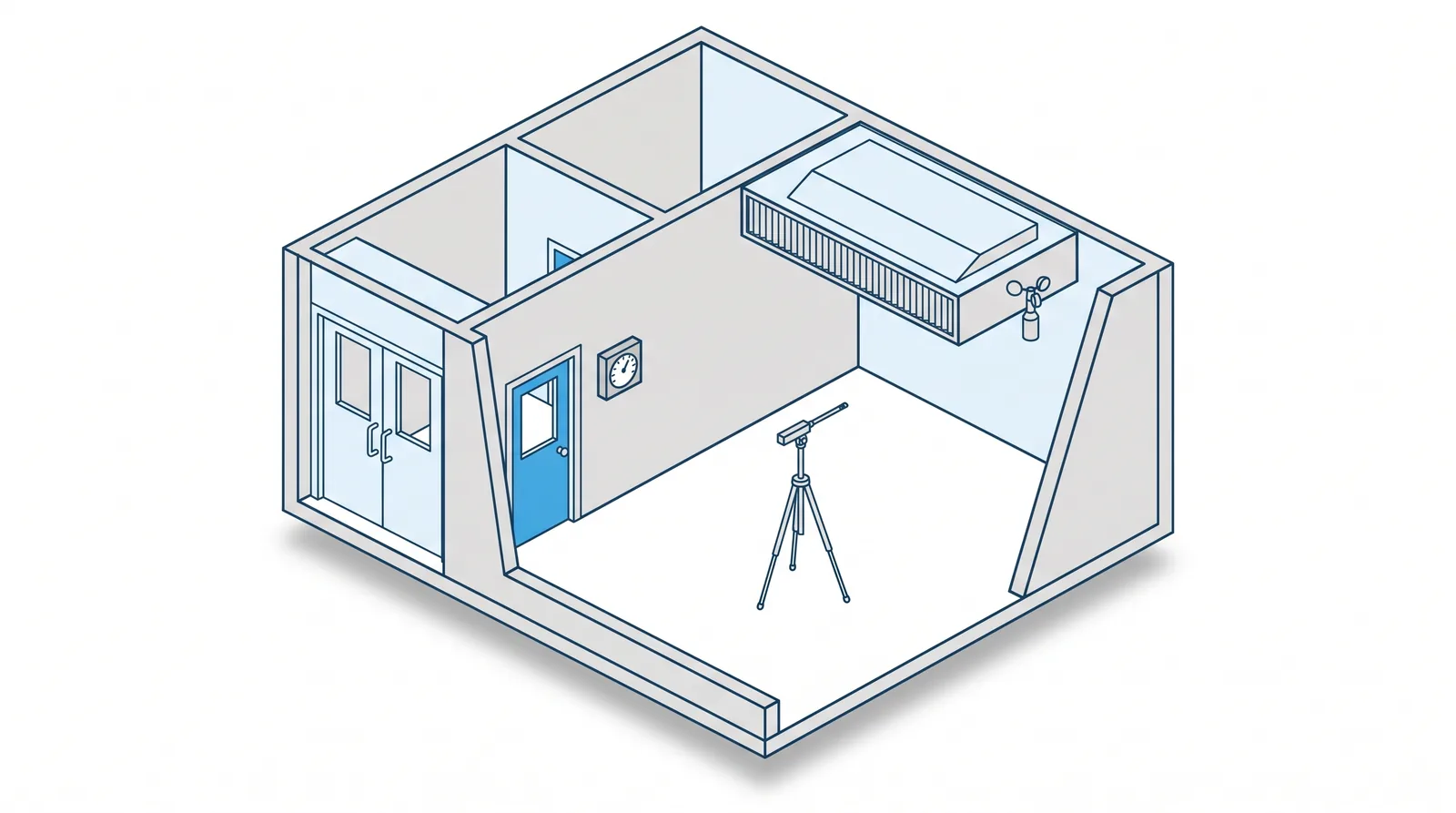
The four things you will meet on almost every cleanroom project are ISO 14644, which classifies how clean the air is by particle count; EU-GMP, which grades cleanliness for medicine manufacturing from Grade A to Grade D; Schedule M, India's own good manufacturing practice baseline for pharmaceuticals; and the validation sequence, DQ, IQ, OQ and PQ, which is how a finished room is qualified and documented. The sections below explain each one, how they relate, and why a room is "qualified" or "validated" rather than "certified" by a regulator.
01
What "cleanroom compliance" actually means
Compliance is not a single certificate. It is the combination of designing a room to the right standard, building it so the design holds, and then generating the documented evidence that it performs as designed. A pharmaceutical cleanroom, for example, is designed to an EU-GMP grade and an ISO 14644 class, built with the airflow, filtration and pressure regime those targets demand, and then qualified through a validation dossier that an inspector can read. Miss any one of the three, the design, the build, or the evidence, and the room is not compliant even if it looks the part.
The standards split roughly into two families. One family classifies the environment by how many particles the air is allowed to carry: this is ISO 14644, and it is industry-neutral, used in pharma, semiconductors, electronics and beyond. The other family is the good manufacturing practice framework that sits on top for regulated products, chiefly medicines: EU-GMP, WHO-GMP, the US-FDA's cGMP expectations, and in India, Schedule M. A single pharmaceutical room usually carries both a GMP grade and an ISO class at the same time.
02
ISO 14644: how cleanrooms are classified
ISO 14644-1 is the international standard that classifies air cleanliness by the maximum number of particles, of a given size, allowed per cubic metre. Cleanrooms are described by an ISO Class number, most commonly ISO Class 5 through ISO Class 8 in industrial and pharmaceutical work, where a lower number means cleaner air. An ISO Class 5 space permits far fewer particles than an ISO Class 8 space, which is why the cleanest operations, such as aseptic filling, sit at Class 5, while a supporting gowning or storage area might be Class 8.
Two details trip people up. First, a class is measured at a defined particle size, so a full specification names both the class and the sizes counted. Second, the class can be stated in different occupancy states, "as-built", "at-rest" and "in-operation", because a room with people and equipment working in it is dirtier than the same room empty. A compliant specification always says which state the class applies to. The older Federal Standard 209E classes, the legacy Class 100, Class 1,000 and Class 10,000 you may still hear quoted, were superseded by ISO 14644 in 2001, so treat them as historical shorthand rather than the governing standard.
03
EU-GMP grades A to D
For medicine manufacturing, the European Union's good manufacturing practice guide, EU-GMP, grades cleanroom environments from Grade A, the cleanest, to Grade D. Grade A covers the critical zone where product is exposed, such as the point of aseptic filling, and is typically delivered with unidirectional, or laminar, airflow. Grade B is the background environment around a Grade A zone in aseptic processing. Grades C and D are cleaner-than-normal areas for less critical stages of manufacture. Each grade carries its own airborne particle limits, both at-rest and in-operation, and, for the higher grades, microbial monitoring limits as well.
The GMP grade and the ISO 14644 class are related but not interchangeable: a given GMP grade maps to an ISO class at rest and, usually, a different one in operation. That mapping, and the airflow, air change rate and pressure cascade needed to hold each grade, is where cleanroom design gets specific. The plain point for a buyer is that the product and its process decide the grade, the grade decides the class, and the class decides the engineering.
04
Schedule M: the Indian GMP baseline
Schedule M is the good manufacturing practice standard under India's Drugs and Cosmetics Rules, and it is the baseline any pharmaceutical facility manufacturing for the Indian market has to meet. Its revised form raised Indian requirements closer to WHO-GMP and EU-GMP expectations, covering premises, environmental control, documentation and quality systems. For most Indian pharma buyers, Schedule M is the floor, and export-oriented plants then build to the additional expectations of the market they ship to.
In practice this means an Indian pharmaceutical cleanroom is often designed to satisfy Schedule M and, where the product is exported, to withstand inspection under EU-GMP, WHO-GMP or US-FDA cGMP as well. The standards overlap heavily on the fundamentals, air cleanliness, pressure regime, documented control, so a well-designed room can be built to serve several at once.
05
Built to withstand inspection, not "certified"
A common misconception is that a regulator "certifies" a cleanroom. Regulators such as the US-FDA, the MHRA and the WHO do not certify rooms; they inspect facilities and judge whether they meet the applicable good manufacturing practice. What a manufacturer holds is a qualified, validated room and the documentation to prove it. So the correct framing is that a cleanroom is built to withstand inspection under EU-GMP, US-FDA, WHO-GMP and cGMP expectations, and it is qualified and validated rather than certified.
Fabtech Cleanrooms designs and builds controlled environments to ISO 14644 (ISO Class 5 to 8) and to EU-GMP Grade A to D, and builds them to withstand inspection under EU-GMP, US-FDA, WHO-GMP and cGMP expectations, with a full validation dossier on delivery. One project written up in full, the Ajanta Pharma cleanroom case study, shows what a validated pharmaceutical handover looks like in practice.
06
Validation and qualification: DQ, IQ, OQ, PQ
Validation is how a finished cleanroom is proven and documented. It runs as a sequence. Design Qualification (DQ) confirms the design meets the requirements before anything is built. Installation Qualification (IQ) confirms the room and its systems were installed as designed. Operational Qualification (OQ) confirms they perform across their operating range. Performance Qualification (PQ) confirms the room holds its class in real operation, over time. The evidence behind these is drawn from ISO 14644 test methods: particle counts, HEPA filter integrity testing and airflow verification, among others.
Underpinning all of it, for GMP work, is the Contamination Control Strategy (CCS), the documented, facility-wide plan that ties the design, the monitoring and the procedures together into one coherent argument that contamination is controlled. For a buyer, the validation dossier is the deliverable that turns a built room into a compliant one: it is the paperwork an inspector reads.
07
Guides in this collection
These deeper articles work through specific compliance and validation problems in detail:
Guide · 9 min read
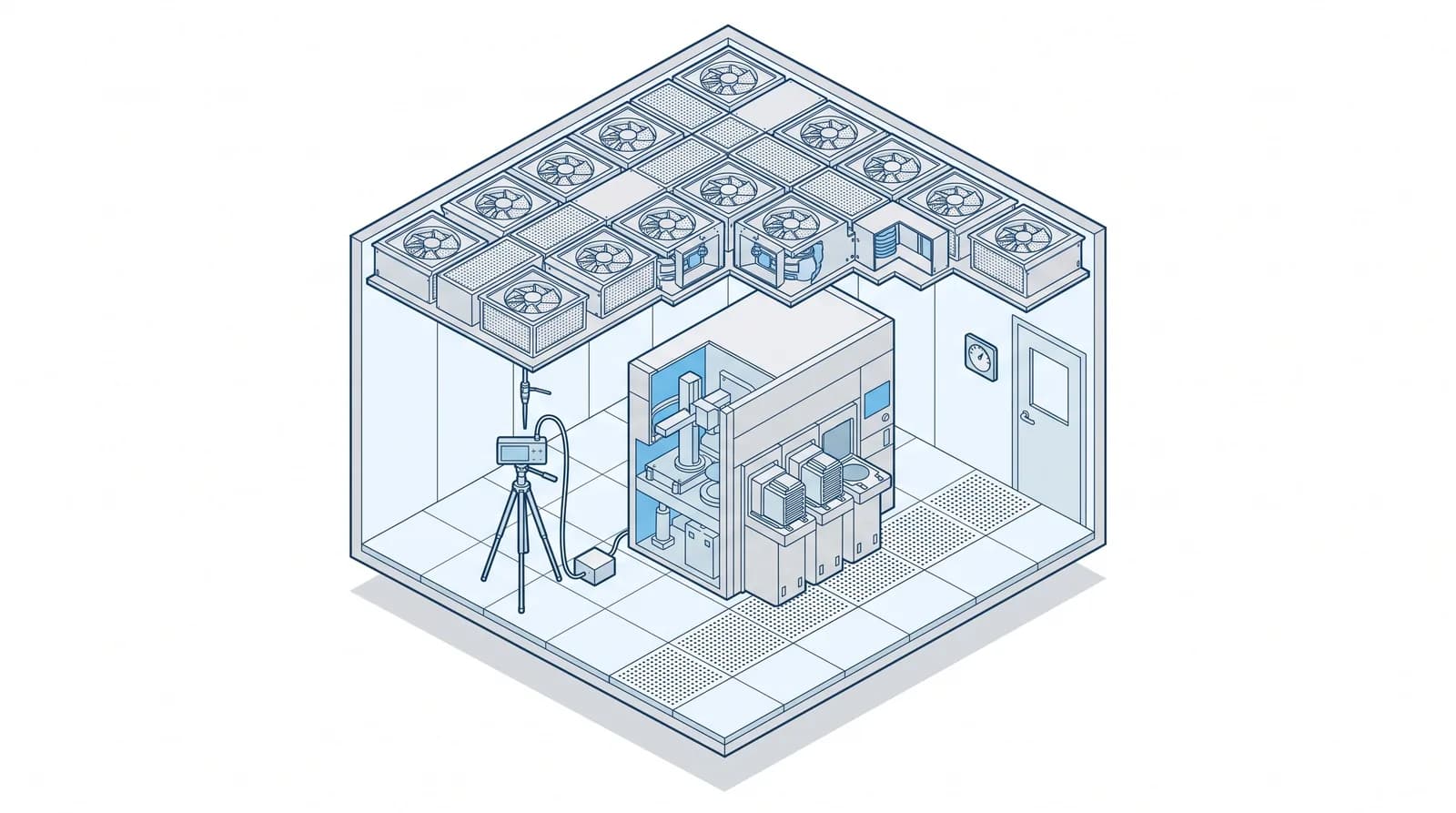
Cleanroom and HVAC Validation: The Invisible Backbone of Semiconductor Manufacturing
How cleanroom and HVAC validation, from DQ and IQ to OQ and PQ, protects semiconductor manufacturing from particle, humidity and ESD defects.
Guide · 8 min read
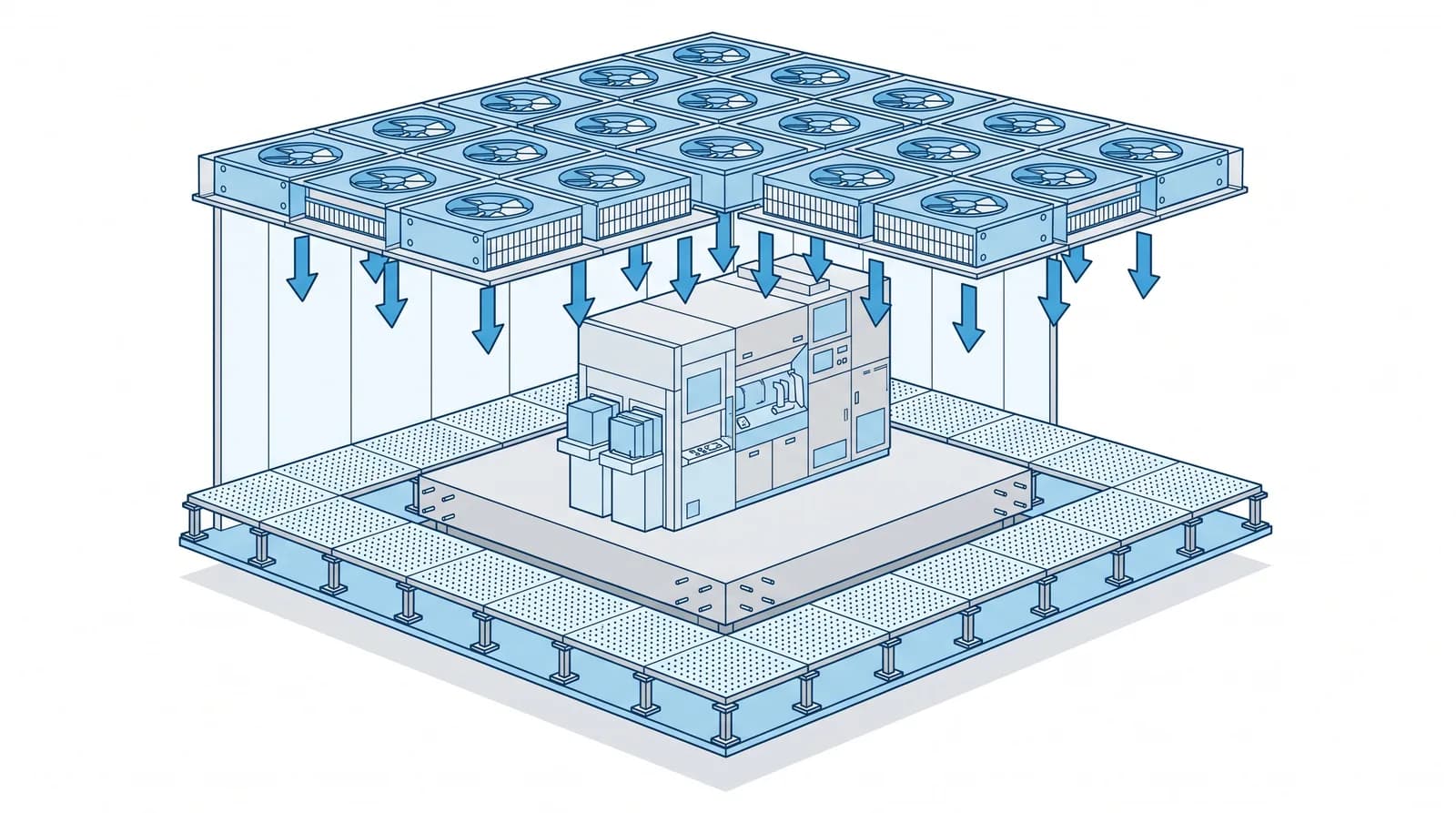
How Modular Cleanrooms Satisfy Semiconductor Requirements
How modular cleanrooms meet semiconductor fab requirements: panel engineering, HEPA/ULPA HVAC, laminar airflow, vibration isolation and monitoring.
08
Where to go next
If you are past the "what does this mean" stage and into planning a build, two service pages carry the commercial detail. For how a room is classified to an ISO 14644 class and an EU-GMP grade against your process, see the cleanroom ISO classification service. For how a room is qualified and documented through DQ, IQ, OQ and PQ, see the cleanroom validation and qualification service.