

Carbon-filtered hoods, no duct needed
Ductless Fume Hoods
A ductless fume hood needs no ductwork, so it can sit anywhere, but it only protects you if its carbon filter matches your chemistry. Fabtech supplies both ductless and ducted hoods for Indian labs. Here is how to tell which one is safe for your chemicals.
- Activated carbon + HEPA pre-filter
- ASHRAE 110
- ANSI/AIHA Z9.5
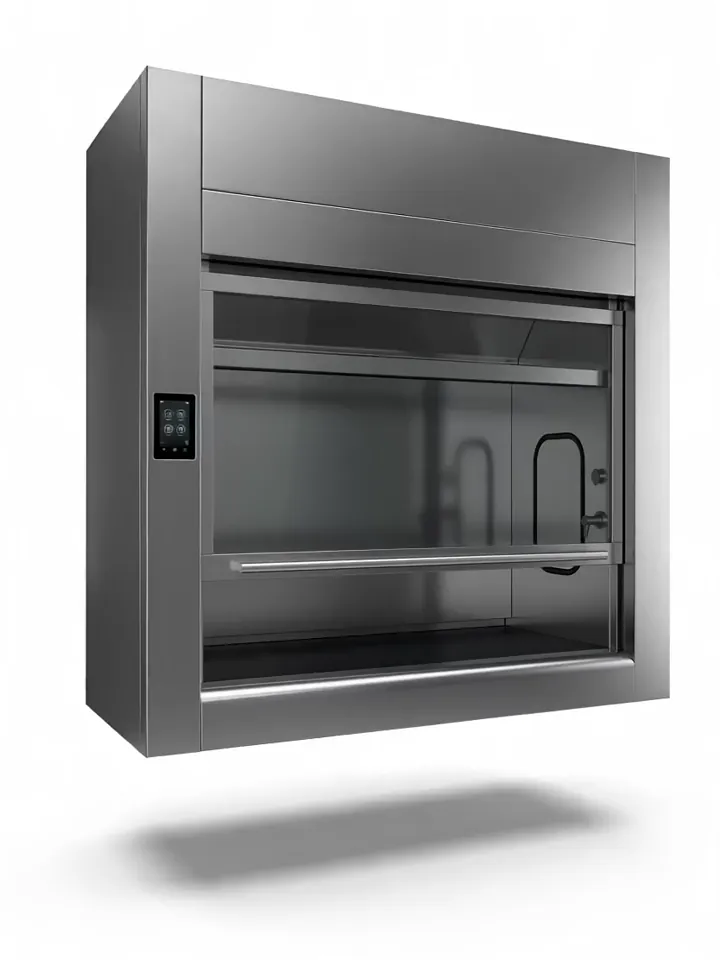
FIG. 01Recirculating hood, illustrative render. A filter bank replaces the duct.
We've engineered and validated 2,000+ controlled environments across every industry that needs controlled air since 2004. The engineers who size your hood have seen where ductless works, and where it quietly fails. They'll tell you straight which one you're facing.
2,000+
Controlled environments
Any
Sector
2004
Engineering since
What a ductless fume hood is
A ductless fume hood is also called a recirculating fume hood. It has no duct to the outside. Instead of pushing contaminated air out through the roof, it pulls that air through a filter bank and hands the cleaned air back to the room. With no ductwork to run, it can sit wherever there is a power socket, and it can move from bench to bench.
- Activated carbon
- HEPA pre-filter
- No ductwork
Inside that filter bank, an activated-carbon filter adsorbs the chemical vapours. A HEPA/particulate pre-filter usually sits ahead of it and takes out the dust.
That freedom is the whole appeal, and also the whole catch. A ducted hood is forgiving: it throws everything outside. A ductless hood is only as safe as the match between its filter and your chemicals. Inside that envelope it is an excellent tool. Outside it, a dangerous one.
How recirculating filtration works
A ductless hood swaps the duct for a filter bank. That one swap moves where the safety lives.
- 01
Capture at the sash
Room air is drawn in across the sash and sweeps the fumes to the back, the same way any fume hood works.
- 02
Filtration, not exhaust
The air then goes through the filters instead of up a duct, and the carbon holds on to the chemical vapours.
- 03
Clean air returned to the room
The filtered air is discharged back into the lab. That is exactly why the filter must be matched to the chemistry and changed before it is exhausted.
- 04
The filter IS the safety system
No duct carries the problem away, so the hood has to warn you first. Breakthrough is the point where the carbon saturates and vapour begins to pass straight through.
- One detail decides the whole design. The HEPA stage traps particulates only. It does not capture gases or vapour. The carbon stage is what makes a ductless chemical hood work.
FIG. 02Two architectures. A ducted hood throws the problem outside and pays for duct, blower and make-up air. A ductless hood loops the room's own air through carbon and hands it back. One is a path, the other is a circle.
Here is what each stage is actually rated to do:
| Stage | What it does | The rating or number that matters |
|---|---|---|
| Capture at the sash | Draws room air in, sweeps fumes to the back | Face velocity generally 0.3-0.5 m/s (60-100 fpm), ANSI/AIHA Z9.5 practice |
| HEPA/particulate pre-filter | Takes dust out ahead of the carbon | Particulates only; captures no gases or vapour |
| Activated-carbon filter | Adsorbs solvent and chemical vapours | General organic carbon, or blends for acids, formaldehyde, amines |
| Breakthrough warning | Tells you before the carbon gives up | Gas sensor and/or scheduled filter-life tracking |
FIG. 03Capture brings the air in, the pre-filter takes the dust, the carbon holds the vapour, and the monitoring calls the filter change before breakthrough.
The mental model is short. A ducted hood's safety lives in the fan and duct. A ductless hood's safety lives in filter selection and replacement.
Ductless vs ducted: the real trade-off
The full multi-type comparison sits on the main fume hood page. Here is the ducted-vs-ductless cut on its own:
| Ductless (recirculating)THIS PAGE | Ducted (conventional) | |
|---|---|---|
| Contaminated air | Filtered, returned to the room | Exhausted outside the building |
| Chemistry range | Limited, must match the carbon filter | Broad, handles most chemistry |
| Install | Plug-in, movable, no ductwork | Fixed; needs duct, blower, make-up air |
| Running cost | Filter replacement; no conditioned-air loss | Conditioned make-up air is exhausted (energy) |
| Main risk | Filter breakthrough if mismatched/overused | Duct/blower failure; higher install cost |
| Best when | Known, low-volume, compatible chemistry; no duct route | Heavy, varied or highly toxic chemistry |
FIG. 04Ductless buys away the ducting, the blower and the energy of throwing conditioned air outside. The price is one hard constraint. The hood is only as safe as the filter-to-chemical match.
Are ductless fume hoods effective?
Yes, within their design envelope. Give one the right carbon filter, a defined and compatible chemistry, lower volumes and working monitoring, and it contains and removes fumes effectively.
They turn ineffective, and unsafe, in three situations: chemistry the filter was never chosen for, volumes high enough to saturate the carbon quickly, or filters run past breakthrough with nothing watching them.
The honest rule is this. Ductless is effective when the chemistry is known and stable and you have a filter-change discipline. It is not a universal substitute for a ducted hood.
The closed loop
Nothing leaves the room. The carbon does all the holding, and carbon runs out.
Watch one service cycle. Room air is drawn in across the face, passes the HEPA pre-filter and the activated carbon, and is handed back to the room. The carbon adsorbs vapour until it is saturated. That point is called breakthrough, and every filter change is scheduled to arrive before it does.
FIG. 05One recirculation cycle on a 24 second clock. The service-life bar is spent as the loop runs; at breakthrough the carbon stops holding and the return air carries vapour into the room, which is why the change-out is scheduled to arrive first. At rest the drawing holds mid-service: carbon partly spent, monitoring watching.
- 01
Adsorbing
Fresh carbon holds the vapour. Cleaned air returns to the room and the loop keeps running.
- 02
Saturating
Capacity is being spent with every pass. A gas sensor and/or filter-life tracking watches the margin.
- 03
Breakthrough
The carbon is saturated and vapour passes into the room. The filter change exists to arrive before this state.
Will a ductless hood work for my chemistry?
This is the question that actually decides safety. So here is the logic an engineer applies before recommending ductless, including the cases where the honest answer is "no, duct it out":
| Your situation | Ductless verdict |
|---|---|
| Known, named chemicals; a carbon type is rated for them; low volume | Ductless OK, confirm the filter match |
| Mixed / changing / unknown chemistry | Ducted: no single carbon covers it |
| High volume or high concentration (saturates carbon fast) | Ducted: breakthrough risk too high |
| Highly toxic, or substances with poor warning properties (you can't smell breakthrough) | Ducted: never rely on the nose |
| Inside a classified GMP/ISO cleanroom | Usually ducted (see standards below) |
FIG. 06Find your row in the left column. The right column is the call an engineer would make on the same facts.
When we refuse ductless
If the chemical list can't be pinned down, a ductless hood is the wrong tool however convenient. The same goes for a substance with no reliable warning property, and for a high-volume duty.
The ductless fume hood suppliers worth shortlisting will say so, rather than sell you the movable box. Filter selection is always confirmed against the actual chemical list before anything is committed.
Not sure which row you're on? Send us your chemical list and we'll tell you straight, including when the honest answer is "duct it out."
Send your chemical listFilters, breakthrough and change-out
The filter is the consumable that keeps the hood safe. So it gets managed, not forgotten.
Carbon type matched to chemistry
General organic, or specific blends for acids / formaldehyde / amines.
HEPA pre-filter
Traps particulates ahead of the carbon (particulates only, not vapour).
Breakthrough monitoring
An electronic gas sensor and/or scheduled filter-life tracking warns before saturation.
Documented change-out
A replacement schedule sized to the chemistry and the usage. This is the recurring cost that ductless trades for ductwork.
Typical filter life is usage-specific and confirmed for your chemistry on request.
Standards, and why ductless is often wrong in a GMP cleanroom
A ductless hood answers to the same containment and ventilation standards as any fume hood. It just has one extra thing to prove: that its filter keeps working.
- ASHRAE 110 / ANSI Z9.5ASHRAE 110 containment testing and ANSI/AIHA Z9.5 lab-ventilation practice apply to ductless hoods too.
- The extra dutyDuctless then adds a duty of its own: filter suitability and change-out, carbon matched to the chemistry, breakthrough monitoring, a documented schedule.
Inside a classified pharma or QC lab, the room around the hood is designed to ISO 14644. The operation inside it works to EU-GMP Annex 1 expectations. Schedule M sets expectations for that same room. Here a ductless hood is frequently the wrong choice.
Two things go wrong when you recirculate into a space like that. Carbon-filtered air returned to a classified room can reintroduce contaminant load. After breakthrough, the hood can quietly release vapour into the controlled space. Many GMP labs therefore require the hood ducted out.
Where ductless is even considered for a room like that, the filter match and the breakthrough monitoring are confirmed against both the chemistry and the room's classification.
A ductless hood has no stack discharge to atmosphere. So the CPCB stack-emission limits that govern ducted exhausts are generally not the governing constraint here. Confirm your own site's regulatory position rather than assuming. The trade is simple: the contaminant stays in your filter and, if mismanaged, in your room.
FIG. 07Recirculation inside a classified room. The return air, and any post-breakthrough release, stays inside the ISO 14644 envelope, which is why many GMP labs duct the hood out instead.
How Fabtech approaches ductless hoods
On a ductless hood, the thing you are really buying is the filter call. You want that call made by an engineering team, not by a reseller working to a monthly quota.
Fabtech specifies, supplies, installs and validates ductless fume hoods, matched to your chemistry. That holds whether the hood stands on its own or sits inside a turnkey lab. The same team that delivers the hood also designs, builds and validates the controlled labs it lives in.
The value here is the selection logic. That means matching the carbon to your chemistry, sizing the monitoring around it, and saying plainly when ductless is not appropriate and a ducted hood is the safe answer. What one costs is driven mostly by filter type and monitoring rather than ductwork, so see fume hood price .
Proof of capability
Fabtech has engineered controlled labs and cleanrooms for pharma and research clients across India, including Ajanta Pharma, Desano and BARC. That is the lab-ventilation and contamination-control work a hood lives inside.
Ask us and we'll walk you through a named ductless-fume-hood project reference.
Talk to an engineer about your chemistryFrequently asked questions
A ductless fume hood filters contaminated air through an activated-carbon filter, behind a HEPA pre-filter, and returns the cleaned air to the room. It does not exhaust outside through a duct. Because it needs no ductwork, it can be moved between benches.
Yes, within their design envelope. They work for known, compatible, lower-volume chemistry with the right carbon filter and working monitoring. They are neither effective nor safe for chemistry the filter was not selected for, or when filters run past breakthrough.
A ducted hood exhausts contaminated air outside the building. A ductless hood filters it through activated carbon and returns it to the room. Ducted handles a broad chemistry range but needs ductwork and make-up air. Ductless is movable and duct-free, but limited to what its carbon can capture.
Avoid ductless for mixed or unknown chemistry, high volumes or concentrations, highly toxic substances, and anything with poor warning properties you cannot smell. Usually avoid it inside a classified GMP cleanroom. A ducted hood is the safe choice. For biological hazards you need a biosafety cabinet, which Fabtech builds in-house.
Breakthrough is the point where the activated carbon saturates and can no longer adsorb the vapour, so contaminants begin to pass through into the room. Monitoring and scheduled filter changes exist to prevent it. That is why filter discipline is central to ductless safety.
Usually a HEPA/particulate pre-filter traps dust and aerosols, while an activated-carbon filter handles the chemical vapours. HEPA alone does not capture gases. The carbon stage is what makes a ductless chemical hood work.
Check your chemistry with an engineer
Send your chemical list and how you work. We will tell you straight whether ductless is safe for it, including when the honest answer is to duct it out.