

Hazard-rated and acid-duty hoods
Chemical Fume Hoods
A chemical fume hood is a fume hood built to survive the chemistry: corrosive acids, toxic solvents, flammable vapour. It has to do more than move air. It has to prove it keeps the fumes off you. Fabtech specifies and supplies them for Indian labs, with the liner, sash and ductwork chosen from your hazard.
- EN 14175
- ASHRAE 110
- 0.5 m/s face velocity
- Acid and perchloric duty
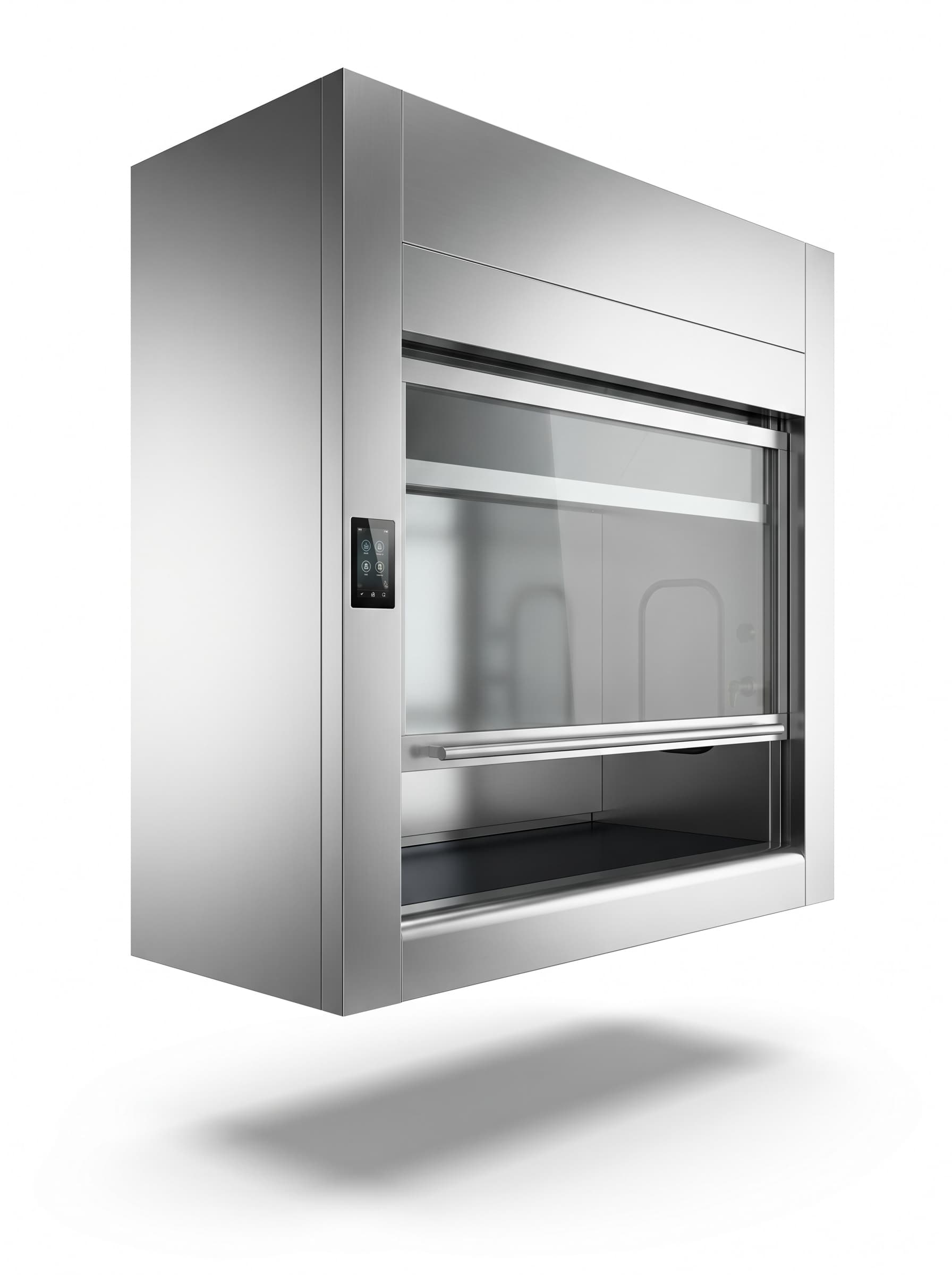
FIG. 01Chemical fume hood, illustrative. Liner, worktop, sash and ductwork are all chosen from the chemistry, not from a catalogue line.
What a chemical fume hood is
So this page is about picking the right hood for your hazard. It is also about the look-alike cabinet you must never confuse it with.
A chemical fume hood is a fume hood built and rated for hazardous chemistry. That means corrosive acids, toxic solvents, and flammable or volatile reagents. It does the same core job as any fume hood. It draws air away from the operator and carries the fumes off.
What makes it a chemical hood is the build. Its materials, exhaust and variants are chosen so it can stand up to aggressive chemicals and contain what they release.
If you are specifying a chemical fume hood rather than a plain one, the stakes are higher and your questions are sharper. What exactly does it protect me from? How does it work? How is it different from the cabinet beside it that is for biology? This page answers those.
At a glance
- Protects
- The operator, from chemical vapour, fume, dust and aerosol
- Does not protect
- The product or sample, and nothing biological
- Face velocity
- 0.5 m/s nominal, 0.3 to 0.5 m/s design range
- Containment proof
- ASHRAE 110 tracer gas, EN 14175 type and on-site tests
- General build
- Epoxy-coated steel liner, phenolic resin worktop, safety glass sash
- Acid build
- Full polypropylene (PP) with wash-down
- Exhaust
- Ducted to a discharge outside and clear of intakes
- Recirculating variant
- Ductless carbon fume hood
What a chemical fume hood protects against
The job is simple to state. Keep what you are working with out of your lungs. In safety terms the hood is an engineering control for inhalation and exposure hazards. It protects the operator from four things.
Toxic vapours and gases
Released by reactions and solvents. The hood draws them off the bench and away from breathing height before they can build up in the room.
Corrosive fumes
From acids and bases, the kind that damage airways and equipment. These are also the fumes that decide what the hood itself has to be built from.
Flammable vapours
The hood dilutes them and carries them away, which reduces the risk of reaching a flammable concentration. It is not a substitute for proper flammables storage. Nor, where required, for a flameproof or specially-rated installation.
Dusts and aerosols
Thrown up by weighing, grinding or sample prep. Once a fine solid is airborne it behaves like the vapour does, so the same inward sweep carries it away.
Now the limits, which matter just as much.
Each of these is a specification error somebody has already made. The three cabinets look alike on a general arrangement drawing and they do three different jobs.
- Not the productThe hood does not protect the product or sample from contamination. That is a laminar flow hood's job. Laminar airflow units
- Not biologyIt gives no protection against biological hazards. That is a biosafety cabinet's job. Biosafety cabinets
- Not instead of PPEIt is no substitute for PPE either. Gloves, goggles and a lab coat are still worn. The hood removes the hazard at source. PPE is the backup.
How a chemical fume hood works
There is nothing mysterious about it. Air moves in one direction, away from you, and it does not come back. Four things make that happen.
- 01
Inward capture across the sash
Room air is pulled in across the sash at a controlled face velocity. The usual design range is 0.3 to 0.5 m/s (60 to 100 fpm). Working with the sash low both protects you and keeps that capture velocity correct.
- 02
Even draw via the baffle
A slotted rear baffle spreads extraction from top to bottom. Fumes get caught whether they rise (warm and light) or sink (heavy and cold).
- 03
Exhaust to a safe discharge
A blower pulls the contaminated air through ducting to a discharge point outside and clear of intakes. A ducted hood does not filter the vapours. It dilutes and discharges them safely outside. Gas-phase filtration is the ductless carbon variant's job, and only for known, compatible chemistry. Heavy or varied chemistry should leave the building, which is why a chemical hood is most often ducted.
- 04
Corrosion-resistant build
The liner, worktop and sash are chosen for the chemistry. Epoxy-coated steel suits general use. Polypropylene (PP) suits acids. Worktops come in phenolic resin or ceramic, and sashes in safety glass.
The part that tells you it is working
One more part earns its keep. A front airflow monitor and alarm confirms the hood is containing. If face velocity drops, it warns you to stop.
- Watches
- Face velocity at the sash
- Nominal
- 0.5 m/s
- Re-tested
- Periodically, in service
The capture falloff, and where the work has to sit
9 %
Of the face velocity, one face dimension out into the room
A fume hood has no force field. It has a fan, and a fan pulls hardest right at the opening it is pulling through.
Capture velocity falls with the square of distance from the face, so a source one face dimension away already feels about a tenth of the face velocity. Containment only exists inside the capture zone.
FIG. 02Watch the particles, not the arrows. Everything inside the dashed arc is pulled back through the baffle slots and out to the duct. Everything outside it belongs to the room, and the room has its own draughts.
Capture velocity in front of an opening follows a relation every ventilation engineer knows, and the important part of it is the square. Double the distance from the sash face and the pull does not halve, it falls to roughly a quarter. Which is why the argument about where a beaker sits is not fussiness. It is the whole of containment.
For an opening of area A drawing volume flow Q, capture velocity at distance x in front of the face is v = Q / (10x squared + A). Take a 1.0 square metre sash opening at a nominal 0.5 m/s face velocity, so Q is 0.5 cubic metres per second. At the sash plane the reading is the face velocity itself. At 300 mm out it is 0.26 m/s. At one face dimension out, a metre into the room, it is 0.05 m/s, about a tenth of what the hood is rated at.
FIG. 03Capture velocity in front of a 1.0 square metre sash opening at a nominal 0.5 m/s face velocity, plotted against distance out from the sash plane. The dashed datum is a typical room cross draught from a person walking past. The curve falls under it at about 320 mm, and by one metre the hood is pulling at roughly a tenth of its rated face velocity.
That is the honest limit, and it is the line that separates this page from the cabinet standing next to it. A chemical fume hood protects the operator from vapour. It never protects the product, and it is not a substitute for biological containment.
- At the sash plane0.50 m/s, and that is the boundary of the capture zone, not the inside of it. Cross draughts in a working lab run the same order, so a source on the plane is a contest rather than a certainty. Lab ventilation practice puts the work at least 150 mm behind the sash, and ASHRAE 110 sets its tracer gas source at that depth for exactly this reason. A beaker left on the sash line is not contained.
- 300 mm out0.26 m/s. The hood's pull has fallen to roughly the draught a person walking past the bench makes. From here the room and the hood are pulling with the same strength, and the room has more of it.
- One face dimension out0.05 m/s, about a tenth of the face velocity. Containment is not weaker at this distance, it is absent. A chemical fume hood is a local capture device, never a room extract, and it cannot be asked to police a spill on the floor.
- On the work surfaceNothing at all, in the sense buyers usually mean. Everything above protects the person standing at the sash. None of it protects the sample, because the air crossing that sample is unfiltered room air on its way out of the building.
Chemical fume hood vs biosafety cabinet
They look alike, and they get confused constantly. Using the wrong one is a real safety failure. Here is the difference in one view.
Chemical hazard
Chemical fume hood
Operator protection. Exhausted outside, or carbon filtered on a ductless variant.
Biological hazard
Biosafety cabinet (BSC)
Operator, product and environment protection. HEPA filtered, contained recirculation.
- Protects
- The operator
- Operator, product and environment
- Against
- Chemical vapours, fumes and dust
- Biological hazards, live cultures and pathogens
- Air handling
- Exhausts, or carbon filters. Protects people, not the sample
- HEPA filtered, contained recirculation
- Use the other one for
- Biohazards, use a BSC
- Volatile chemicals, most BSCs are not rated for them
FIG. 04Rule of thumb: chemical hazard goes to a chemical fume hood, biological hazard goes to a biosafety cabinet. Most standard BSCs are not rated for significant volatile chemistry. A chemical fume hood, in turn, gives no protection to a biological sample or to the room.
Work that carries both hazards at once is a specific dual-hazard design decision. It is not a pick either. Raise it with an engineer before the bench layout is frozen.
Why a HEPA filter does not solve this
There is a physical reason the two cabinets cannot be swapped, and it is easier to see on a size scale than in a specification.
A biosafety cabinet works because the things it contains are particles. Bacteria, cell debris and aerosol droplets all sit on the scale below, and a HEPA filter removes at least 99.95 percent of them at the most penetrating particle size under EN 1822. A solvent vapour is not on that scale at all. Molecules are a few hundred times smaller than the left edge of the axis, so they pass through HEPA media untouched. Removing a vapour takes a gas-phase medium such as activated carbon, matched to the chemistry, or it takes ducting the air out of the building.
FIG. 05Airborne particle sizes on a logarithmic scale, in micrometres. Everything a HEPA filter is rated against lives on this axis. A chemical vapour does not: it is molecular, a few hundred times smaller than the left edge, and no particulate filter touches it. That is why a chemical fume hood exhausts or carbon filters instead.
Acid and special-duty variants: matching the hood to the hazard
The hazard class decides the build. This is where a chemical hood stops being one product and becomes a family.
Acid fume hood
Full polypropylene (PP) construction with wash-down, for hydrochloric, sulphuric and similar acids. An acid fume hood resists the corrosion that would destroy a steel hood.
Perchloric acid hood
A water wash-down hood that rinses the ductwork. Perchloric acid forms explosive perchlorate salts, and those must never be allowed to dry in a duct. It needs non-reactive (stainless) ductwork, and it must never be manifolded with organic-solvent hoods. A general chemical hood must not be used for perchloric work.
Radioisotope and walk-in variants
These exist for specific duties and are scoped on request. A walk-in hood is built tall enough to take floor-standing apparatus, and a radioisotope hood is built to be decontaminated.
Hazard class decides the build, not the other way round
The chemical fume hood suppliers worth shortlisting are the ones who match construction to your chemistry and size the exhaust and make-up air. Not the ones who quote a cabinet in isolation.
- General organic solvents
- Epoxy-coated steel liner, phenolic resin worktop, safety glass sash, ducted to a discharge outside
- Acids, hydrochloric and sulphuric
- Full polypropylene (PP) liner and worktop, wash-down, non-metallic ductwork
- Perchloric acid
- Water wash-down through liner and duct, non-reactive stainless ductwork, a dedicated stack, never manifolded with solvent hoods
- Radioisotopes
- Seamless decontaminable liner and worktop, dedicated exhaust
- Floor-standing apparatus
- Walk-in hood, full-height sash opening, exhaust sized to the larger face area
- Known low-volume compatible chemistry
- Ductless carbon fume hood, only where the chemistry is known and the carbon is matched to it
Standards a chemical fume hood is judged against
Containment is not a claim you make. It is a result somebody measures, against published test methods.
| Standard or check | What it covers | What it applies to |
|---|---|---|
| ASHRAE 110 | The tracer-gas containment test, the proof it keeps fumes off the operator | The hood |
| EN 14175 | Fume-cupboard type, on-site and containment tests, often referenced on Indian projects | The hood |
| ANSI/AIHA Z9.5 | Laboratory ventilation: face velocity, exhaust, make-up air | The hood and the lab |
| Face-velocity testing | Periodic re-test that the hood still contains, alongside airflow-monitor checks | The hood, in service |
| EU-GMP Annex 1 and Schedule M | Applies to the classified pharma or QC room around the hood, not to the hood itself | The room |
| CPCB limits | What the exhaust may discharge, which can decide whether the stack needs a scrubber | The discharge |
FIG. 06Regulators inspect against these. They do not certify a hood.
Two rows there are easy to get backwards. The room a hood stands in is designed to ISO 14644, while the hood itself carries no room class. And the exhaust still has to leave the building within the pollution-board limits, which is what can put a scrubber on the stack.
How Fabtech approaches chemical fume hoods
Fabtech Cleanrooms is a cleanroom and lab-engineering manufacturer. We design, build and validate controlled labs across India.
Fabtech specifies, supplies, installs and validates chemical fume hoods, including the acid and perchloric variants. Each one is matched to your chemistry and built into the lab. You can take a hood on its own, or as part of a turnkey project.
On a chemical hood, the part that decides whether it actually contains is the engineering. That is the part Fabtech owns. We match construction to the chemistry. We size the exhaust and the make-up air so the hood truly contains.
We keep the discharge inside CPCB limits. And we know when a job needs a ducted, acid, perchloric or dual-hazard solution. What a chemical hood costs is driven by construction, size and exhaust, and there is more on that on our fume hood price page.
A chemical-fume-hood-specific project we can name is available on request. The deeper proof is the controlled pharma and research labs Fabtech has already engineered across India.
- Ajanta PharmaOral solid dosage manufacturing environments at Aurangabad, the ventilation and contamination-control work a chemical hood lives inside.
- DesanoPharmaceutical process and QC environments at Bangalore, engineered, installed and validated.
- BARCResearch and hospital controlled environments, where containment and decontamination govern the build.
Behind the specifications on this page is a real team. We have delivered 2,000+ controlled environments across every industry that needs controlled air since 2004. The person who sizes your exhaust is the person who answers for it.
Chemical fume hoods, common questions
A chemical fume hood is used for working safely with hazardous chemicals. That covers corrosive, toxic, flammable and volatile substances. It draws air away from the operator and exhausts (or carbon-filters) the fumes. The point is to protect the person from inhalation and exposure.
It protects the operator from inhalation and exposure. That means toxic vapours and gases, corrosive acid and base fumes, flammable vapours, and dusts or aerosols. It protects the person, not the sample. It gives no protection against biological hazards.
A chemical fume hood protects the operator from chemical hazards. A biosafety cabinet is HEPA-filtered and protects operator, product and environment from biological hazards. They are not interchangeable. Most BSCs are not rated for volatile chemicals, and a fume hood gives no biological protection.
Room air is drawn in across the sash at a controlled face velocity. It sweeps across the work and through a rear baffle. A blower then exhausts it to a safe outside discharge. A ductless variant carbon-filters it back to the room instead. Corrosion-resistant construction handles aggressive chemistry.
An acid fume hood is a chemical hood built in polypropylene (PP) with wash-down. It resists the corrosion from acids such as hydrochloric and sulphuric that would destroy a steel hood. Perchloric acid needs a dedicated water wash-down hood with non-reactive ductwork.
No. It protects the operator from chemicals. It gives no protection to a biological sample or to the environment. Use a biosafety cabinet for biohazards. Work that is chemical and biological at once is a specific design case, so raise it with an engineer.
At least 150 mm behind the sash plane, and further back is better. Capture velocity falls with the square of distance from the face, so a source out in the room feels only a fraction of the rated face velocity. ASHRAE 110 places its tracer gas source 150 mm behind the plane for the same reason. Keep the sash low and the apparatus back from the opening.
It depends on what the exhaust carries. A ducted hood dilutes and discharges rather than filters, so the stack still has to meet CPCB limits at the discharge point. Acid duties and high organic loads are the ones that most often need a scrubber, and that is decided when the exhaust is sized, not after the hood is installed.
Tell us your chemistry
Send the hazard class, the bench layout and whether a duct route exists. Our engineers respond with a scoped hood specification, an exhaust sizing and a make-up air note, not a brochure.