
Industries we engineer for
Cleanroom solutions by industry
The industry decides the spec, not the other way round. We are sector agnostic: a different rulebook every time, one engineering team that builds to all of them.
- ISO 14644-1
- EU-GMP Grade A to D
- BSL-2 / BSL-3
- ULPA U15 to U17
- IEC 61340-5-1
- HACCP / FSSAI
- Schedule M
Each industry answers to a different governing framework, so the same four walls do a different job in each one.
In one line
Every industry asks something different of a cleanroom, because the room is engineered around the work inside it. That is the whole idea behind cleanroom solutions by industry. Pharmaceuticals, biotechnology, semiconductors, electronics, solar, data centres and food and beverage are the industries that use cleanrooms for their most sensitive work. Each answers to a different rulebook. Each sets a different bar for how clean is clean enough. So the same four walls do a very different job in each one.
What this page answers
- Which framework governs my industry
- What ISO class or GMP grade it targets
- What changes against a generic cleanroom
- Where the proof for my sector lives
- Grade A to D in pharmaceutical
- EU-GMP
- Containment levels in biotechnology
- BSL-3
- U15 to U17 in semiconductor
- ULPA
- ESD practice in electronics
- IEC 61340
- With FSSAI in food and beverage
- HACCP
Why the industry decides the spec, not the other way round
Two cleanrooms can look identical from the corridor and be built to completely different rules. A vaccine suite, a wafer fab, a battery dry room and a dairy line all keep contamination out. But the industry decides what counts as contamination, how clean the air must be, and even which direction the air should move. Get that starting point wrong and you pay for it twice. Either you overspend on a class you never needed, or you underbuild a room that fails its first audit. So the first question is never how big or how much. It is what work runs in here, and who inspects it.
The answer names your governing standard. For most industries that standard is ISO 14644, the shared rulebook for clean air, with the industry's own framework layered on top. The standard fixes your target: a cleanliness class, or for medicines a grade from EU-GMP Grade A to D. That target then sets almost everything else. It sets the air-change rate, measured in ACPH. It sets the pressure cascade that keeps air moving the right way between rooms. It decides whether HEPA or ULPA filters carry the ceiling. And it shapes the finishes, the humidity and the dew point the room must hold. It also defines the paperwork. Every regulated room carries a file that proves it does what it claims: the design, installation, operational and performance qualification record. All of these industries follow the same discipline. Only the numbers change.
Link A
The work
What process actually runs in the room.
Link B
The inspector
Who audits it, and against what.
Link C
The standard
ISO 14644-1, plus EU-GMP, BSL, SEMI, IEC 61340 or HACCP.
Link D
The class or grade
ISO Class 3 to 8, or Grade A to D.
Link E
Everything else
Filters, ACPH, pressures, finishes and the paperwork.
FIG. 01Each link decides the next. Change the industry at the top and every number below it changes with it.
How cleanroom requirements change by industry
Scroll the industries. The room stays the same. The class, the pressure sign, the controlling risk and the air pattern do not.
What changes as you scroll
- 01
- The class band. Which ISO rungs and GMP grades the industry targets.
- 02
- The ceiling. Full FFU array, a unidirectional core, or mixed diffusers.
- 03
- The pressure sign. Air held outward, or held inward to contain an agent.
- 04
- The controlling risk. The thing that actually ruins the process in that room.
- Pharmaceutical
- Biotechnology
- Semiconductor
- Electronics
- Solar and PV
- Data centre
- Food and beverage
Scroll to change industry
01 / 07
Pharmaceutical
- Governing standard
- ISO 14644-1, EU-GMP Annex 1, Schedule M, WHO-GMP
- Target class
- ISO Class 5 to 8, mapped to EU-GMP Grade A to D
- Pressure regime
- Positive, a mapped cascade of roughly 10 to 15 Pa between adjacent grades
- Controlling risk
- Viable and non-viable particles, counted at rest and in operation
- Air pattern
- A unidirectional Grade A core over the critical zone, mixed flow around it
02 / 07
Biotechnology
- Governing standard
- ISO 14644-1 with BSL-2 and BSL-3 biosafety practice
- Target class
- ISO Class 5 to 8 alongside a BSL-2 or BSL-3 containment level
- Pressure regime
- Negative, the air held inward so nothing leaves the suite
- Controlling risk
- A live biological agent escaping the envelope
- Air pattern
- Inward cascade, HEPA on the exhaust as well as the supply, a sealed and gas-fumigable envelope
03 / 07
Semiconductor
- Governing standard
- ISO 14644-1 with SEMI practice
- Target class
- ISO Class 3 to 6, with assembly and test to ISO Class 7
- Pressure regime
- Positive, held tightly across the whole fab shell
- Controlling risk
- Sub-micron particles and airborne molecular contamination (AMC)
- Air pattern
- A near-full fan-filter-unit ceiling, unidirectional downflow, ULPA U15 to U17
04 / 07
Electronics
- Governing standard
- ISO 14644-1 with IEC 61340-5-1 for ESD
- Target class
- ISO Class 6 to 8 inside an ESD-protected area (EPA)
- Pressure regime
- Positive, with a controlled dew point held in the dry room
- Controlling risk
- Electrostatic discharge and moisture, as much as particles
- Air pattern
- Mixed flow over a grounded EPA, with battery and Li-ion work in a dry room
05 / 07
Solar and PV
- Governing standard
- ISO 14644-1
- Target class
- ISO Class 7 to 8, held evenly across a large production footprint
- Pressure regime
- Positive, held evenly across wide clear spans
- Controlling risk
- Particles and handling damage on high-value cells
- Air pattern
- Mixed flow zoned across the hall so the class holds shift after shift
06 / 07
Data centre
- Governing standard
- ISO 14644-1
- Target class
- ISO Class 8 in the white space
- Pressure regime
- Positive, sized to the cooling airflow rather than to a laboratory number
- Controlling risk
- Heat load first, particulate second, and never fighting the cooling
- Air pattern
- Filtration and pressure sized around cold-aisle containment
07 / 07
Food and beverage
- Governing standard
- ISO 14644-1 with HACCP, FSSAI and food-GMP
- Target class
- ISO Class 7 to 8, with no EU-GMP grades
- Pressure regime
- Positive, over hygienic washdown-ready surfaces
- Controlling risk
- Microbiological and hygiene risk, plus temperature and humidity
- Air pattern
- Mixed flow with tight temperature and humidity control on dairy and beverage lines
Same section. Same seven walls. Seven different specifications.
01 / 07
ISO 5 to 8
Pharmaceutical
Grade A aseptic core
Risk: viable and non-viable particles
02 / 07
ISO 5 to 8
Biotechnology
BSL-3 containment suite
Risk: a live agent leaving the envelope
03 / 07
ISO 3 to 6
Semiconductor
Lithography and wafer handling
Risk: sub-micron particles and AMC
04 / 07
ISO 6 to 8
Electronics
SMT line and battery dry room
Risk: electrostatic discharge and moisture
05 / 07
ISO 7 to 8
Solar and PV
Cell and module line
Risk: particles and handling damage
06 / 07
ISO 8
Data centre
White space, cold aisle contained
Risk: heat load first, particulate second
07 / 07
ISO 7 to 8
Food and beverage
Filling and packing hall
Risk: microbiological and hygiene control
- Filtered supply air
- Pressure across the door
- Target class band
FIG. 02One cleanroom section, read seven ways. ISO 14644-1:2015 limits are the maximum permitted particles 0.5 micron and larger per cubic metre. The EU-GMP grade column is the at-rest equivalence and applies to the pharmaceutical reading only. The pressure differentials shown are typical design values, not figures the standard sets.
This is the single reference you can lift to brief a facility. It compares cleanrooms by industry: the governing standard, the usual cleanliness target, and what actually changes on site. Each row is a public standards fact, so nothing here is a Fabtech-specific claim.
| Industry | Governing standard(s) | Typical ISO class / GMP grade | What changes vs a generic cleanroom |
|---|---|---|---|
| Pharmaceutical | ISO 14644-1, EU-GMP Annex 1, India's Schedule M, WHO-GMP | ISO 5-8 / EU-GMP Grade A-D | The room carries two particle limits, one at rest and one in operation; a mapped pressure cascade; a unidirectional (laminar) Grade A core; and a full DQ/IQ/OQ/PQ dossier with a Contamination Control Strategy. |
| Biotechnology | ISO 14644-1, BSL-2 / BSL-3 biosafety practice | ISO 5-8 / BSL-2-3 containment | The air runs inward under negative pressure to contain a live agent, the opposite of a pharma room; HEPA sits on the exhaust, not just the supply; the envelope is sealed and gas-fumigable. |
| Semiconductor | ISO 14644-1, SEMI practice | ISO Class 3-6 (assembly and test to ISO 7) | Far cleaner classes; near-full fan-filter-unit (FFU) ceilings; ULPA U15-U17; airborne molecular contamination (AMC) filtration; and tight vibration and heat-load control. |
| Electronics | ISO 14644-1, IEC 61340-5-1 (ESD) | ISO 6-8 / ESD-protected area (EPA) | Electrostatic discharge control across a grounded EPA matters as much as particles; battery and Li-ion work needs a dry room held to a controlled dew point. |
| Solar and PV | ISO 14644-1 | ISO 7-8 | A large production footprint has to hold its class evenly, shift after shift, across wide clear spans, protecting high-value cells from particles and handling damage on mono, poly and thin-film lines. |
| Data centre | ISO 14644-1 | ISO Class 8 (white space) | Contamination control has to support the cooling and cold-aisle containment, not fight it; air filtration and positive pressure are sized to the heat load, not to a lab number. |
| Food and beverage | ISO 14644-1 with HACCP, FSSAI, food-GMP | ISO 7-8 | Two rulebooks run at once, an ISO particle class and a food-hygiene framework; surfaces are hygienic and washdown-ready; dairy and beverage lines lean hard on temperature and humidity control, and there are no EU-GMP grades. |
FIG. 03Public standards references: ISO 14644-1, EU-GMP Annex 1, India's Schedule M, IEC 61340-5-1, HACCP and FSSAI.
How to read the table: the cleanest rooms belong to semiconductors, where one stray particle can ruin a device. Pharmaceuticals go nearly as clean at the aseptic core, then add the strictest paperwork of any industry. The rest sit cleaner or dirtier depending on what a particle actually costs the process. Find your row, then follow it to the industry page below for the room types, applications and proof behind it.
Where the class numbers come from
ISO 14644 classification explains how a target class is set, tested and held on site, and what the at-rest and in-operation numbers actually mean.
Find your industry
Each industry below has its own detailed page. Every page covers the classification, the cleanroom applications we engineer for, the room types and the proof.
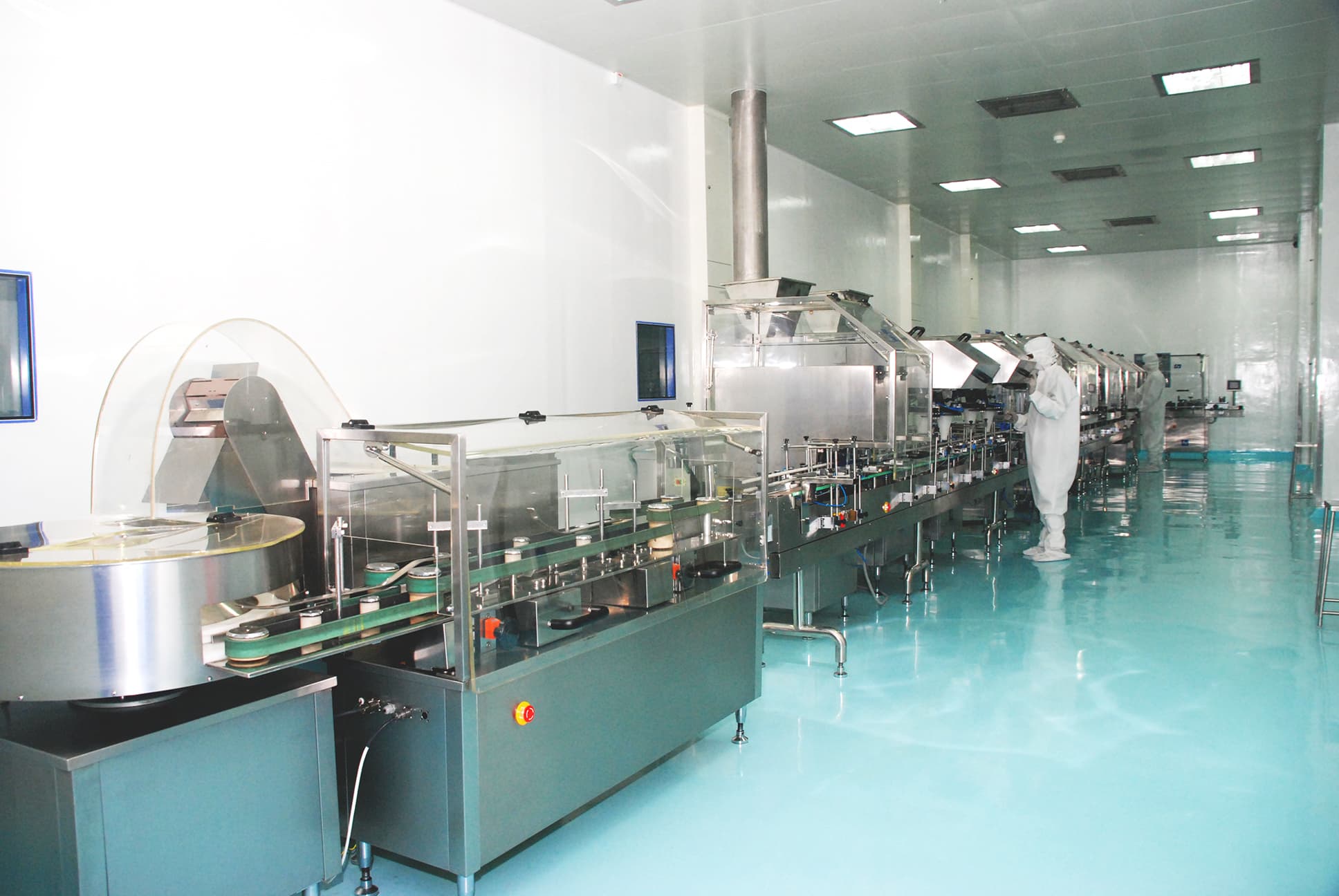
Pharmaceutical
Two particle limits per room, a proven pressure cascade and a validation dossier written to pass inspection, with the air system designed alongside the room rather than after it.
pharmaceutical cleanrooms and GMP HVAC 02ISO 5 to 8
Biotechnology
When the work is alive and risky, the air has to protect the product and contain the agent at the same time, which is where negative-pressure design and HEPA exhaust come in.
biotechnology cleanrooms and BSL containment 03ISO 3 to 6
Semiconductor
The cleanest classes there are, where FFU ceilings, ULPA filtration, vibration control and heat management protect device yield one particle at a time.
semiconductor cleanrooms (ISO Class 3-7) 04ISO 6 to 8
Electronics
PCB and SMT assembly plus EV and Li-ion battery dry rooms, where electrostatic discharge control and dew-point control sit next to the particle class.
electronics and ESD cleanrooms 05ISO 7 to 8
Solar and PV
Production-scale contamination control for solar-cell and PV-module lines across mono, poly and thin-film, holding an even class across a large hall.
solar and PV cleanrooms 06ISO 8
Data centre
ISO 8 white-space particulate control engineered to support your cold-aisle containment and cooling, on new builds and live retrofits alike.
data-centre white-space contamination control 07ISO 7 to 8
Food and beverage
Hygienic, washdown-ready rooms that answer to an ISO particle class and a HACCP and FSSAI hygiene framework at the same time.
food and beverage cleanrooms (HACCP/FSSAI)
What stays the same across every industry
A different rulebook every time. One build system.
- PharmaceuticalEU-GMP
- BiotechnologyBSL-3
- SemiconductorSEMI
- ElectronicsIEC 61340
- Solar and PVISO 14644
- Data centreISO 14644
- Food and beverageHACCP
One build system
FIG. 04Seven governing frameworks set seven different targets. The engineering that meets them, and the team accountable for it, does not change.
The standard changes with the industry. The way the room gets built does not. Whatever the class or grade, the same engineering spine sits underneath, and one team owns it from the first design conversation to handover.
We manufacture the core of every cleanroom in our own facility. That starts with modular wall and ceiling systems with PUF and Rockwool infill as standard. Honeycomb-infill panels are supplied where a project specifies them. On the air side we build the air-handling units, the terminal HEPA housings and the fan-filter units (FFUs), each sized to the target class and proven on handover. We also build laminar airflow (LAF) units, pass boxes, air showers, cleanroom doors and biosafety cabinets. Building the equipment and the room with one engineering team is why the design that holds your class is the design that actually gets installed. That is true whatever the sector.
Built in our own facility
That spine connects to the rest of the work across the site:
- Turnkey cleanroom servicesThe full design-to-handover scope, one accountable team from the first specification to the handover file.
- Cleanroom HVAC systemsThe air strategy that actually holds the class: air changes, pressure cascade, filtration and dew point.
- Validation and qualificationDQ/IQ/OQ/PQ written and executed so the room is proven on record, not just built.
- ISO 14644 classificationThe class definitions themselves, and how a target class is set, tested and held.
- Cleanroom equipmentEvery device that goes into the room, from panels and doors to LAF units and biosafety cabinets.
Proof across industries
In pharmaceuticals, our delivered work includes the GMP oral-solids facility at Ajanta Pharma, Aurangabad. Desano (Bangalore) and German Remedies are further delivered pharmaceutical projects. In high-containment biotechnology, we designed, built and validated the BSL-3 laboratories at PGICH Noida and ASMC Shahjahanpur. We have also delivered research cleanroom work for BARC. For electronics, we delivered an electronics-grade particle and ESD-protected manufacturing cleanroom for Bosch, Nashik. The exact class, area and scope of each site are available on request.
Solar and data-centre lines draw on the same contamination-control and modular-cleanroom engineering proven in the delivered work above. That means even-class control across large clear-span halls, and white-space particle control sized to the cooling load.
- Ajanta Pharma, AurangabadGMP oral solids
- Desano, BangalorePharmaceutical
- PGICH NoidaBSL-3 laboratory
- ASMC ShahjahanpurBSL-3 laboratory
- BARCResearch cleanroom
- Bosch, NashikElectronics, ESD-protected area
Why Fabtech, whatever the sector
We have delivered more than 2,000 controlled environments since 2004, across every one of these industries. One accountable engineering team designs, manufactures, installs and validates the room, instead of handing the job across a chain of vendors. That single line of accountability is why the room briefed in the first meeting is the same room that passes on test day.
Behind that accountability sit named delivered work, in-house manufacturing, and a validation dossier written to withstand inspection under EU-GMP, US-FDA, WHO-GMP and cGMP expectations.
Written to withstand
- EU-GMP
- US-FDA
- WHO-GMP
- cGMP
Regulators inspect a facility, they do not certify the company that builds it. The dossier is written so the inspection has something complete to read.
Standard to class
Design
We start from the process and the regulator, then set the ISO class or GMP grade, the zoning and the air strategy that will hold it.
In our own facility
Manufacture
Panels and ceilings, LAF units, pass boxes, air showers, doors and biosafety cabinets are built to the design that was signed off.
One team on site
Install
The same engineering team that drew the room builds it, so the design that holds your class is the design that actually gets installed.
DQ / IQ / OQ / PQ
Validate
The room is proven on record against its target class, its pressure cascade and its recovery, and handed over with the dossier.
FIG. 05One accountable engineering team, from the first design conversation to the validated handover.
Cleanroom solutions by industry, common questions
Pharmaceuticals, biotechnology, semiconductors, electronics, solar and photovoltaics, data centres, and food and beverage are the main ones, along with aerospace and research. Each uses a cleanroom to keep contamination away from a sensitive process. Each is governed by its own standard and its own cleanliness target.
Semiconductor manufacturing generally needs the cleanest air, reaching ISO Class 3 to 5 at the most sensitive lithography and wafer steps. A single sub-micron particle can ruin a device. Pharmaceutical aseptic processing runs almost as clean at its Grade A core, and adds the strictest documentation of any industry.
The governing standard differs first. Pharma answers to GMP grades, with limits at rest and in operation. Biotech adds containment, with air running inward. Semiconductors and electronics chase far cleaner air plus static control. Food pairs its class with a hygiene rulebook. Data centres size control to the cooling.
No. Almost every cleanroom cites a cleanliness class from ISO 14644-1, the shared particle standard, so the industries speak a common language for clean air. Each adds its own framework on top: EU-GMP grades in pharma, biosafety levels in biotech, static control in electronics, hygiene rules in food.
No. A food cleanroom is not graded A to D like a pharma room. It runs an ISO particle class and a food-hygiene framework side by side: HACCP, FSSAI and food-GMP. Surfaces are hygienic and washdown-ready. Specifying pharma grades for a food line adds cost the process never needed.
As a rough guide: semiconductors run ISO 3 to 6, and pharma and biotech run ISO 5 to 8. Electronics sits at ISO 6 to 8, and solar and food run ISO 7 to 8. Data-centre white space is typically ISO 8. Your process step and governing standard set the exact target.
Not sure which class or grade your process needs?
Tell us your industry, your process and your floor area, and our engineers respond with a scoped proposal that names the standard, the ISO class and the validation plan.