

Airflow Design: How Cleanrooms for Data Centres Improve Server Performance
How cleanroom airflow design, HEPA/ULPA filtration and laminar airflow control heat, dust and cooling to lift data centre server performance.
10 min read · a working guide by the Fabtech Cleanrooms engineering team · first published 2026-02-17
The guide
In a digital-first world, server performance is no longer just an IT concern. It is a business priority. Faster application response times, a seamless user experience, lower operational costs and minimal downtime all trace back to how reliably a data centre runs, and that reliability flows straight through to customer satisfaction and business continuity.
What is often overlooked is that high-performing servers need an equally high-performing physical environment. Beyond processors, memory and software optimisation, one of the most influential factors affecting server efficiency and longevity is airflow design. Poor airflow leads to overheating, dust accumulation, energy waste and frequent equipment failures. This is where cleanroom technology for data centres plays a transformative role.
Cleanrooms were traditionally associated with pharmaceutical and semiconductor manufacturing. Today they are increasingly adopted in modern data centres and high-density server environments. Through advanced filtration and precisely controlled airflow, a cleanroom creates an ultra-clean, stable environment that measurably improves server performance, reliability and energy efficiency.
01
How cleanroom airflow design improves server performance
1. Advanced contamination control and hardware protection
Airborne contamination is one of the silent threats to server hardware. Dust, fibres and microscopic particles that seem harmless can, over time, cause serious damage inside high-speed electronic equipment.
HEPA/ULPA filtration systems. Cleanrooms use High-Efficiency Particulate Air (HEPA) or Ultra-Low Penetration Air (ULPA) filters, typically HEPA H13 or H14 grade. H13 removes at least 99.95% and H14 at least 99.995% of airborne particles at the most penetrating particle size (MPPS, around 0.1 to 0.2 microns), so even the hardest-to-catch particles are trapped. This level of cleanroom air filtration dramatically reduces dust compared with a conventional server room.
Preventing component failure. Dust accumulation can lead to short circuits, corrosion, insulation failure and overheating. In storage devices such as hard drives, airborne particles can even cause physical head crashes from friction at high rotational speeds. A cleanroom environment lets these high-speed mechanical parts operate without interference, so servers run at optimal efficiency without dust-induced failures.
Positive pressure control. Cleanroom server halls are held at a positive air pressure relative to the surrounding areas. When a door opens, air flows outward rather than inward, keeping external dust, hair and fibres out. That constant outward airflow acts as a protective barrier around the clean environment.
2. Optimised thermal management
Thermal management is a critical determinant of server performance. Excess heat shortens hardware lifespan and triggers internal throttling that reduces CPU and GPU performance.
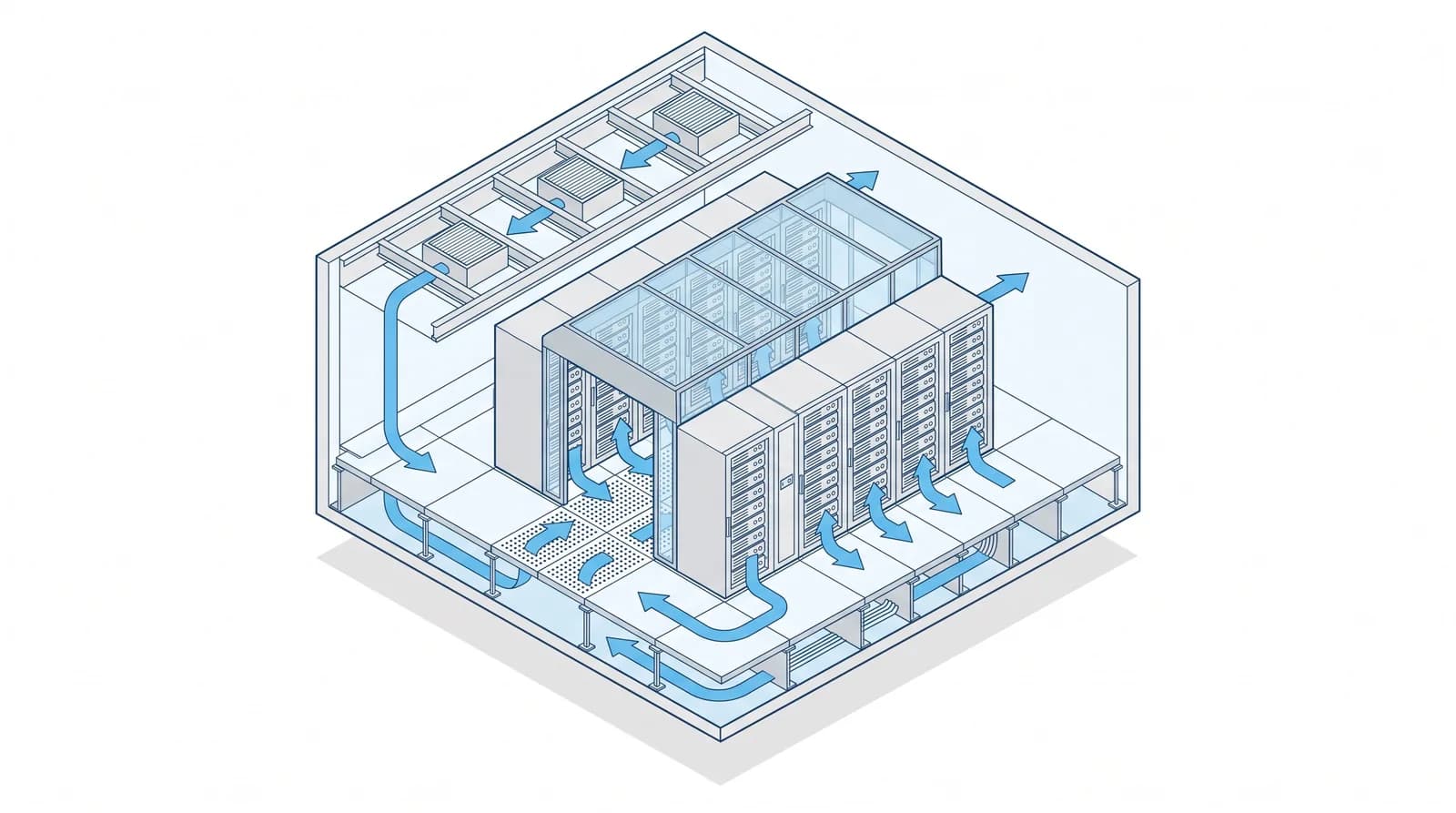
Laminar airflow design. Cleanroom environments favour laminar (unidirectional) airflow over turbulent, mixed patterns. In a laminar system, filtered air moves in smooth, controlled, parallel layers that sweep heat away uniformly from server racks. This prevents dead zones and eliminates the hotspots where heat accumulates and stresses equipment.
Precise temperature and humidity control. Cleanrooms hold strict environmental parameters, typically temperatures between 20°C and 24°C and relative humidity between 45% and 55%. That balance reduces the risk of electrostatic discharge (ESD) and condensation, both of which can damage sensitive electronics. Consistent airflow keeps cooling systems working efficiently without tripping the performance-limiting safety controls inside servers.
3. Improved cooling efficiency
Efficient cooling is not about indiscriminately lowering temperatures. It is about delivering the right amount of cool air to the right place at the right time.
Eliminating air mixing. Cleanroom airflow design for data centres often uses hot-aisle and cold-aisle containment. Physical barriers such as panels or curtains stop hot exhaust air from mixing with cold intake air. That separation lets cooling systems run at higher, more energy-efficient setpoints while still holding safe server temperatures.
Targeted air delivery. Raised-floor systems combined with perforated tiles deliver cool air directly to server intakes. This targeted approach makes sure high-density racks get sufficient cooling without overloading the HVAC plant, so cooling capacity is used more efficiently and energy consumption and mechanical wear both drop.
4. Increased energy efficiency and operational reliability
Energy is one of the highest operational costs in a data centre, and cooling accounts for a significant share of it. Cleanroom airflow design addresses this directly.
Reduced cooling load. Because cleanroom air is continuously filtered and recirculated in a controlled way, HVAC systems operate more efficiently. Disciplined data-centre airflow management can deliver a meaningful reduction in cooling energy. Cleanroom-grade filters also keep airflow resistance low, which further lowers power use.
Uniform air distribution. High-performance cleanroom designs often pair a fully HEPA-filtered ceiling with a raised floor. This configuration keeps airflow distribution consistent across every server rack, including high-density installations, preventing localised overheating and improving overall reliability.
Extended equipment lifespan. Stable temperature and humidity reduce thermal cycling, fan stress and electrostatic risk. Over time this clean, stable environment eases the load on cooling fans and other internal components, lowers maintenance requirements and extends the working life of servers and supporting infrastructure.
02
Key components of a successful cleanroom server environment
To achieve these performance benefits, a cleanroom-based data centre brings together several specialised components.
Cleanroom panels. Modular, non-porous panels form the cleanroom envelope. Common materials include pre-coated galvanised iron (PCGI) for strength, Rockwool panels for fire-rated and acoustic performance, and aluminium or steel sandwich panels with anti-static coatings. Together they deliver durability, safety and contamination control. Fabtech designs and manufactures its own modular cleanroom panels for this envelope.
Fan filter units (FFUs). FFUs are ceiling-mounted, self-powered units that combine energy-efficient fans with HEPA/ULPA filters. Equipped with EC motors, they deliver particle-free air while enabling modular, scalable airflow control, which suits high-density server environments where flexibility and reliability matter.
Laminar airflow systems. Laminar airflow systems deliver HEPA-filtered air in uniform downward streams, typically at velocities between 0.36 and 0.54 m/s. It is this unidirectional airflow at about 0.45 m/s, not a simple air-change count, that holds the tightest contamination levels such as ISO Class 5, sweeping particles away continuously without recirculation. Where a space is served by general recirculated (mixed) airflow rather than a full laminar canopy, cleanliness is instead specified by air changes, typically around 30 to 50 air changes per hour (ACPH) for ISO Class 7 to Class 8 environments.
Blanking and filler panels. Rack blanking panels seal unused rack spaces to prevent bypass airflow, where cold air escapes without cooling any equipment. These simple components play a real part in maintaining airflow integrity, reducing hotspots, improving cooling efficiency and lowering Power Usage Effectiveness (PUE).
03
Bringing it all together
Designing a high-performance data centre goes far beyond server specifications and cooling capacity. The environment in which servers operate plays an equally decisive role. A cleanroom-based airflow design addresses contamination, thermal stability and energy efficiency in a single integrated approach, creating conditions where servers can perform reliably, consistently and at their full potential.
Fabtech Cleanrooms engineers precisely controlled environments that support data centre server performance while mitigating physical and thermal risk. Compared with a conventional server room, a cleanroom-based design combines advanced filtration, engineered airflow patterns and scalable infrastructure to support long-term hardware reliability, operational efficiency and business continuity. The airflow itself is delivered through cleanroom HVAC engineered for the class, load and rack density of the facility. For how a controlled environment is scoped for high-density computing, see also cleanroom solutions for data centres.
The same design discipline is what gets a cleanroom through validation. One example of a Fabtech cleanroom delivered, validated and handed over is the Ajanta Pharma cleanroom project in Aurangabad.
Planning a new data centre, or considering an upgrade? Make airflow design a strategic advantage, and talk to our engineers about the controlled environment that will help your facility deliver peak server performance and reliability.
Keep reading
More from hvac and validation
Guide · 9 min read
Cleanroom and HVAC Validation: The Invisible Backbone of Semiconductor Manufacturing
How cleanroom and HVAC validation, from DQ and IQ to OQ and PQ, protects semiconductor manufacturing from particle, humidity and ESD defects.
Guide · 7 min read
Consistency: The Quiet Discipline Behind Cleanroom Performance
How consistency in cleanroom design, HVAC, monitoring and IQ/OQ/PQ validation keeps environmental control stable, batch after batch, in manufacturing.
Guide · 7 min read
Key Components of HVAC Systems and Their Functions
The key components of an HVAC system, from the AHU and HEPA filtration to coils, blowers and ductwork, and how each keeps a cleanroom controlled.
Ready to move from reading to scoping? Our turnkey cleanroom services cover design, construction and validated handover as one accountable scope.
Talk to the engineers