

Consistency: The Quiet Discipline Behind Cleanroom Performance
How consistency in cleanroom design, HVAC, monitoring and IQ/OQ/PQ validation keeps environmental control stable, batch after batch, in manufacturing.
7 min read · a working guide by the Fabtech Cleanrooms engineering team
The guide
Consistency is what turns talent into results, effort into achievement, and potential into performance. It is the discipline of repeating the right actions, in the right way, every single time. In a high-stakes environment such as a cleanroom for pharmaceutical manufacturing, consistency is not optional. It is essential.
Think of any success story: a successful sportsperson, a high-performing employee, a consistent exam topper, a retired officer living an active life, or a globally recognised brand. Their journeys differ, but one factor stays constant across all of them. Consistency. It is consistency that separates good from great.
Cleanrooms operate on this very principle. In controlled manufacturing and research environments, consistency is not just a best practice; it is a foundational requirement. Cleanrooms are designed to hold unwavering environmental control to protect sensitive processes, ensure product integrity, support quality control in cleanroom manufacturing, meet regulatory requirements, and deliver repeatable, high-quality results day after day, batch after batch.
01
Eliminating Variability Through Design Engineering
Consistency begins at the design stage. Well-engineered cleanrooms are built to eliminate variability before operations even begin. Modular cleanroom systems use standardised components, smooth surfaces, non-shedding materials, sealed interfaces, and quality cleanroom wall panels to reduce particle generation and accumulation.
Pressure cascades are carefully designed to control airflow direction between rooms of different classifications, preventing cross-contamination. Positive and negative pressure differentials ensure contaminants move away from critical zones. In parallel, material and personnel flow layouts are optimised to minimise unnecessary movement, which is a major contributor to contamination.
Lighting, utilities, and service penetrations are integrated seamlessly, so they do not disrupt airflow or cleanliness.
02
Unchanging Environmental Control
Every well-performing cleanroom works within strictly controlled environmental conditions. Airborne particle counts, airflow patterns, temperature, and relative humidity are consistently maintained within tightly defined limits, in accordance with ISO cleanroom standards and industry-specific cleanroom standards.
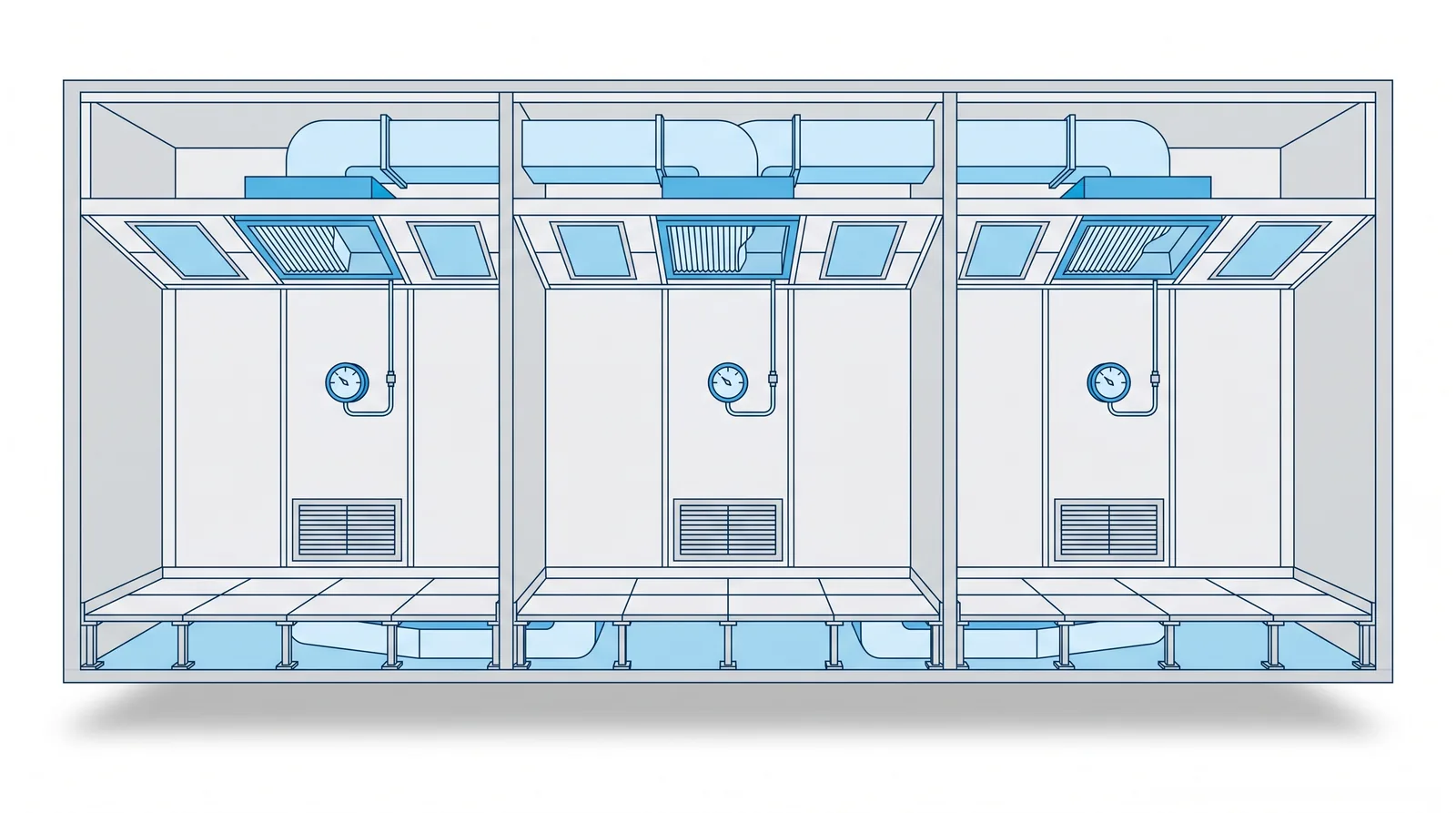
HVAC systems equipped with HEPA and ULPA filtration, high-performance insulation panels, and optimised airflow designs work together to create a stable internal environment. These parameters are not allowed to fluctuate, because even the slightest deviation can compromise a sensitive manufacturing process or product quality. As a result, cleanrooms are engineered to eliminate variability rather than react to it.
03
Rigorous Operational Protocols
Cleanrooms rely on strict, validated operational protocols that turn daily activities into controlled, repeatable processes.
- Gowning procedures are designed to control human-borne contamination at every entry point.
- Validated cleaning and disinfection routines keep surfaces free of particulate and microbial buildup.
- Cleaning agents, disinfectants, and methods are selected on compatibility, efficacy, and residue control.
When these protocols are followed with precision and consistency, everyday activities become repeatable, contamination-controlled processes.
04
Continuous Monitoring
Environmental monitoring systems (EMS) provide continuous visibility into cleanroom conditions and trigger alarms when parameters approach defined limits. This lets deviations be detected immediately, so corrective action can be taken before product quality or compliance is compromised.
Air sampling, pressure differentials, temperature, and humidity sensors operate in real time and further validate environmental control. This relentless monitoring keeps the cleanroom in a constant state of compliance and control.
05
Validation, Qualification, and Lifecycle Management
Cleanroom consistency is sustained through structured validation and qualification.
- Installation Qualification (IQ) confirms correct system installation.
- Operational Qualification (OQ) verifies system functionality.
- Performance Qualification (PQ) demonstrates consistent operation under real production conditions.
Regular requalification keeps the facility in step with ISO, GMP, and other regulatory requirements. Preventive maintenance programmes, calibrated instrumentation, and controlled change management prevent performance drift over time.
By managing the cleanroom across its entire lifecycle, from design and commissioning through operation, expansion, and upgrades, organisations secure long-term reliability and reduce risk.
06
The Human Element
People are essential to cleanroom operations, and also a major source of contamination. Human movement, behaviour, and discipline have a direct impact on environmental stability.
That is why comprehensive training matters. Cleanroom personnel undergo regular training to ensure strict adherence to protocols, proper gowning behaviour, disciplined movement, correct cleaning procedures, and contamination awareness within controlled spaces. Training ensures that every individual contributes to cleanroom stability rather than disrupting it.
07
Repeatable Processes and Statistical Process Control
Reliable product quality is achieved through repeatability. Cleanrooms achieve this through data-driven control methods such as Statistical Process Control (SPC). SPC enables trend analysis, early deviation detection, and proactive corrective action.
By monitoring critical consumables such as cleanroom wipers, garments, and disinfectants, SPC helps keep inputs consistent, predictable, and within specification. This level of control removes uncertainty from the supply chain and supports consistent production outcomes.
08
How Fabtech Builds for Consistency
Consistency is the backbone of cleanroom operations, and Fabtech Cleanroom brings the same consistency into every cleanroom we design and build. Our modular cleanrooms combine precision engineering, optimised airflow systems, intelligent monitoring, and disciplined operational frameworks to deliver environments that stay stable, controlled, and compliant.
With Fabtech Cleanrooms, consistency becomes the foundation of reliability, supporting product quality, regulatory compliance, and operational confidence today and into the future. If you are planning a controlled environment, our engineers can scope the design, HVAC, and validation plan around the standard and ISO class your process demands. Let us build environments that stay in control, together.
The design, construction, and validated handover behind all of this is covered on our turnkey cleanroom services page.
For a worked example of a validated cleanroom delivered end to end, see the Ajanta Pharma cleanroom case study.
Keep reading
More from hvac and validation
Guide · 10 min read
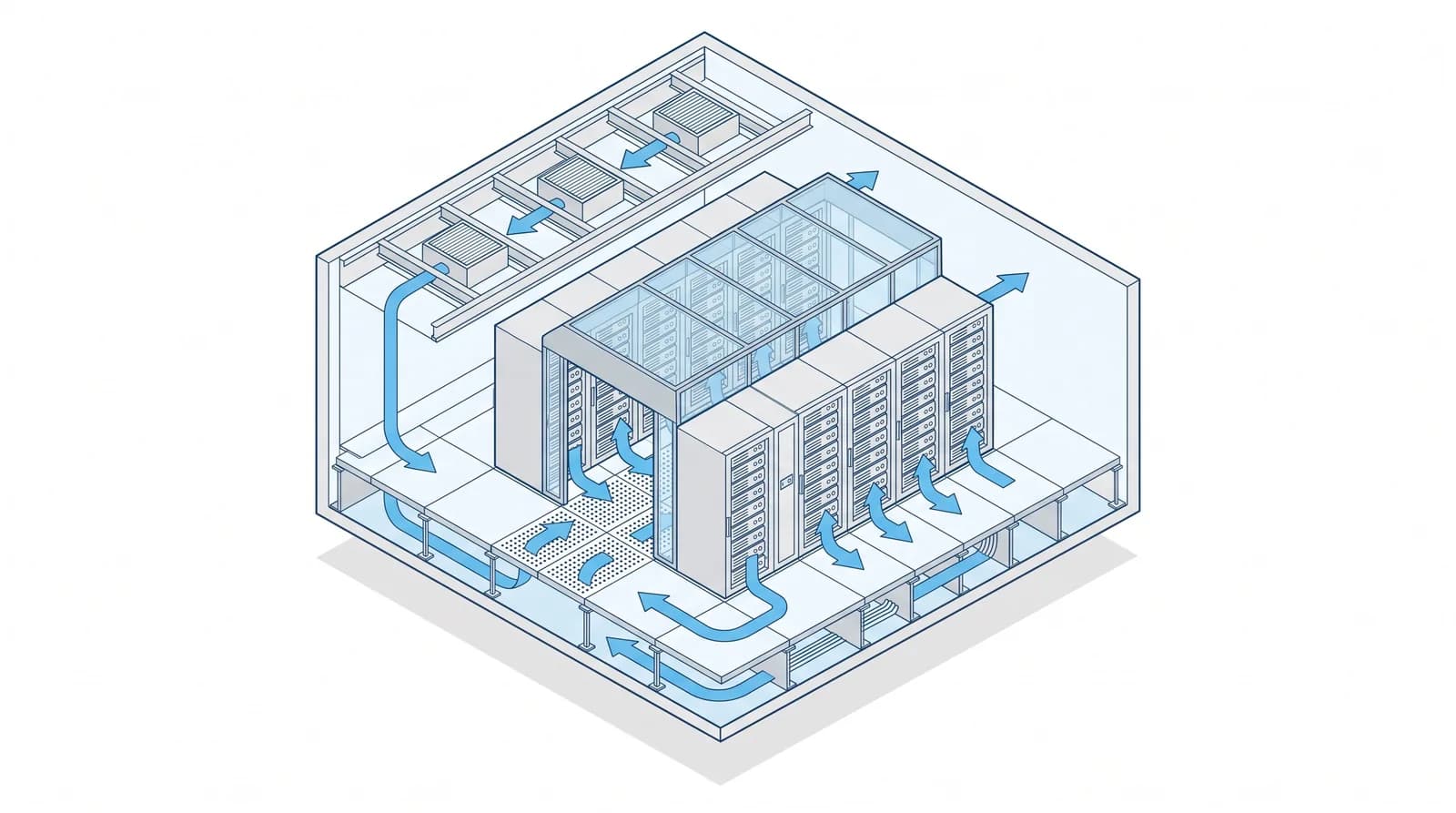
Airflow Design: How Cleanrooms for Data Centres Improve Server Performance
How cleanroom airflow design, HEPA/ULPA filtration and laminar airflow control heat, dust and cooling to lift data centre server performance.
Guide · 9 min read
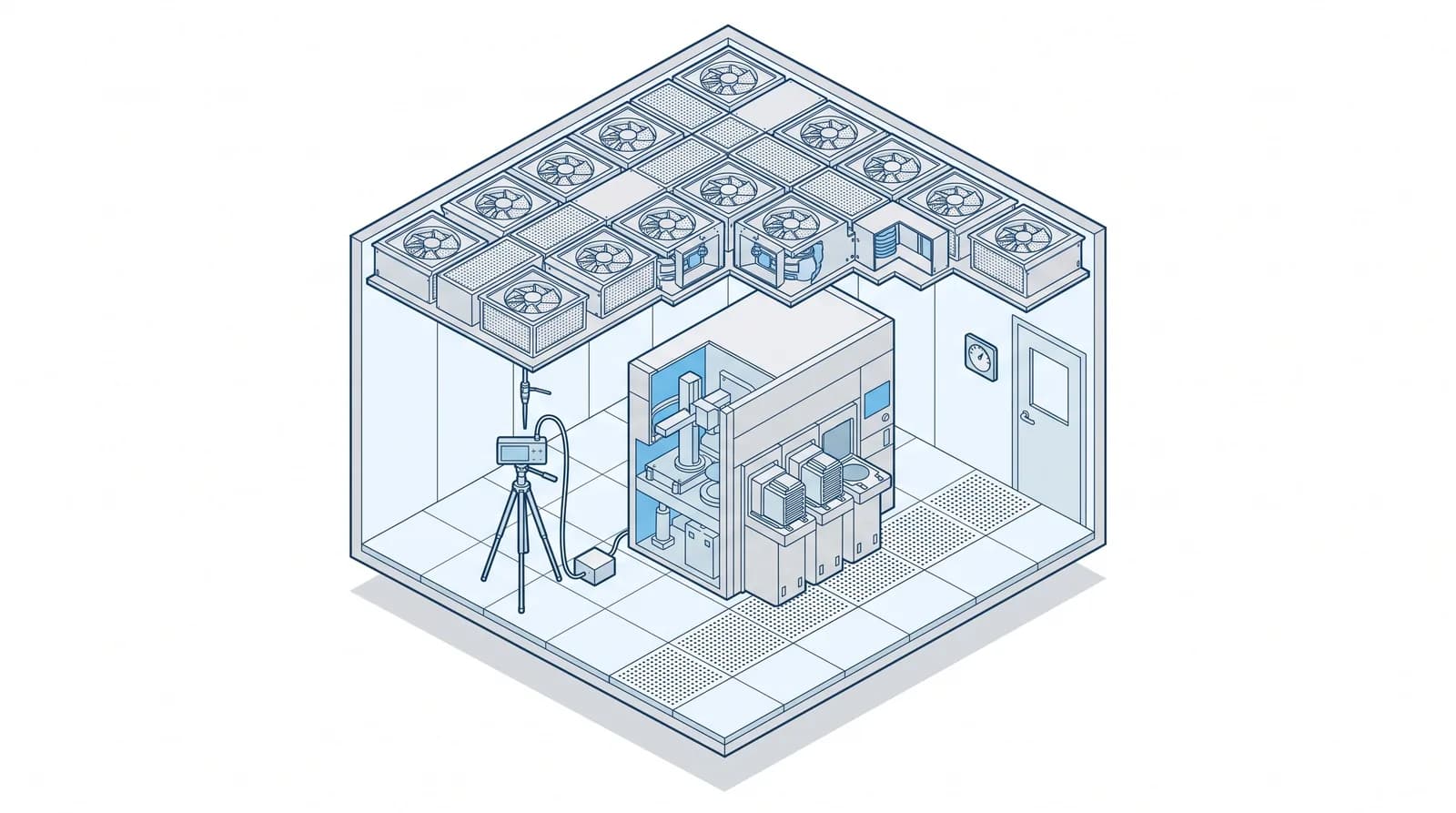
Cleanroom and HVAC Validation: The Invisible Backbone of Semiconductor Manufacturing
How cleanroom and HVAC validation, from DQ and IQ to OQ and PQ, protects semiconductor manufacturing from particle, humidity and ESD defects.
Guide · 7 min read
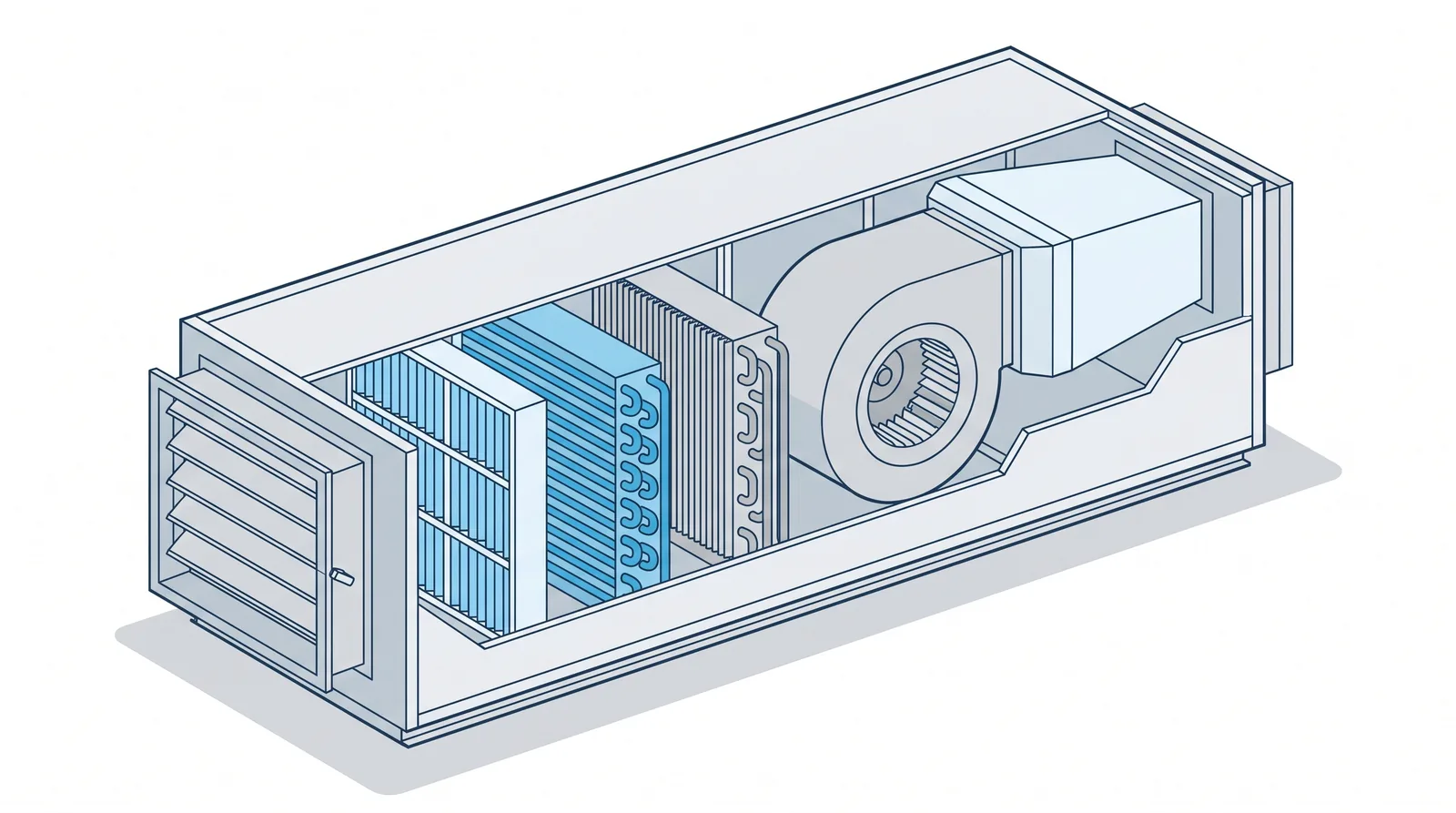
Key Components of HVAC Systems and Their Functions
The key components of an HVAC system, from the AHU and HEPA filtration to coils, blowers and ductwork, and how each keeps a cleanroom controlled.
Ready to move from reading to scoping? Our turnkey cleanroom services cover design, construction and validated handover as one accountable scope.
Talk to the engineers