

HVAC System in the Pharmaceutical Industry: How It Works
What an HVAC system does in the pharmaceutical industry: full form, functions, main types, tablets vs injectables, and how it is qualified.
17 min read · a working guide by the Life Engineers at Fabtech Cleanrooms · first published 2026-11-18
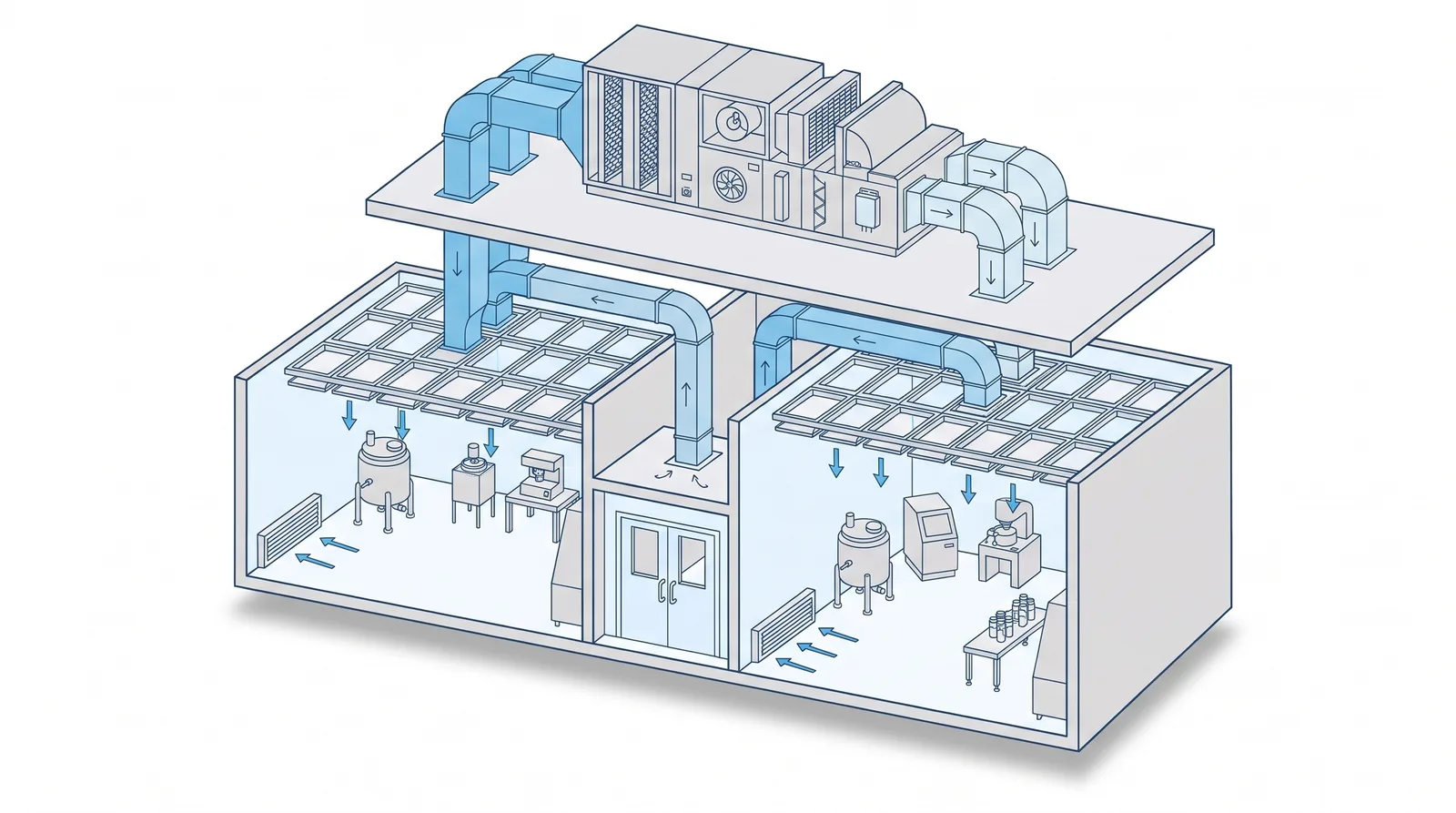
The guide
An HVAC system in the pharmaceutical industry is the air system that keeps every production room clean, at the right temperature and humidity, and at the right pressure against the rooms around it. HVAC stands for heating, ventilation and air conditioning. In a drug plant the air touches the product, so the plant has to control it as carefully as any ingredient on the batch record.
When the air system falls short, the plant pays in failed batches, products contaminating each other and observations at inspection. Fabtech Cleanrooms designs and builds these systems for drug manufacturers across India, and makes the air handling units in its own facility.
01
Why HVAC is important in the pharmaceutical industry
Air reaches every surface in a production room, including the open product. If that air carries dust, microbes or particles from the room next door, they settle in the batch. The HVAC system is the one control that acts on all of them at once, around the clock.
It does three jobs:
- It protects the product from particles, microbes and traces of other products made in the same building.
- It protects the people who handle potent or dusty materials, by keeping that dust inside the room where it is made.
- It protects the environment outside, by filtering exhaust air before it leaves the building.
Because the air system bears directly on product quality, regulators treat it as a critical system. The plant designs it, installs it and then proves it with documented tests, the same way it would a tablet press or a filling machine. In India, the revised Schedule M sets the expectations for air handling in drug manufacturing premises.
02
The functions of a pharmaceutical HVAC system
An office air conditioner is judged on comfort. A pharmaceutical HVAC system has six functions, and each one appears in the room's specification and gets checked during testing.
| Function | Why it matters | How the system holds it |
|---|---|---|
| Control airborne particles | Particles carry microbes and settle on open product | Staged filtration ending in a terminal HEPA filter (H13 or H14) at the room, plus enough air changes to dilute what people and machines release |
| Control microbial contamination | A sterile product cannot be cleaned after it is sealed | Filtered supply air, airflow that sweeps from clean to less clean, and environmental monitoring |
| Prevent cross-contamination | Traces of one product can end up in another | Pressure differences, airlocks, dedicated or segregated air handling, and filtered return or exhaust air |
| Hold temperature | Affects product stability and the comfort of gowned operators | Heating and cooling coils, controlled to each room's set point |
| Hold relative humidity | Moist air spoils hygroscopic powders; very dry air builds static and dries out capsule shells | Cooling coils to remove moisture, desiccant dehumidifiers for very dry rooms, humidifiers where needed |
| Set pressure and airflow direction | Decides which way air, and anything in it, moves between rooms | A pressure scheme between rooms; many designs use 10 to 15 Pa between adjacent grades, and EU-GMP Annex 1 gives a minimum guidance value of 10 Pa |
Each function gets a set point and an acceptable range in the user requirement specification, and the product decides those ranges. Many production rooms run at about 20 to 25 °C and 40 to 60 percent relative humidity. Effervescent tablets and other moisture-sensitive products need much drier air, while hard gelatin capsule shells turn brittle if the air gets too dry.
03
Types of HVAC system in the pharmaceutical industry
Engineers sort pharmaceutical HVAC systems three ways: where the air comes from, how it moves through the room, and how the plant is split into zones. One plant often uses several types side by side.
| Type | How it works | Where it fits |
|---|---|---|
| Recirculating system | Most room air returns to the air handler, where it is filtered and conditioned again; a share of fresh air is added | Production areas where return air cannot carry a risk from one product to another; it saves a large share of cooling energy |
| 100 percent fresh air (once-through) | All supply air comes from outside and leaves through filtered exhaust; nothing returns | Rooms handling solvents or highly potent materials, and areas where recirculated air could spread contamination |
| Unidirectional (laminar) airflow | Filtered air moves in one direction at a steady speed across the critical zone and sweeps particles away from it | Grade A zones for aseptic filling and other exposed sterile work, through a HEPA ceiling or laminar air flow units |
| Non-unidirectional (turbulent) airflow | Filtered air enters through ceiling diffusers, mixes with room air and dilutes particles before leaving through low-level returns | Grade B, C and D rooms and most oral-solids areas |
| Dedicated (segregated) air handling | A separate air handler serves one product area, with no shared ducts or return air | Penicillin and other beta-lactam products, and many high-potency areas |
The critical zones in sterile work usually get their unidirectional flow from laminar air flow units or a full filter ceiling. The WHO guideline on HVAC for non-sterile products (WHO Technical Report Series 1010, Annex 8) allows recirculation where there is no risk of contamination or cross-contamination, normally with at least H13 filters. Penicillin needs fully separate air handling.
04
The parts that make an HVAC system pharmaceutical
The core of the system looks like any large air system: an air handling unit with fans and coils, the ducts, and the controls. The parts that make it pharmaceutical sit where the air enters and leaves each room.
- Staged filtration. Air passes a pre-filter and a fine filter in the air handler, then a terminal HEPA filter in the room ceiling, so the last filter the air meets is the finest one.
- Low-level returns. Return or exhaust grilles sit near the floor, so the air carries particles down and away from the work surface.
- Dehumidification. Desiccant dehumidifiers dry the air for moisture-sensitive products, further than a cooling coil can reach.
- Dust extraction. In tablet and capsule areas, point extraction at granulators, compression machines and coating pans captures powder at the source.
- Pressure control and airlocks. Dampers hold each room at its set pressure. Airlocks separate rooms of different grades, and pass boxes let materials cross between them without opening a full door.
- Monitoring. A building management system logs temperature, humidity and pressure, and raises an alarm when a room drifts out of range.
Fabtech builds the air handling units, terminal HEPA housings and laminar air flow units for its projects in its own facility, so the main air-side equipment stays under one team's quality control. For a part-by-part walk through coils, blowers and ductwork, see the guide to the key components of HVAC systems.
05
Tablets or injectables: how the HVAC design changes
A tablet plant and a sterile injectables plant both need clean, controlled air, but their risks differ. In a tablet plant the main risk is powder from one product drifting into another room. In a sterile plant it is a single microbe reaching a vial that nobody can clean once it is sealed. The air design follows the risk.
| Factor | Oral solids (tablets, capsules) | Sterile injectables |
|---|---|---|
| Main risk | Powder cross-contamination between products | Microbes and particles reaching exposed sterile product |
| Typical cleanliness | Often designed to Grade D (ISO 8) by convention, with Grade C where the product needs it | Grade A at the point of fill in a Grade B background, with Grade C and D for preparation |
| Pressure direction | Rooms that release dust usually sit below the corridor, so air flows in and the powder stays put | A positive cascade from the Grade A zone outward, so air flows out of the most critical space |
| Airflow | Turbulent dilution, plus point extraction at the machines | Unidirectional airflow over the critical zone; EU-GMP Annex 1 gives 0.36 to 0.54 m/s as a guidance range at the working position |
| Humidity | Often held low and tight for hygroscopic products | Held steady for gowned operators and for the process |
| Return air | Filtered return is common; 100 percent exhaust where solvents or potent products are handled | Recirculation through HEPA filters is common within the same grade |
Pressure is the row that surprises people. In a sterile suite the cleanest room has the highest pressure, so air always pushes outward. In a tablet plant the WHO guideline normally holds the corridor above the rooms where powder is released, so air flows into those rooms and carries the dust nowhere. Some plants keep the rooms positive instead and place an airlock at each door as a pressure sink, lower than both sides, which catches the dust in between.
In an oral-solids plant there is no Grade A core, and the air design centres on keeping powder inside the room where it is handled. In a sterile plant the design is arranged around the Grade A zone, and every room further out exists to protect it.
06
Air changes per hour (ACPH): the figure ISO 14644 leaves to the designer
You will not find a required air-change rate for each grade in ISO 14644-1. The standard sets the particle limit for each ISO 14644-1 cleanroom class and leaves the air volume to the designer.
The designer sizes the air volume from three loads: the particles that people and machines release, the heat the room must remove, and how fast the room has to recover after a disturbance. EU-GMP Annex 1 expects a room to return to its at-rest particle limits within a clean-up period that the plant sets when it proves the room, with a guidance value of less than 20 minutes.
A worked example shows why the figure matters. A 60 m³ room at 20 air changes per hour needs 1,200 m³ of filtered air every hour; at 40 it needs 2,400 m³. In the same ductwork, fan power rises roughly with the cube of the airflow, so doubling the air can cost up to eight times the fan energy. ISO 14644-16, the energy-efficiency part of the ISO 14644 series, asks designers to set air volumes from the real load rather than from habit.
Designers often start from typical ranges, such as the ones on our cleanroom HVAC page, and then size each room from its own load. Testing at handover shows whether the room recovers in the time the design promised.
07
How a pharmaceutical HVAC system is qualified
Qualification is the documented proof that the HVAC system does what the design said it would. An inspector wants results measured in the finished room, signed and dated, and a design calculation does not substitute for them. The work runs in four stages:
- Design qualification (DQ) confirms the HVAC design meets the user requirement specification before anything is built.
- Installation qualification (IQ) confirms the air handlers, ducts, filters and controls went in as designed.
- Operational qualification (OQ) tests the system against its limits in the finished rooms.
- Performance qualification (PQ) shows the rooms holding those limits with people and the process running.
The guide to cleanroom HVAC and validation covers each stage in more depth. These are the tests that make up most of the HVAC record:
| Test | What it proves | Reference |
|---|---|---|
| Airflow volume and velocity | The room gets the air volume, and the critical zone gets the air speed, that the design set | ISO 14644-3 |
| HEPA filter integrity (PAO or DOP leak scan) | Each installed filter and its seal let no unfiltered air through | ISO 14644-3 |
| Particle count classification | The room meets the particle limits of its class | ISO 14644-1 |
| Pressure differential | Each room holds its pressure against its neighbours, in the right direction | User requirement specification; EU-GMP Annex 1 guidance |
| Airflow visualisation (smoke study) | Air over the Grade A zone moves in one direction and away from the product | EU-GMP Annex 1 |
| Recovery test | The room clears a particle challenge (a 100:1 drop) within the target time | ISO 14644-3; EU-GMP Annex 1 guidance of less than 20 minutes |
| Temperature and humidity | Each room holds its set points across the space and over time | User requirement specification |
The tests come back on a schedule. Annex 1 sets the maximum interval for requalification at six months for Grade A and B areas and twelve months for Grade C and D. Fabtech hands over each room with its test record as part of a validated handover dossier.
08
Pharmaceutical HVAC guidelines: what the regulators ask for
Four sets of rules shape most pharmaceutical HVAC design in India. They cover the same ground from different angles, and a plant that supplies more than one market often answers to more than one of them.
| Rule | What it asks of the HVAC system |
|---|---|
| India's revised Schedule M | Brings India's manufacturing rules in line with WHO-GMP. Air handling has to prevent contamination and cross-contamination in each area, with temperature, humidity and pressure differentials monitored and recorded |
| WHO-GMP, Technical Report Series 1010, Annex 8 | Detailed guidance for HVAC in non-sterile plants: protection concepts, pressure differentials, airlocks, recirculation and dust control |
| EU-GMP Annex 1 | Sterile products: Grade A to D cleanliness limits, unidirectional airflow over Grade A, pressure differentials and requalification intervals |
| US FDA, 21 CFR 211.46 | Adequate ventilation; control of air pressure, microorganisms, dust, humidity and temperature when appropriate; air filtration on supplies to production areas when appropriate; completely separate air handling for penicillin, apart from other drug products for human use |
Inspectors check the plant against whichever of these rules its markets require, so the design and the test record have to answer to each. Fabtech designs its pharmaceutical cleanrooms to Schedule M from the first layout. Where a plant supplies regulated export markets, the same design also answers to EU-GMP or WHO-GMP.
09
Pharmaceutical HVAC design: what to settle first
Late decisions are the expensive ones in a pharmaceutical HVAC project. Settle these before design starts, and write each one into the user requirement specification:
- The products and processes in each room: dust, solvents, potency and moisture sensitivity.
- The grade or ISO class of each room, and which rooms sit next to each other.
- The pressure scheme, and the airlocks between grades.
- Temperature and humidity set points, with the tolerance for each.
- Which zones can recirculate air, and which need 100 percent fresh air or dedicated air handling.
- Monitoring and alarms: what the system logs, where alarms go and how long records are kept.
- The tests and documents you expect at handover.
- Energy: heat recovery and variable-speed fans cut running cost, provided they leave room control intact.
Fabtech designs, builds and validates HVAC systems for pharmaceutical cleanrooms, from the first design and the air handling units to the test record at handover. See our cleanroom HVAC services, or send us your room list with answers to these eight points, and the engineers who would size the system will talk it through with you.
Frequently asked questions
HVAC stands for heating, ventilation and air conditioning. In a pharmaceutical plant the term covers more than temperature. The same system filters the air, controls humidity, holds each room at a set pressure and keeps air moving from clean areas to less clean ones. Some plants call it the air handling system.
Air touches the product in every open process. The HVAC system controls the particles, microbes, temperature, humidity and pressure in that air. That protects the product from contamination, protects operators from potent dust and keeps one product out of another. Regulators treat it as a critical system and expect documented proof that it works.
Engineers group them by air source, airflow and zoning. Recirculating systems reuse filtered room air, while 100 percent fresh air systems exhaust it all. Unidirectional airflow serves Grade A zones and turbulent airflow serves Grade B, C and D. Dedicated air handling serves areas such as penicillin production that must not share air.
HVAC qualification is the documented testing that proves an installed HVAC system meets its design. It covers airflow, filter leak tests, particle counts, pressure differentials, airflow visualisation, recovery time, and temperature and humidity. The results form part of the record an inspector reviews, and the tests repeat on a set schedule.
US rule 21 CFR 211.46 requires adequate ventilation and, when appropriate, control of air pressure, microorganisms, dust, humidity and temperature. It calls for air filtration on supplies to production areas when appropriate, control of dust in recirculated air and adequate exhaust. Air handling for penicillin must be completely separate from that for other drug products for human use.
No. ISO 14644-1 sets particle limits for each cleanroom class and leaves the air-change rate to the designer. The designer sizes the air volume from the particle load, the heat load and the required recovery time, then proves it by testing. EU-GMP Annex 1 gives less than 20 minutes as a guidance value for recovery.
The air handling unit (AHU) is one part of the HVAC system: the cabinet with fans, coils and filters that conditions the air. The HVAC system is the whole arrangement, including ducts, terminal HEPA filters, return grilles, dehumidifiers, dampers and the controls that hold each room in range.
Yes, in many areas. Recirculating filtered air saves energy and is common within rooms of the same grade. Where return air could carry contamination between products, or where the room handles solvents or highly potent materials, the design uses 100 percent fresh air or dedicated air handling. A risk assessment decides which applies.
Keep reading
More from hvac and validation
Guide · 10 min read
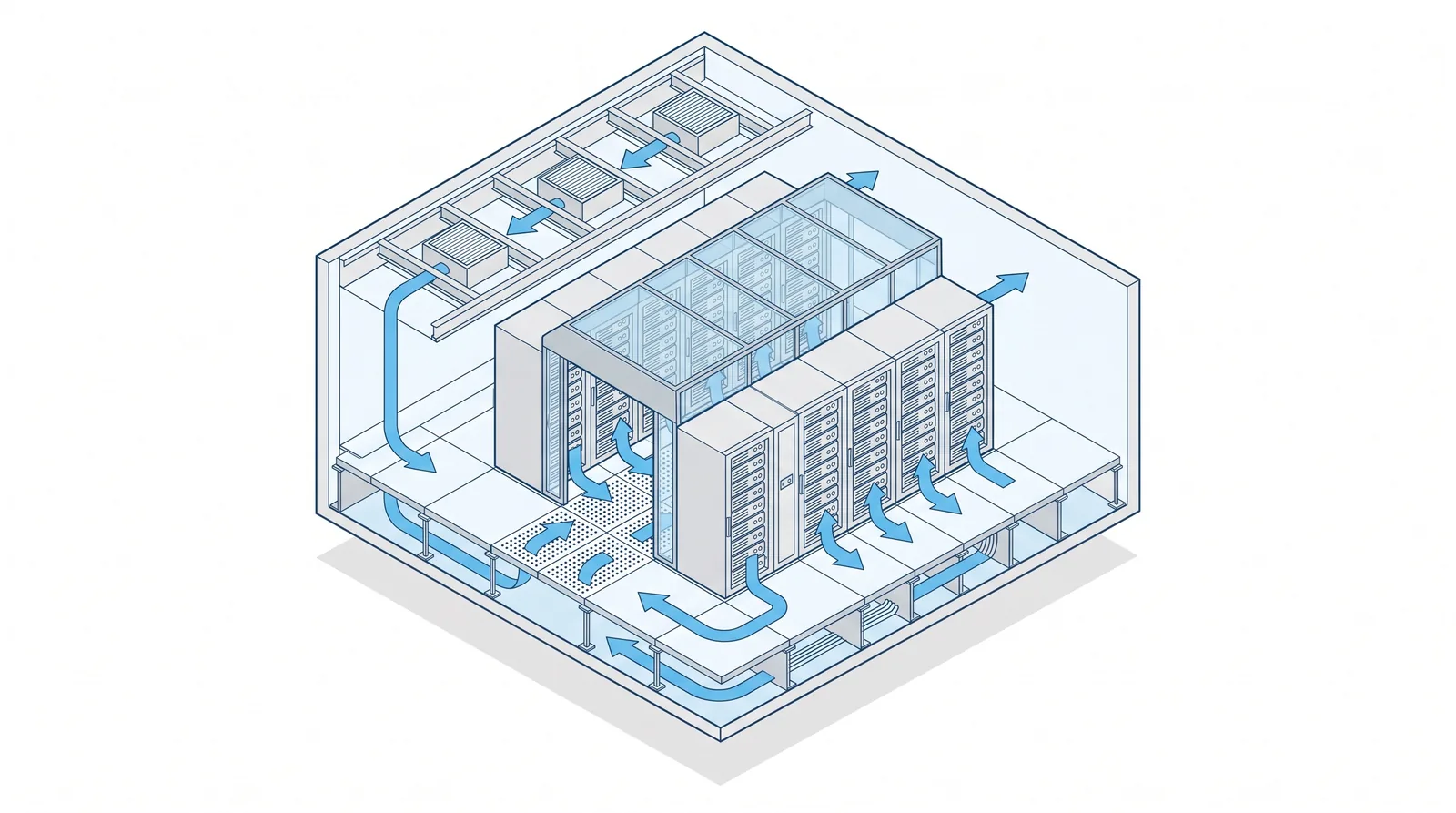
Airflow Design: How Cleanrooms for Data Centres Improve Server Performance
How cleanroom airflow design, HEPA/ULPA filtration and laminar airflow control heat, dust and cooling to lift data centre server performance.
Guide · 9 min read
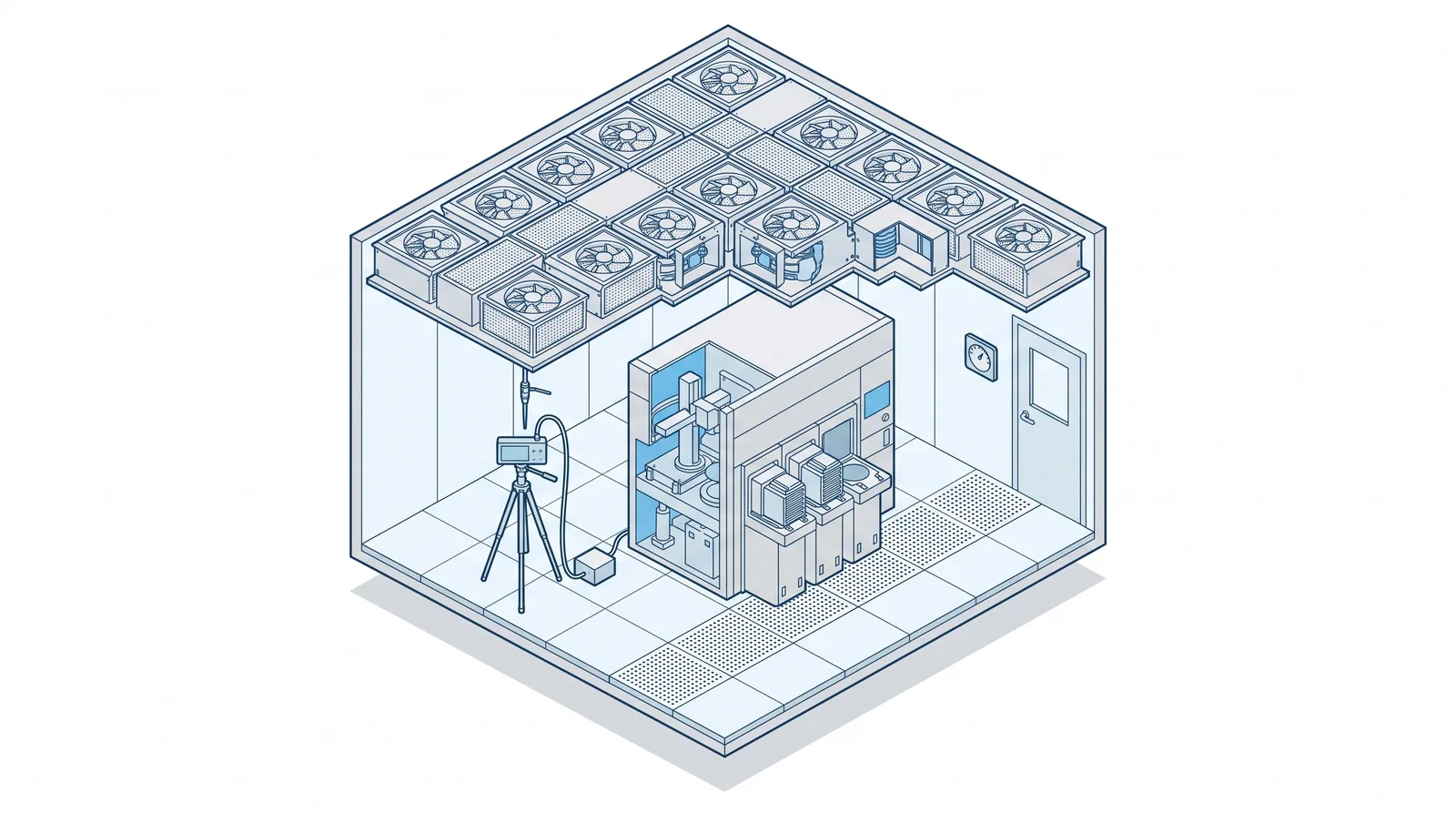
Cleanroom and HVAC Validation: The Invisible Backbone of Semiconductor Manufacturing
How cleanroom and HVAC validation, from DQ and IQ to OQ and PQ, protects semiconductor manufacturing from particle, humidity and ESD defects.
Guide · 7 min read
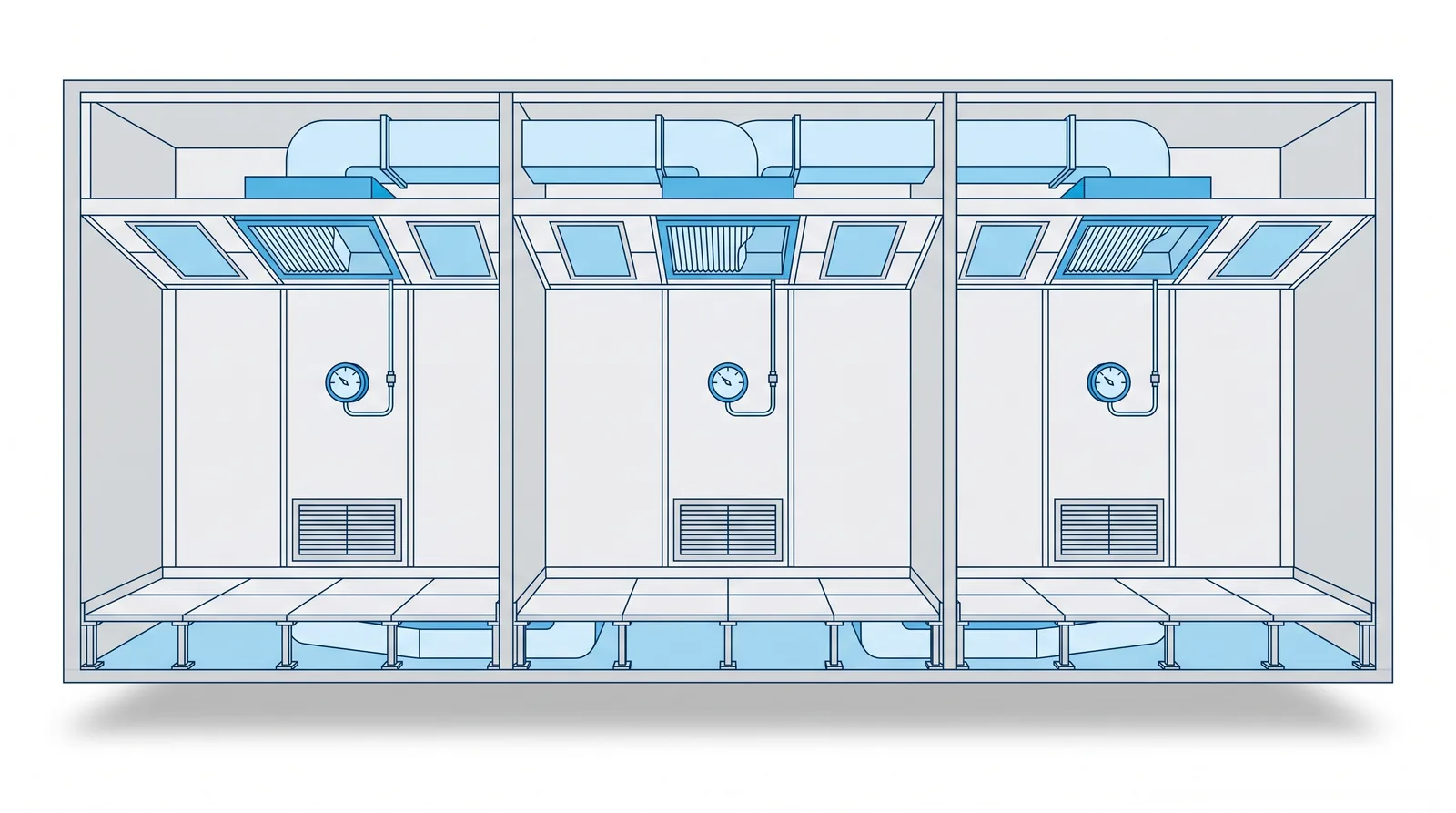
Consistency: The Quiet Discipline Behind Cleanroom Performance
How consistency in cleanroom design, HVAC, monitoring and IQ/OQ/PQ validation keeps environmental control stable, batch after batch, in manufacturing.
Ready to move from reading to scoping? Our turnkey cleanroom services cover design, construction and validated handover as one accountable scope.
Talk to the engineers